
The bobcat tells you the year, not the alloy
Turn the quarter over before you reach for a scale. A bobcat and the dates 1867–1967 identify Canada’s Centennial quarter. Regular circulation examples came in two alloys, one 80 percent silver and the other 50 percent. With the 1968 caribou, the question is different: it can be 50 percent silver or almost pure nickel. For that date, a magnet gives you a useful first answer. Royal Canadian Mint, 25-cent designs and composition
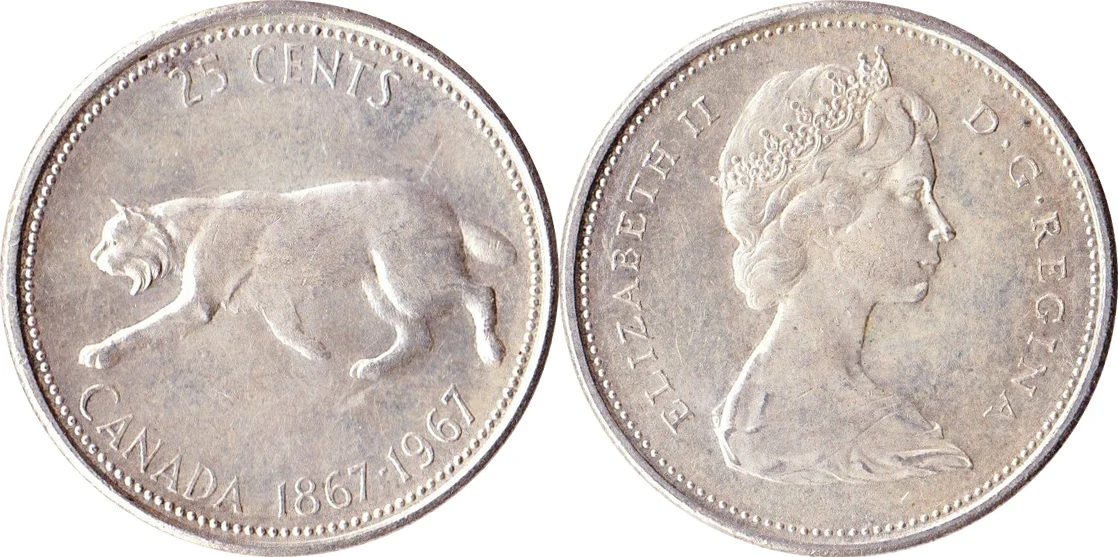
For the centennial of Confederation, Canada swapped its familiar coin reverses for six animals designed by artist Alex Colville. He gave the dollar a Canada goose, the half dollar a wolf and the quarter a bobcat. He saw something self-reliant and alert in the cat. In the 1966 Mint report, he called it an expression of “intelligent independence.” Look at its pose on the coin: the figure is economical enough to read at pocket-change size. Bank of Canada Museum, Colville’s Centennial designs
The cat stayed while the alloy changed. The Royal Canadian Mint’s composition history lists both 80 percent and 50 percent silver for 1967. The design and date do not separate the two regular issues. Neither alloy should stick strongly to an ordinary magnet, so that test cannot tell you which silver mix a genuine regular-issue bobcat contains. If all you know is the date and design, record its exact fineness as undetermined.
The 1968 caribou: a useful magnet test
The usual caribou reverse, by Emanuel Hahn, returned in 1968. The Bank of Canada Museum holds two quarters dated that year with the same design: one cataloged as silver and one as nickel. Both look like quarters. Only one is made with silver. The museum identifies 1968 as the final year for Canadian silver quarters in this circulation series. Mint denomination history · Museum silver specimen · Museum nickel specimen
Set the quarter on a clean, soft surface and bring a magnet near it without scraping the coin. A strong attraction points to the 99.9 percent nickel issue. No strong attraction is consistent with the 50 percent silver issue, if the coin is genuine and you have already identified the denomination and date. That last condition matters. Lots of nonsilver metals don’t stick to a magnet. This is a way to sort two known issues, not a test for silver in any unfamiliar coin. University of Waterloo Earth Sciences Museum, nickel’s magnetic properties
| Date | Reverse | Regular circulation alloy | Strong attraction to a magnet? |
|---|---|---|---|
| 1867–1967 | Bobcat | 80% silver, 20% copper | No |
| 1867–1967 | Bobcat | 50% silver, 50% copper | No |
| 1968 | Caribou | 50% silver, 50% copper | No |
| 1968 | Caribou | 99.9% nickel | Yes |
What the 1968 law says about weight
The schedule in Canada’s 1968 coinage amendment gives the half-silver quarter a standard gross weight of 90 grains (about 5.832 grams). At 50 percent silver, that is 45 grains of pure silver, or 0.09375 troy ounce, about 2.916 grams. The pure-nickel quarter’s standard was 78 grains (about 5.054 grams). These are figures for the statutory standards, not measurements of worn coins. The Royal Canadian Mint’s current online table gives 5.05 grams for both entries; the original statutory schedule is the source for the 1968 weights here. The Bank of Canada Museum’s cataloged silver and nickel coins are consistent with that distinction. Canada, 1967–68 statutes, chapter 26, Schedule Part II, printed p. 244
Why silver disappeared from the quarter
The change wasn’t a new name for the denomination or a new way to draw the animal. It was a change in what the Mint could afford to put into regular change. The Bank of Canada Museum points to rising silver prices. In June 1967, Finance Minister Mitchell Sharp told Parliament that the United States had restricted its silver sales to domestic users and Canada needed to conserve supplies for uses including coinage. The Mint could use less silver without asking anyone to learn to recognize a smaller quarter. Across two dates you can trace the change in three steps: 80 percent silver, half silver, then nickel. Bank of Canada Museum, “The true value of money” · Canadian House of Commons debate, June 5, 1967
One museum object is worth mentioning precisely because it is not a regular circulation issue. The Bank of Canada Museum has a nickel Centennial bobcat dated 1967 and cataloged as a trial strike, a test piece. It shows the Mint was trying the new metal, not that the circulation table needs a third 1967 row. If an apparent 1967 bobcat strongly attracts a magnet, have it examined before assuming it is that rare kind of object. Bank of Canada Museum, 1967 nickel trial
The little sorting rule to remember: on a bobcat, don’t guess the silver percentage; on a 1968 caribou, check for strong attraction to a magnet. For collecting notes, write down the date, the animal and what you actually observed. A carefully recorded unknown is more useful than the wrong percentage.
Keep reading
- World Silver Coins, a collector’s guide to identifying the issuer, date and denomination.
- Silver Identification, on separating a material claim from evidence.
- Same Date, Two Dollars, another case where a date and denomination aren’t the whole story.
- The Denver Quarters With Too Much Silver shows what it takes to actually measure fineness.