
One watch, two cases
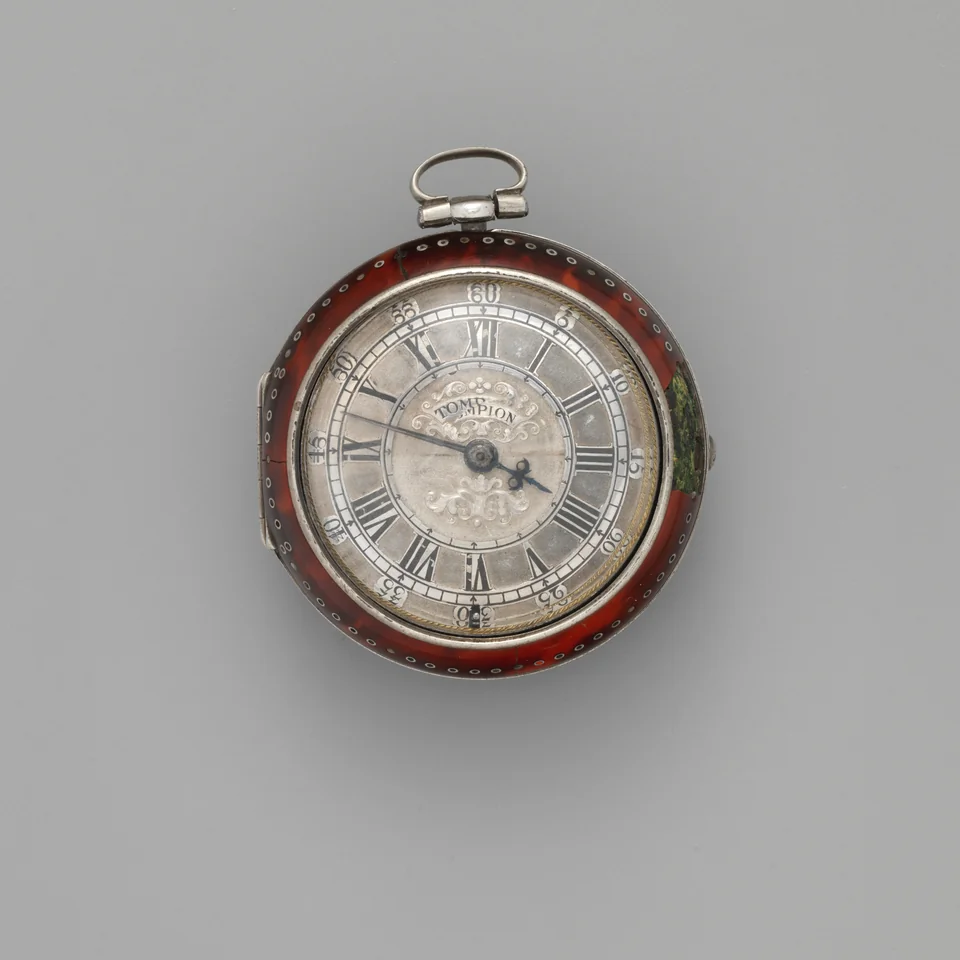
Look for the thin red ring just beyond the silver dial. It is not merely a stripe of color on the watch. It belongs to a case the watch can come out of. Remove that outer shell and there is still a dial, a suspension loop and a silver case around the mechanism. That is what makes this a pair-case watch: one working assembly housed in an inner case, with an additional case fitted around it.
The Met dates this London watch to 1685–86 and names Thomas Tompion as watchmaker and Nathanial Delander I as case maker. The dial and inner case are silver, while the outside is red tortoiseshell with silver inlay. Neither the name on the mechanism nor the brightest material on the outside is a complete description of the whole object.
What comes off, and what stays?
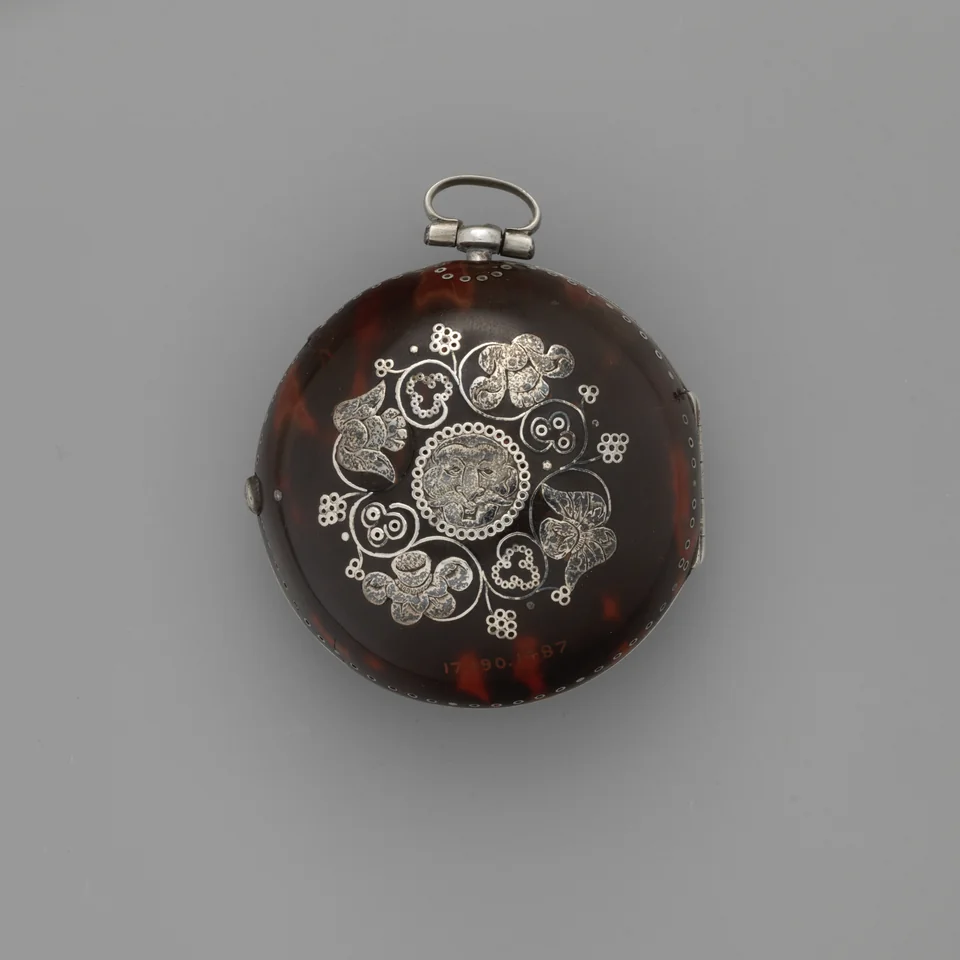
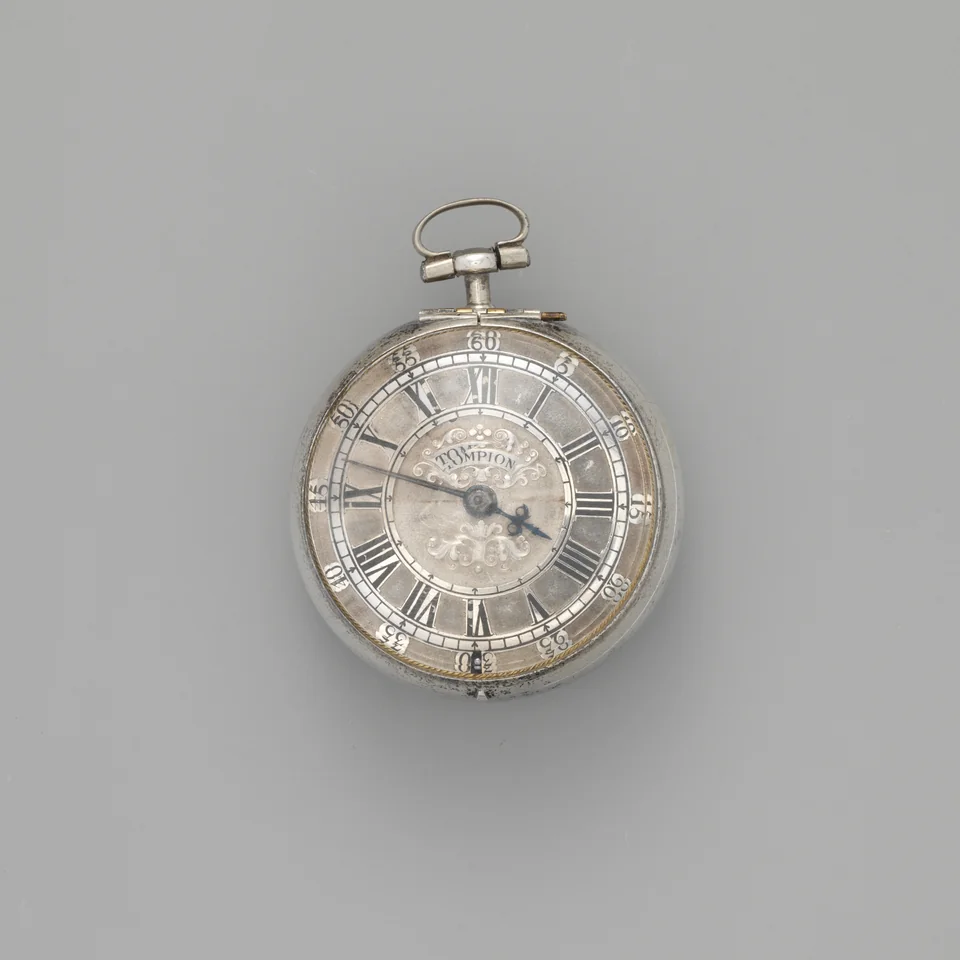
From behind, the reddish outer shell is a display surface: its inlay turns a curved back into a small picture. Compare that view with the silver watch photographed outside the shell. Most of what makes the object recognizable as a watch stays. The decorative back and the thin red rim seen in the first photograph belong to a separate envelope of protection.
The extra case had to be shaped to accept that smaller assembly. It might acquire wear of its own while the structure underneath remained useful. A protective shell was not a claim that the watch could survive water or rough handling. Nor was it the only way to shield a dial. On a much later Vacheron and Constantin hunter-case watch, for example, a metal front lid is hinged to the watchcase itself. A lid opening on a hinge is not, by itself, evidence for a second nesting case.
Not every pair-case watch wore an ornate outer shell. The material and decoration of this one are clues to its makers' choices, not rules for recognizing the whole class. For other case forms, start with the Collect Silver pocket-watch guide.
Follow the number through three parts
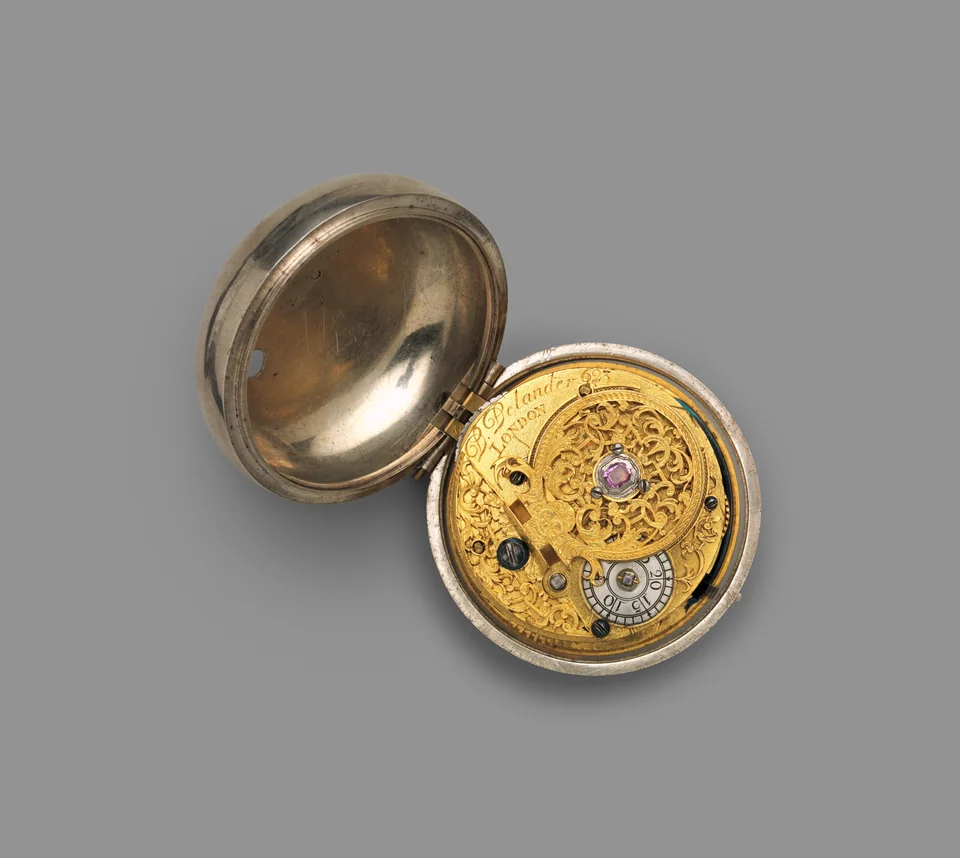
A pair of plain silver cases can tell an even more specific story. In a watch The Met dates to about 1715–19, the number 623 appears on the movement and on the insides of both cases. The movement bears Daniel Delander's name. The cases bear worn WI stamps that the museum identifies as the mark of watchcase maker William Jaques. Jaques had apprenticed in part under the earlier Delander who made cases for Tompion.
On this object, the repeated number connects the cases to the mechanism. The separate signatures help assign different jobs without turning every part into the work of the same person. The museum also records a hole in the back of the inner case that gives access to the movement's winding square. That small opening is a feature with a purpose, not an automatic sign of damage.
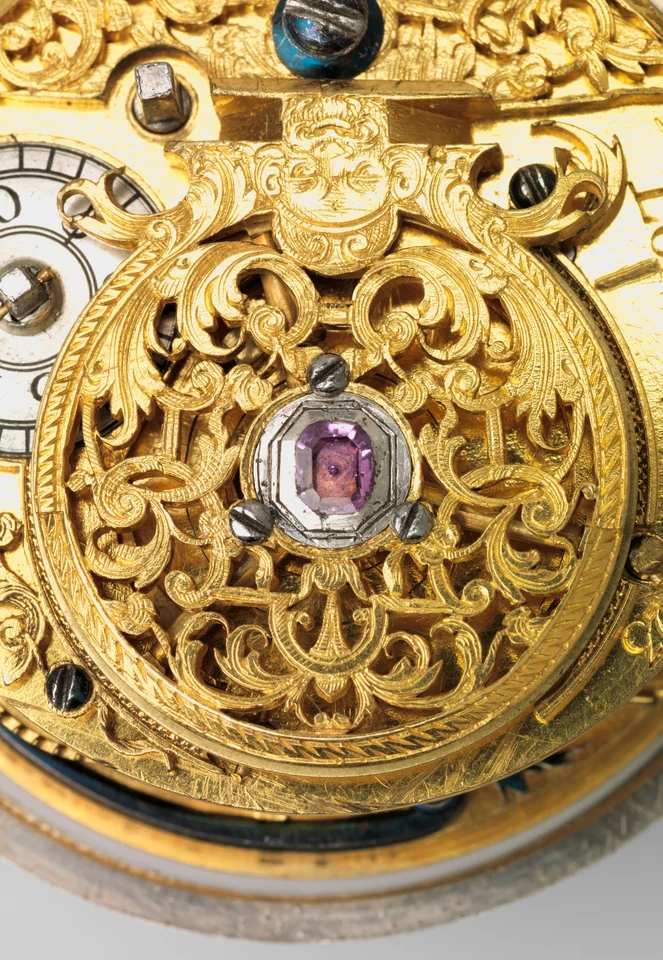
There is an unexpected reason to protect what lay inside. The pink speck in the movement close-up is a diamond endstone. It has a blind hole, drilled partway through, in which a pivot of the balance staff turns. The watch's most colorful gem is not set into the silver outside for someone across a room to see. It sits inside the works, where its job is mechanical.
Compare the Massy-signed alarm watch, whose silver cases instead contain deliberate openwork so the sound of a bell could escape. Both watches put several layers between the wearer and the works. Their openings solve different problems.
When a name no longer agrees with the watch
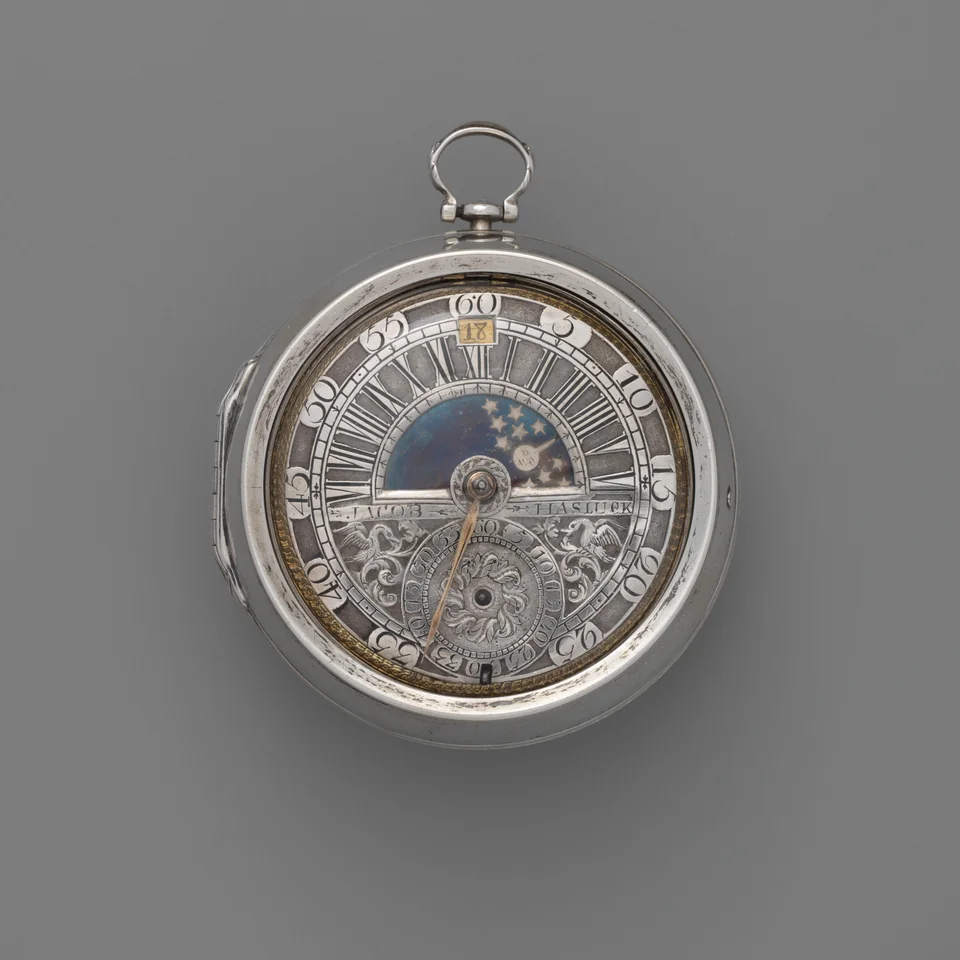
On another pair-case watch, made in Amsterdam around 1695, a semicircular opening in the dial reveals a turning disk with sun and moon figures. That is the hour display; the outer ring provides the minutes. The small seconds display lower down has lost its hand. This is not an object to identify from a single name read across the front.
The Met attributes the watch to Jacob Hasius and the silver cases to Marcus Bellanger. The museum records that the dial was partly abraded and a different signature engraved in place of the earlier watchmaker's name. It is a useful contrast to number 623. Matching marks can tie layers together in one documented object; an altered inscription may tell part of a later history in another. A present-day fit between two parts does not settle either question.
Record the watch in layers
- Describe the assembly as it sits. Photograph the dial, back, side profile, any clearly visible seam, and the suspension loop. Describe what you can see before assuming a case is missing or a second cover is detachable.
- Keep the marks in their places. If a watch specialist safely opens the object, ask for separate photographs of the movement, inner case and outer case. Transcribe each inscription with its location. Note whether a number repeats; don't confuse a serial number with an assay or maker's mark.
- Leave stiff parts alone. Do not pry at an unfamiliar seam, force a hinge, or try a random key. A case worn on the back does not tell you the condition of the works. If the watch needs inspection, ask a repairer who works on antique movements.
Then separate the parts you can document from the ones you only suspect. The guide to watch accessories does the same for what used to hang from the watch. The instinct is transferable: a little silver object may be easiest to understand by noticing what can be taken away and what still does its original job.
Sources and object records
- The Met: Thomas Tompion and Nathanial Delander I, pair-case watch, 1685–86. Dial, inlaid exterior and separate inner-case photographs.
- The Met: Daniel Delander and William Jaques, pair-case watch, ca. 1715–19. Movement, serial, marks and pink diamond endstone.
- The Met: Jacob Hasius and Marcus Bellanger, pair-case watch, ca. 1695. Hour display and later dial signature.
- The Met: European Clocks and Watches in The Metropolitan Museum of Art. Chapter entries and glossary for pair-case construction.
The object photographs are in the public domain through The Met's Open Access program.