
Look at the holes
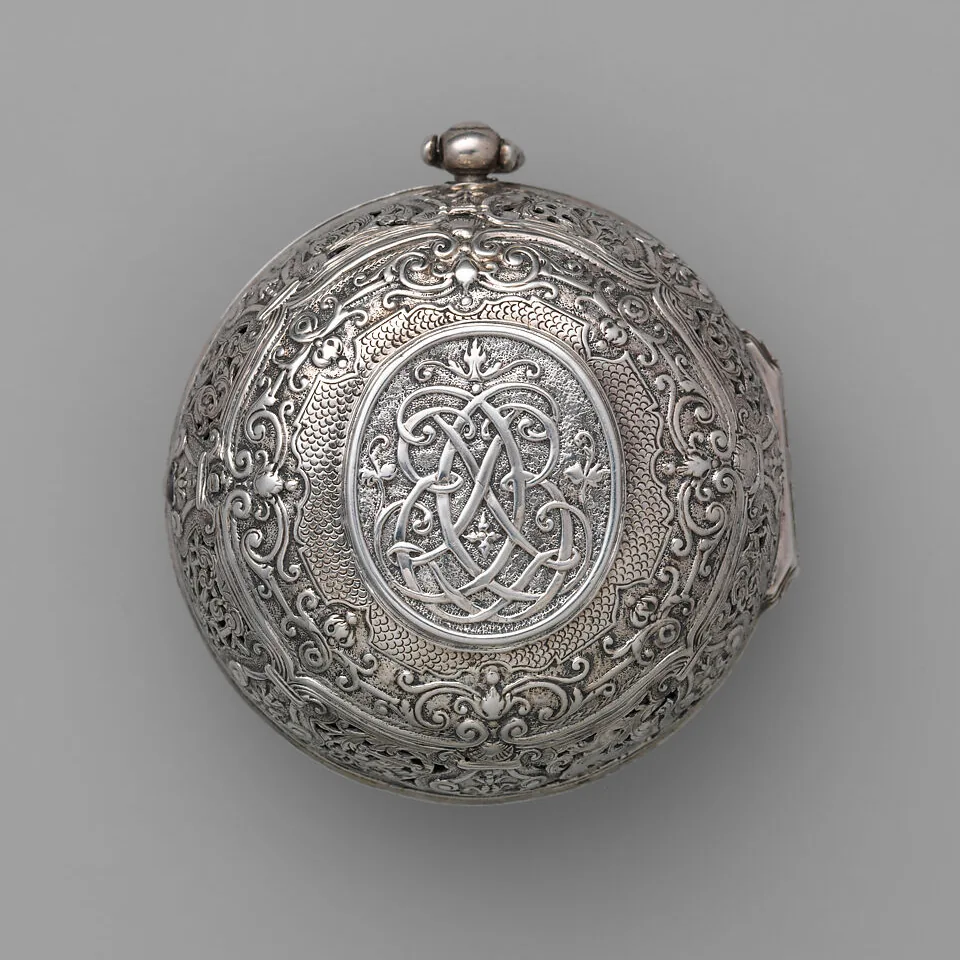
Start with the back. In the center of this late seventeenth-century pocket watch is a set of letters worked in relief. Around them are scrolls, then a ring of foliage cut all the way through the silver. It is an unusual detail on a case meant to protect clockwork. Why put holes in the thing that keeps the mechanism covered?
The answer is on the other side of the case. A bell was fitted inside it, and a hammer could strike that bell when the watch reached a time its owner had selected. The inner case is pierced along its sides, too. The openwork wasn’t just a display of skill. It gave the sound a way out through both layers of silver.
The Metropolitan Museum of Art dates the watch to about 1695 and places it in London. Its outer case measures 5.9 centimeters across. At that scale there was room for a monogram, two independent sets of clockwork parts and a sound meant to reach a person who wasn’t looking at the dial.
Two mechanisms, one face
There is just one blued-steel hand on the silver dial. The ring around it shows the hours in Roman numerals, with small raised diamonds marking the half-hours. Look closer and you’ll see a second circle of numbers in the center. Those belong to the alarm, not to the time display.
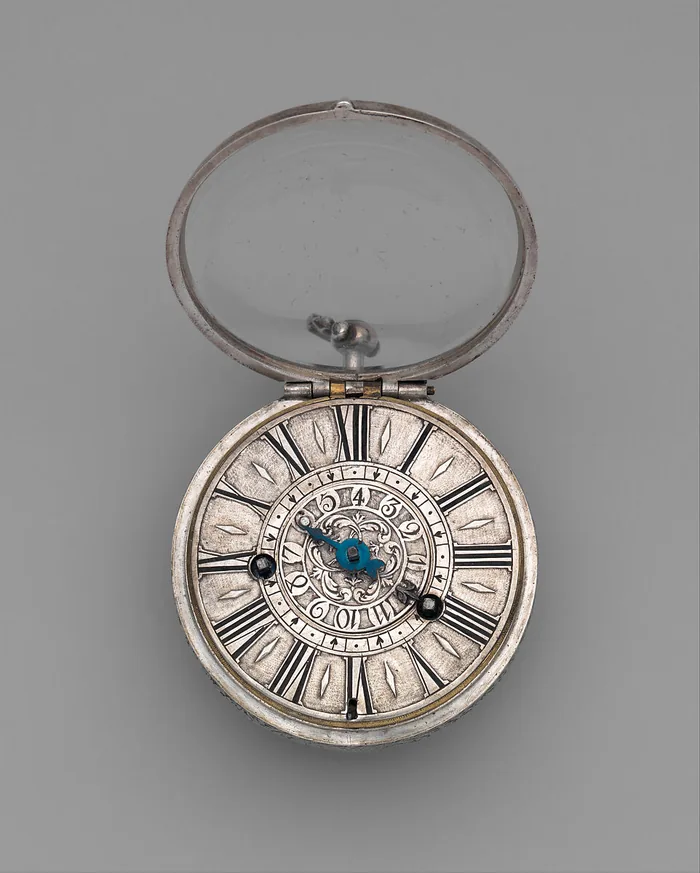
The distinction carries through the mechanism. One train, a succession of wheels transferring power, drives the time display. Another powers the alarm. According to The Met, the user wound the two separately through openings in the dial, at four and nine o’clock. A knob at six adjusted the central alarm dial. When triggered, the alarm mechanism drove a double-armed hammer against the bell mounted inside the inner case.
A watch that displays the time waits for someone to look. An alarm watch makes itself known. That difference shaped the silver: drill or cut too sparingly and you enclose the bell; make an openwork pattern and the same design can carry sound and identify the watch’s taste. We don’t know how loudly this particular watch rang or where its first owner wanted to hear it. It would take more than a photograph to answer either question.
A London signature, a French line of work
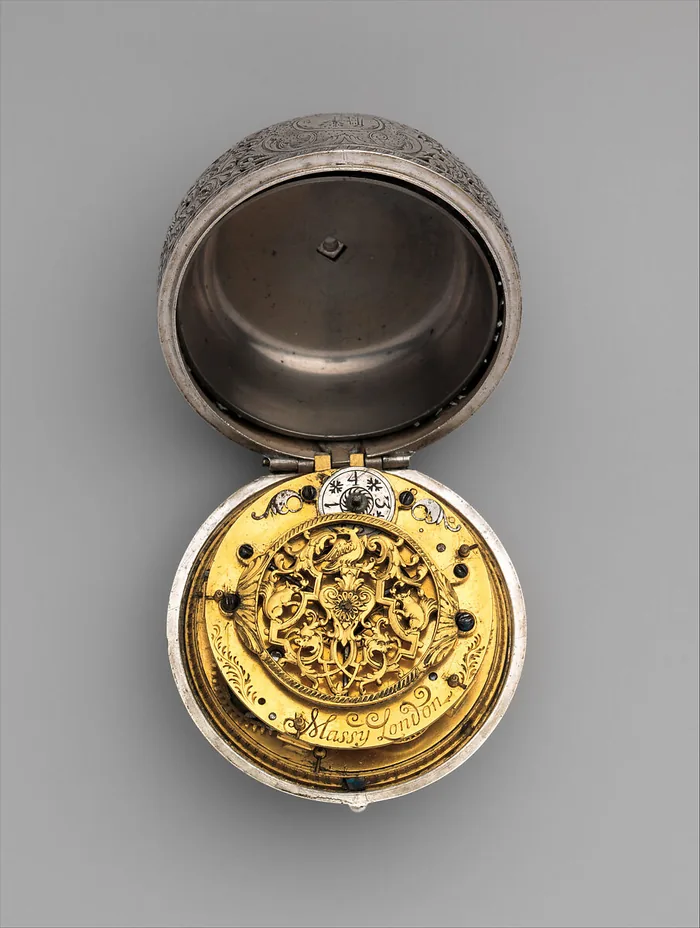
The back of the movement is marked “Massy / London.” That gives a name and place, but not a first name. The Met favors Nicolas II Massy, a watchmaker from Blois who was admitted to London’s Clockmakers’ Company in 1682 and naturalized in 1685. His son Nicholas was admitted in 1693, and the museum’s public record also lists Henry Massy among its possibilities. These are alternative attributions, not a list of people known to have worked together on the piece.
The elder Nicolas was already recorded in London before the 1685 revocation of the Edict of Nantes. The date matters: the watch fits a wider movement of French Protestant craftsmen, but it would be wrong to say the decree sent this particular man across the Channel. The Met sees French precedents in the movement’s pierced balance bridge and in the ornament on the case. Look closely at the bridge and the foliage resolves into two squirrels and a bird. It is decoration on a part most users wouldn’t have seen while telling the time.
As for the person who made the silver cases, The Met tentatively names a member of the Roumeau family. The case has no maker’s mark, however, and the museum found no documentary evidence that Roumeau supplied the Massys. Nor do the letters on the outside settle who first carried the watch: the cipher can be read as either CB or BC. A signature, a stylistic attribution and a monogram are three different kinds of evidence. They shouldn’t be combined into a single confident ownership story.
The parts that changed
The watch has passed through a collector’s hands as well as a watchmaker’s shop. The Met traces it to British banker and collector Frederick George Hilton Price before its arrival as part of J. Pierpont Morgan’s gift in 1917. Unlike the original owner, Price has a name in the institution’s record.
The record also describes repairs where the inner case meets the pendant, a dent near eleven o’clock and a missing screw where the bell was attached. The hand is a replacement, and so is the bezel holding the glass. The Met suggests the bezel may have been made for replacement glass, but doesn’t give a date or name for the work. Those details matter because the single hand is one of the first things people see: you can correctly describe this as a one-handed watch without calling that particular hand original.
The holes in the silver survived. So did the dial and the movement with which to make sense of them. The watch moved from an instrument people could set to an object a museum can study. Calling it an alarm watch describes the construction. It does not promise the surviving object can still ring.
Read one yourself
On an unfamiliar pocket watch, start with three views: the dial, the side where you can see whether it has nested cases, and the back. If there are openings or a smaller numbered dial, photograph them and compare them with a well-documented example. Piercing alone doesn’t prove an alarm; a central scale alone doesn’t tell you exactly what it controls. Here it’s the combination of the dial, the separate train, the hammer and the bell fitting that tells the story.
Keep any movement signature separate from the case’s marks or engraved initials. Record whether a detail is visible, described by a catalogue or identified by a specialist. If you can’t inspect the movement without forcing anything, stop at the outside. There’s no need to wind an old watch just to see whether your description of it is right.
See The Case Around the Clockwork for nested cases and repair evidence, and Silver Timepieces for how to tell the different makers and materials apart.
Sources and image credits
Museum catalogue and photograph records
- The Met: Pair-case watch with alarm, 17.190.1498a, b. Object, materials, measurements, technical examination and ownership; the entry cites the Clockmakers’ Company records of April 3, 1682 and July 3, 1693. Quotations in this article are limited to inscriptions rather than curatorial wording.
- The Met: European Clocks and Watches in The Metropolitan Museum of Art, cat. 27. Museum catalogue version of the examination, not an independent corroboration.
- Photographs: The Metropolitan Museum of Art, Gift of J. Pierpont Morgan, 1917, 17.190.1498a, b. Public Domain (Met Open Access).