
Read it from the foot
Start at the foot of Tiffany’s Magnolia Vase. There’s a blue-green opal set into a pool of silver ridges. Above it, a stalk of goldenrod climbs into a bank of white flowers. The blossoms look soft enough to bruise. The silver around them looks hard enough to ring.
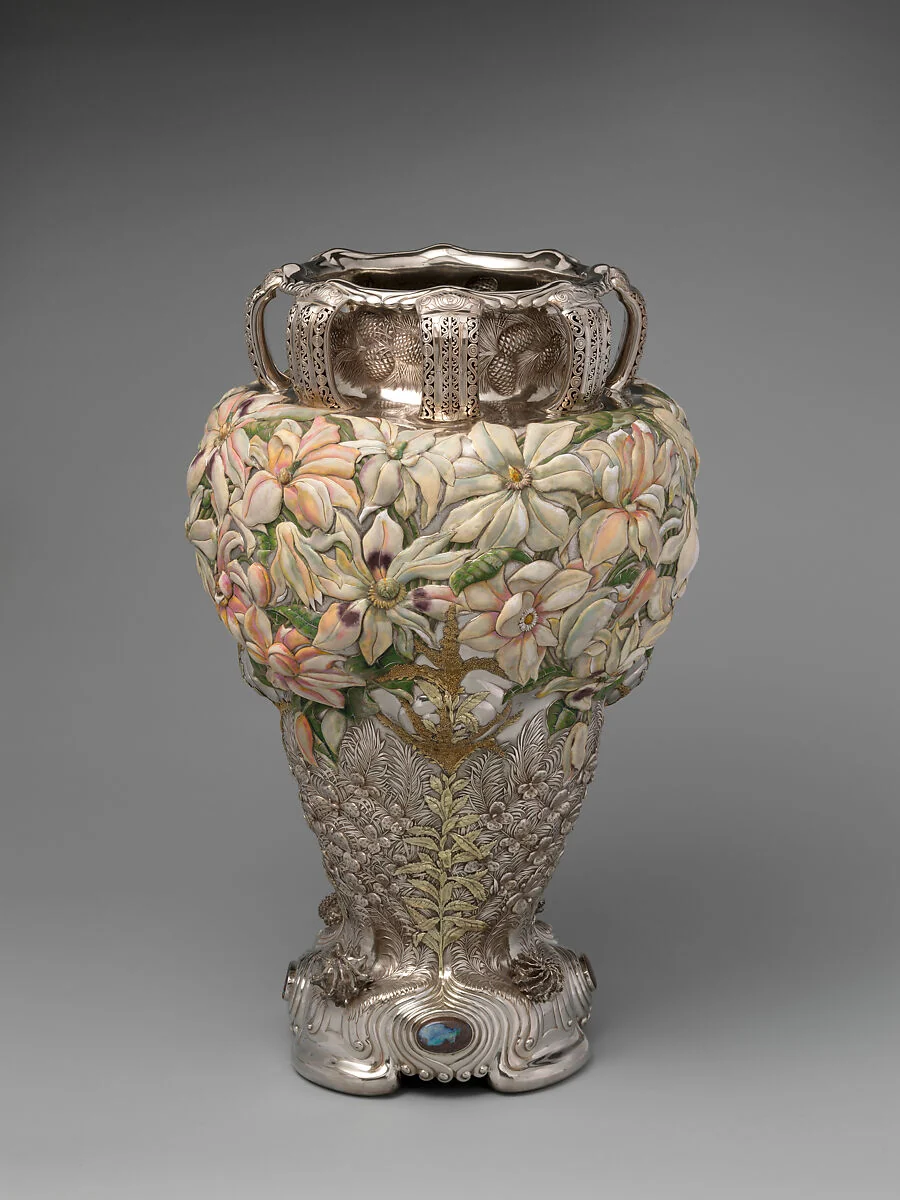
In 1893, this nearly 31-inch vase was the centerpiece of Tiffany & Co.’s display at the World’s Columbian Exposition in Chicago. It was meant to represent more than a New York silver workshop. Tiffany had set out to put the idea of a country on a single vessel. You can read that idea from the bottom up.
A map without borders
The Met identifies cacti with the Southwest. Pinecones and needles stand for the North and East; magnolias for the South and West. The goldenrod represents the country as a whole, and Tiffany made it from gold mined in the United States. These are symbols, not a guide to where the plants actually grow. The gold is doing double duty: it gives the eye a path through the silver, and its origin is part of what the designers wanted fairgoers to notice.
Then look past the flowers to the vessel itself. The Met traces its shape to Pueblo pottery and the decoration on its handles to Toltec motifs. Those are distinct traditions, not interchangeable details, and neither is the same thing as Tiffany’s design. The vase shows which forms an American luxury manufacturer chose to borrow in the 1890s, not how the peoples behind those traditions chose to portray themselves. That makes Tiffany’s declaration of national identity more complicated, and more interesting, than the botanical scheme alone.
The flower that couldn’t shine
The petals have the quiet look of a real magnolia. They don’t reflect light the way the rim does, and their color shifts rather than sitting flat on the surface. On a vessel built to attract attention across a room, one of the workshop’s hardest jobs was getting part of it to stop gleaming.
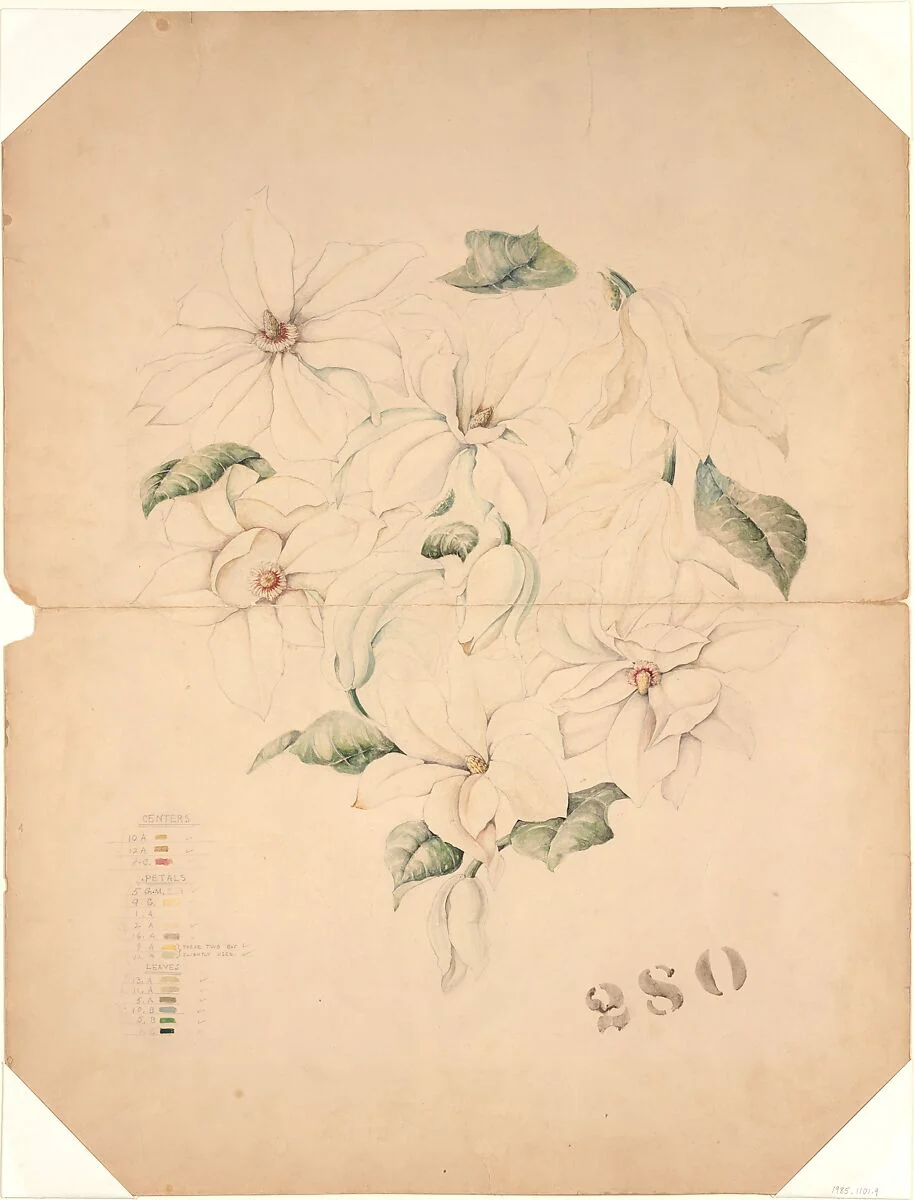
That was an enamel problem. Enamel is glass fused to a surface; here it had to stay in place on curved metal and still give the petals a soft, matte finish. A Tiffany design drawing takes you to the workbench. Look at the bottom left and you’ll see little color samples grouped by flower centers, petals, and leaves. Set the drawing beside the finished vase and it becomes easier to see what the makers were solving: not just how to put white flowers on silver, but how to give each part of a flower its own color and depth.
The hands behind the Tiffany mark
Edward C. Moore helped shape the way Tiffany’s silversmiths worked. He put objects and books within reach of workshop staff so they could study them, borrow ideas, and try things for themselves. He was planning for the Chicago fair near the end of his life, but he died in 1891 and never saw the vase finished.
His successor, John T. Curran, guided the work after him. The Met’s account of the workshop names Godfrey Swamby as the lead enamelist and says more than fifteen craftspeople took part over nearly two years. The finished object carries the Tiffany name. The museum’s research gives us a way to see beyond it: Moore could set the direction, but other people had to make the petals hold on a curved shoulder and work out how a blossom should catch the light.
Two ways to show off silver
Elsewhere at the same fair, in the Mines and Mining Building, Montana presented its silver statue of Justice. Montana used the figure to draw attention to what came out of the ground. Tiffany used its vase to show what a team could do with the metal after it reached a workshop. That distinction matters when you look at the vase’s measurements. At roughly 57½ pounds (26.08 kilograms), the vase looks less like an ornament you could turn in your hands. That is the weight of the whole object, not the amount of pure silver in it. It includes the enamel, gold, and opals that help make the vase recognizable in the first place.
A few years later, rival Gorham took another route. Its Martelé punch bowl used handworked relief to throw light and shadow across its surface. Tiffany’s Magnolia Vase is not Martelé. Putting the two side by side shows what silver can do: one workshop made raised forms catch the light; another made the petals look soft in the same light.
Look at the magnolias again. The vase could have made its point with polished silver alone. The parts that look least like silver are what make you lean closer.
Keep exploring
- Montana’s silver Justice: A mining state made a very different statement at the same fair.
- Tiffany & Co.: Learn about the maker behind the showpiece.
- American silver at The Met: Explore more objects from the American Wing.
For a different nineteenth-century workshop object with a long public life, see the Library of Congress’s Louis Lot silver flute.