
A new sonata on an old flute
On February 14, 1958, Jean-Pierre Rampal stood in the Library of Congress’s Coolidge Auditorium with a silver flute already about 78 years old. With pianist Robert Veyron-Lacroix, he gave the U.S. premiere of Francis Poulenc’s sonata for flute and piano. Poulenc and Rampal had played the world premiere in Strasbourg the previous June. The music reaching a new audience in Washington was barely a year old. The instrument that played it came from nineteenth-century Paris.
The Library identifies exactly which flute Rampal played in Washington. Today the same collection record lets us look closely at what was in his hands and follow the same piece of silver to another performance, more than six decades later. The Library on the two premieres · The Library identifies the instrument.
Read the flute like an object
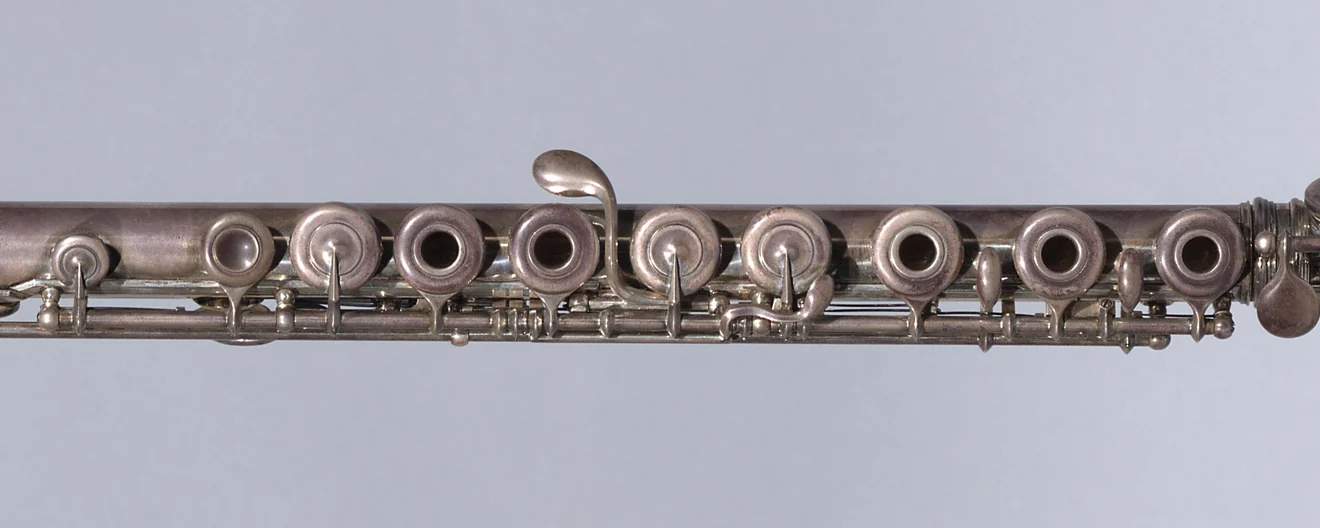
The Library calls it DCM 0452: a flute in C from the Louis Lot workshop, made in Paris and cataloged to 1880. It is about 68 centimeters long, in three sections, with Boehm-system keywork. The ledger says it was made for Howard Coghill, who remembered the year as 1880 or 1881. Serial number 2962 distinguishes it from other instruments made under the same name. The catalog says silver, not sterling. Neither the shine nor the name tells you the fineness of every part. Flute in C, DCM 0452.

The headjoint is where the player sends a stream of air across the edge of the embouchure hole. Farther down, the keys open and close holes, changing how the air inside the flute resonates. The Library records that the finger holes were originally open, that George Haynes covered them, and that William S. Haynes reopened them in 1926. A photograph shows the holes as they are now. The repair note is what tells you they haven’t always looked that way.
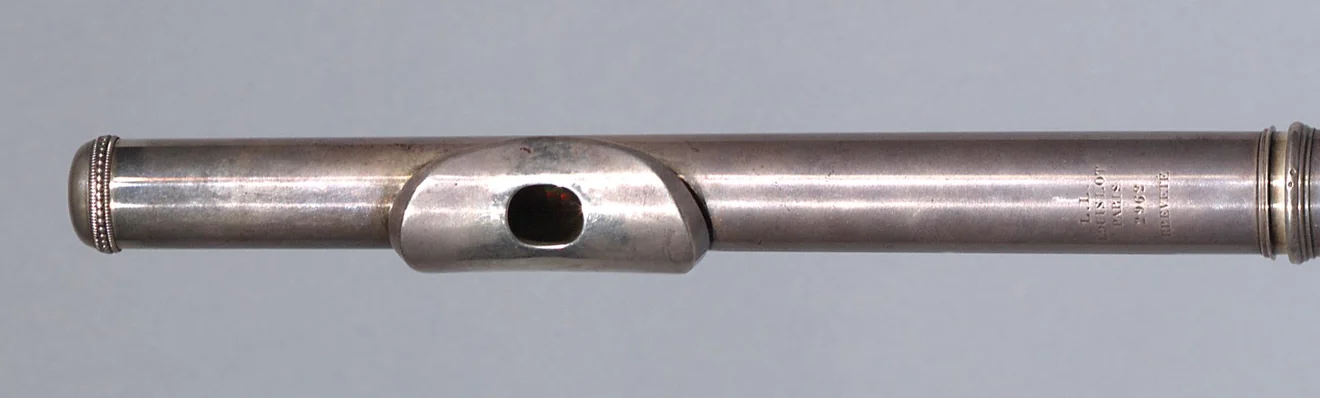
If you’re documenting an old flute, photograph the headjoint, body and footjoint separately, including any marks. The pieces don’t have to tell the same story. And a photograph that helps identify a flute can’t tell you whether it is ready to play.
Does silver change how it sounds?
Theobald Boehm thought the metal mattered. In Dayton C. Miller’s English translation of his book on flute playing, he describes the silver flute as particularly useful in a large room and praises its brilliance. That is a sensitive player and maker reporting his experience, not a controlled test of this instrument. Boehm, The Flute and Flute-Playing.
In a 2001 study, Renate Linortner compared seven versions of the same Muramatsu model, including plated, silver, gold and platinum instruments. Experienced flute players listening to the recordings could not reliably distinguish the instruments; the measurements showed larger differences among players. That doesn’t prove all flutes sound alike. The shape of the headjoint, the way the holes open and the player’s use of breath and lips still matter. A metal named on a tag isn’t a prediction of the sound that will come out. University of Music and Performing Arts Vienna, flute material study.
The same flute, a different visitor
On September 26, 2022, Lizzo visited the Library’s flute vault. The Library lists this Louis Lot silver flute among the instruments she played. It also lists the glass flute associated with James Madison. Those are two different instruments, and it was the Madison glass flute that drew attention at her later arena appearance. The official Library footage shows her visit; the collection guide identifies the instruments she tried. Watch the Library’s video · See the cataloged instruments.
A silver object in a museum can look finished, as if everything it had to do happened long ago. In 1958 someone picked up this flute to introduce a new piece of music to an American audience. In 2022 another musician played it in the building that now keeps it. The catalog number lets us follow the same flute between those two moments, not just admire another silver object behind glass.
Keep reading
- From Ore to Object follows silver from raw material to the things people make and use.
- Tiffany’s Magnolia Vase follows another nineteenth-century workshop’s decisions through photographs of the finished object and its working drawing.
- The Denver Quarters With Too Much Silver distinguishes a known material from a measured fineness.