
The petition over a pair of shoes
In December 1791, buckle manufacturers from Birmingham, Walsall and Wolverhampton took a problem with shoelaces to the Prince of Wales. They were not asking him to invent a better fastener. They wanted him to put the old one back on his feet and set an example. In their telling, the fashion for tying shoes instead of buckling them was threatening livelihoods across the trade.
The petition is dated 17 December in the Royal Archives. A report published on 26 December and later reprinted by the Birmingham historian John Alfred Langford describes the deputation at Carlton House, introduced by Richard Brinsley Sheridan. The prince promised to use his example and influence. The report said laces would not be adopted in his household. That was a promise about his own household, not a law against tying shoes. The distinction is the story: the manufacturers were betting that what the prince wore could change what other people bought.
What the metal actually did
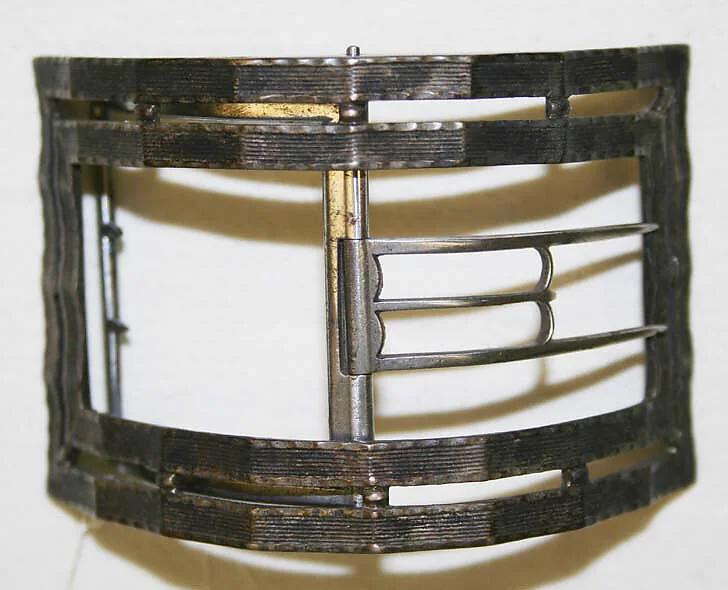
Look through the rectangular frame of the British silver buckle above. The central bar and little projecting points belong to a working mechanism. This was not simply a plaque sewn onto a finished shoe. In the sort of fastening The Met describes, two fabric straps called latchets crossed the top of the foot and were drawn through the buckle to hold the shoe closed. The frame was the part people saw. The fittings within it did the work.
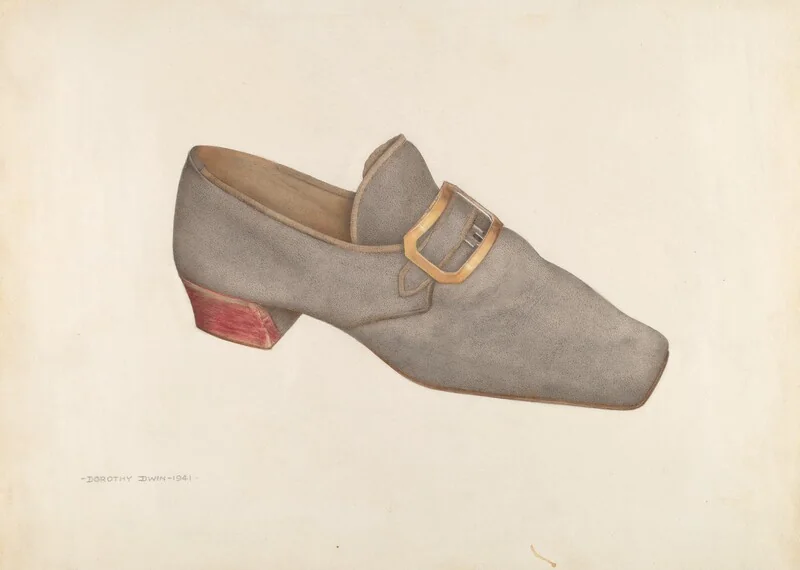
Dorothy Dwin’s 1941 watercolor puts a buckle back in its place over the instep. It is a later drawing, not evidence that the silver buckle in the first photograph belonged to that particular shoe. But the view answers a question a detached buckle can’t: where does all that metal sit when the shoe is on a foot?
Because the buckle and upper were separable, the ornament could be kept apart from the pair of shoes it served. An isolated frame in a drawer is not automatically an incomplete piece of jewelry. First work out whether you’re looking at the fastening on its own, or at a fastening that is itself missing its internal parts.
Silver, silverplate and glass
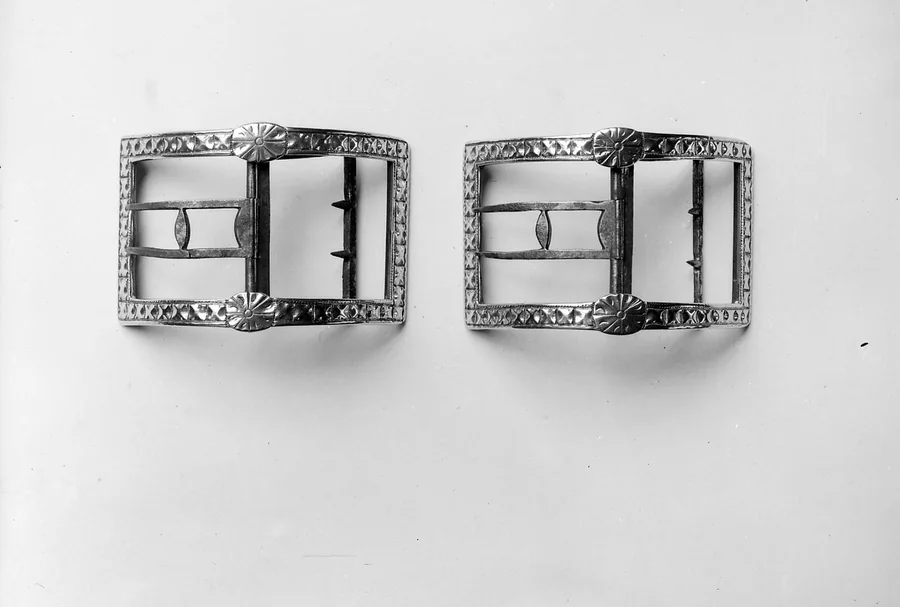
The silver example is just one answer to the question of what a fashionable buckle could be. The Met catalogues a second buckle as silver plate on copper. Look at the photographed mechanism as well as the decorated frame. The museum gives the material for the object, but a photograph like this is not enough to determine the composition of each pin or working part. It also does not establish whether the silver was applied by any particular plating method.
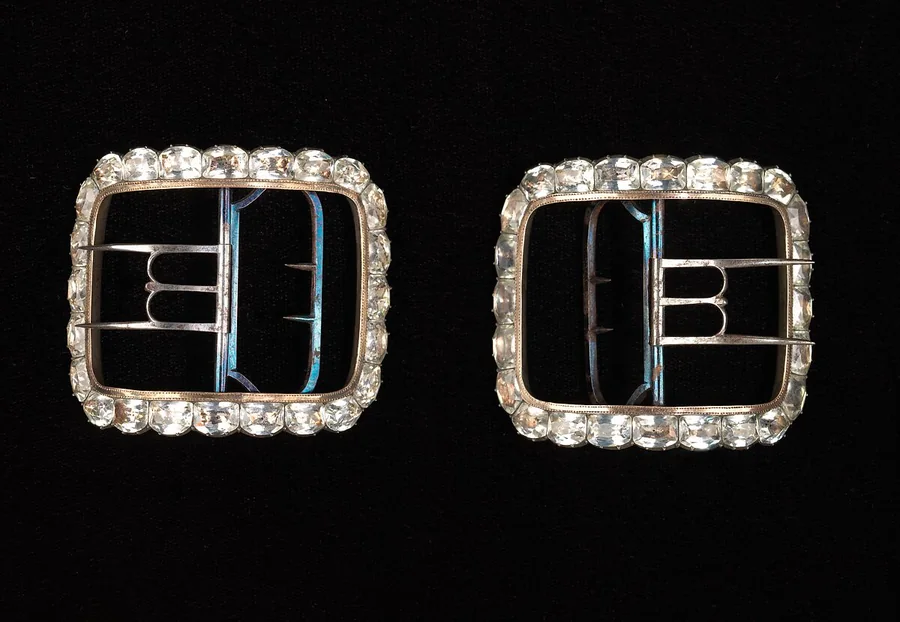
For a very different effect, look at the stones circling the two buckles below. The long, faceted pieces follow the curve of the frames. They are paste, a kind of glass, not diamonds. The Met calls the mount metal and doesn’t identify it as silver. It also notes how the relatively inexpensive material for the stones let bucklemakers devote their effort to the cut and setting. The glass wasn’t there by accident; someone worked to make it catch the light.
A dealer’s phrase like “silver shoe buckles” can hide those distinctions. It might describe the material, the surface, or just the color. Keep separate notes for frame, stones and fitting. As with chatelaines worn at the waist, the name tells you how a piece was used, not what every part is made of. The sterling and silverplate markings guide explains why even a promising mark needs to be read on the part that carries it.
Why ask a prince to get dressed differently?
From the buyer’s side, a lace was another way to keep a shoe on. From the manufacturer’s side, it could erase a separate purchase. The loss wasn't just a little rectangle of metal. Compare the pieces above and think of the different kinds of work an order could support: making the frame, fitting the mechanism, finishing the surface, and on some pieces cutting and setting the glass. Switching the closure could bypass all of it.
The deputation was one effort, not the whole response. The historical study of the trade documents a charity subscription and further approaches to the royal family by London makers in early 1792. In those appeals the makers emphasized that workers with skills specific to the trade could not simply move to another one. The language is meant to persuade; it nevertheless tells us what the makers believed was at stake in getting the buckle back into fashion.
Nor did every buckle vanish at once. In January 1794, the Birmingham press was still cheering royal appearances in newly designed shoe fastenings and hoping demand would revive. That hope makes the December appeal more interesting than a tale of one invention replacing another. There was still room to imagine a comeback, even as buyers were learning to do without the thing the workshops knew how to make.
How to read a loose buckle today
Turn it over before naming it. Look for a crossbar, projecting points and a place for the straps to pass. Note where a missing fitting might have attached. Record the inside width as well as the width of the frame. A shoe buckle, a belt buckle and an ornamental mount can look more alike from the front than they do from the back. See our guide to the hidden supports on dress silver for the same way of looking at other fasteners.
If there are two, compare the backs. The visible decoration can match while the pins, joints or wear differ. Photograph both pieces in the same orientation. Keep a record of repairs and marks before you clean anything. If the hinge is stiff or the stones are loose, leave it alone. A condition photo tells a collector more than a mechanism forced open to prove it moves.
The silver, plated copper and paste examples survived as objects worth collecting. In 1791, their makers would have judged them by another measure: whether someone still needed to buy one to get dressed. That is why a small silver frame can tell a story that a shoelace by itself never could.
Object records and further reading
- John Alfred Langford, A Century of Birmingham Life, vol. I, ch. V, part 2: the 26 December 1791 newspaper report reprinted in 1868.
- The Birmingham report of 27 January 1794, reproduced in the second volume of Langford.
- Matthew McCormack, “So Manly and Ornamental”: Shoe Buckles and Britain’s Eighteenth Century, English Historical Review, pp. 483–85 on the appeals; cites the West Midlands petition, Royal Archives GEO/ADD/16/130.
- The Met, Shoe buckles, silver, 42.118.29, 1784–85.
- National Gallery of Art, Dorothy Dwin, Man’s Shoe, 1941, Index of American Design, 1943.8.1977.
- The Met, Shoe Buckle, silver plate on copper, 33.120.170, 1770–1810.
- The Met, Shoe buckles, metal and glass, 2009.300.2258a, b, 1780–89; explains the latchets and paste.