
Look at where the arm begins
Set these silver spectacles next to a modern pair and something looks wrong. There is no arm beside either lens. A single curved arm starts on the bridge and rises between them. The Rijksmuseum calls the object a voorhoofdsbril, or forehead spectacles. The important difference is not the roundness of the glass. It is where the maker put the support.
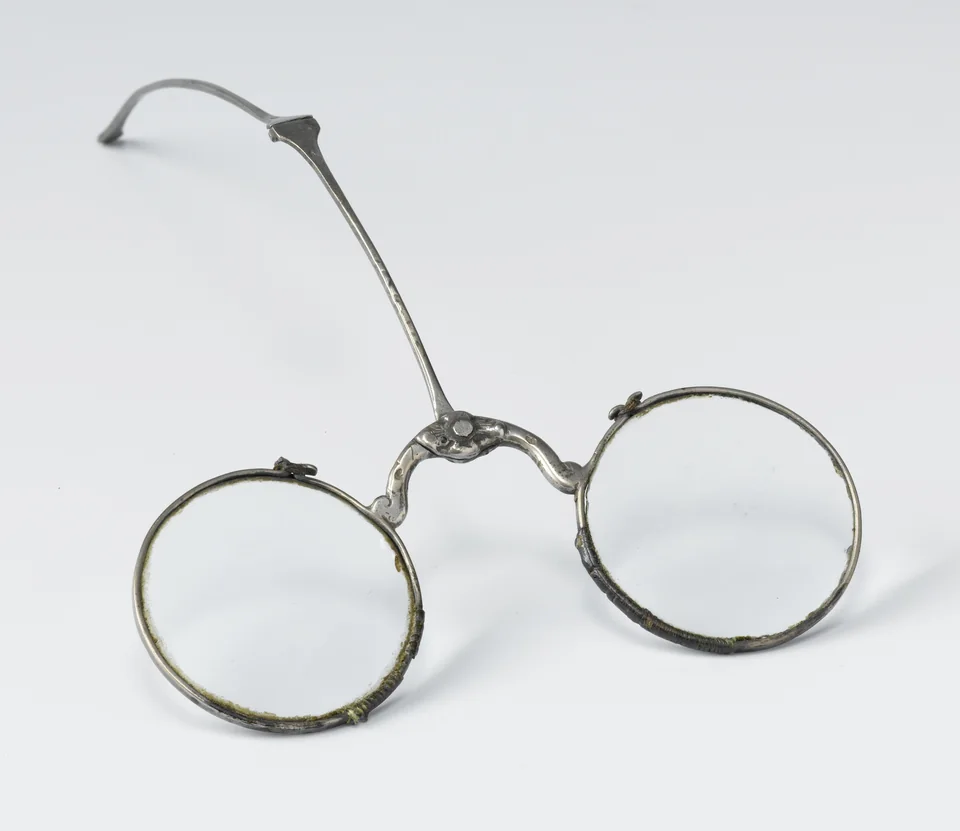
The museum calls the projecting piece a lepel, literally a spoon. It is the catalogue’s name for the support, not an extra utensil. A pin holds it at the arch between the lenses, and a hinge appears along it. Compare that joint with the ones on a modern pair: it moves the support above the nose, rather than folding a pair of side arms inward.
The catalogue dates this pair broadly, about 1675–1775, and proposes the Netherlands or Germany. It does not name a maker or show a named owner wearing the frame. The term “forehead spectacles” and the position of the support tell us far more than we could learn from the silhouette alone, but they do not identify exactly how a particular person wore it.
What a portrait can show
In a late self-portrait at Berlin’s Gemäldegalerie, Anna Dorothea Therbusch looks up from an open book with a round eyeglass in place. Look beyond the lens at the dark line toward her head covering. The painting gives us something a photograph of spectacles lying on a table cannot: a view of eyewear on a reader who has both hands free.
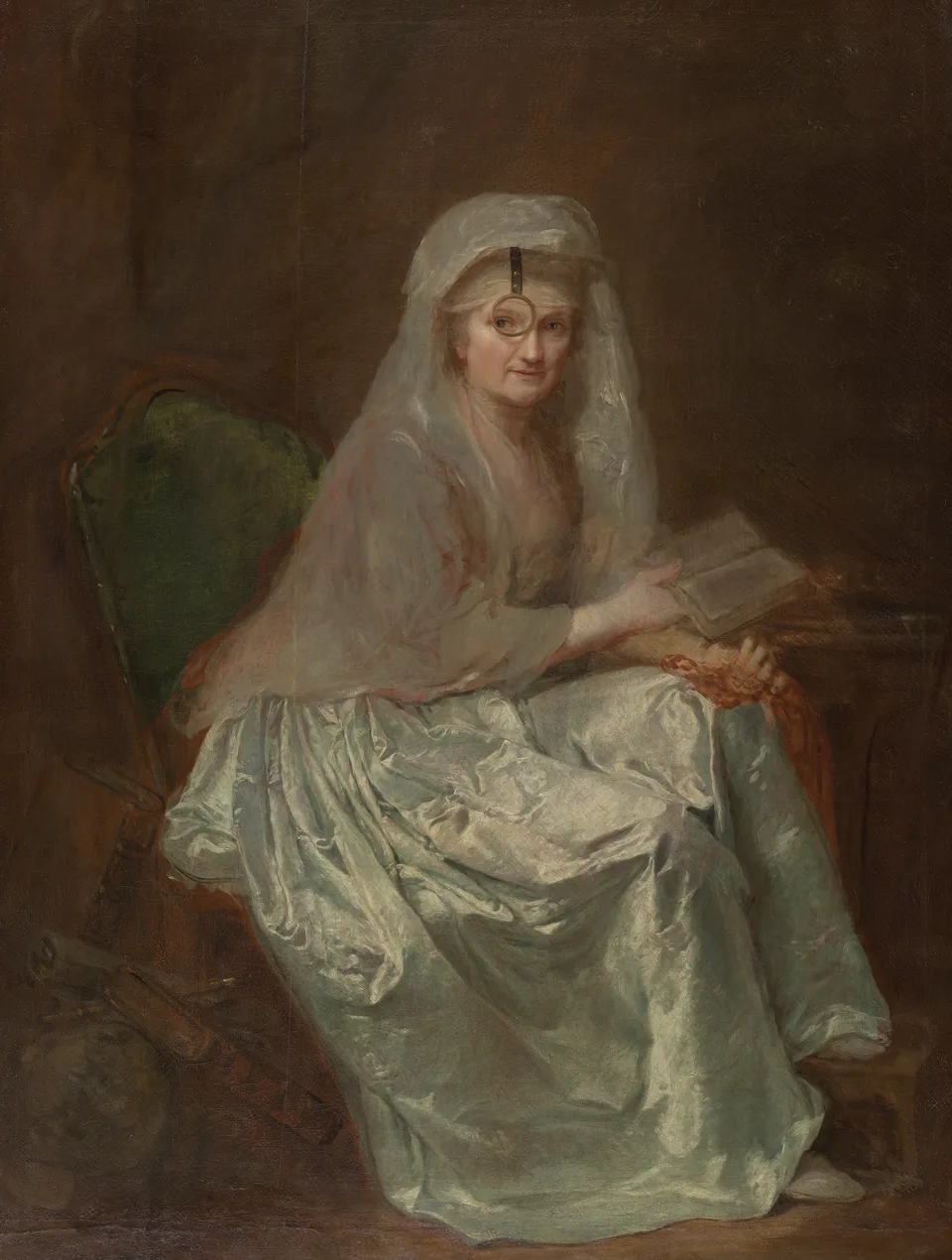
Therbusch depicts a single lens, not the Rijksmuseum’s silver pair. The portrait is not evidence that she owned the silver frame, wore exactly the same mechanism or used a mount made of silver. It does show how a visible lens and its support could belong with a person’s dress. She painted both the book and the eyeglass in the picture, not a reader whose need for a lens had to be hidden.
The frame has to do two jobs
A support holds the lenses in front of a face; a separate bit of engineering holds each lens inside the frame. The open tops of the silver rings on the forehead pair turn back into hooks closed by a small wire, according to the museum’s description. That tiny fastening belongs to the problem of holding glass in the frame, not holding the frame on a head.
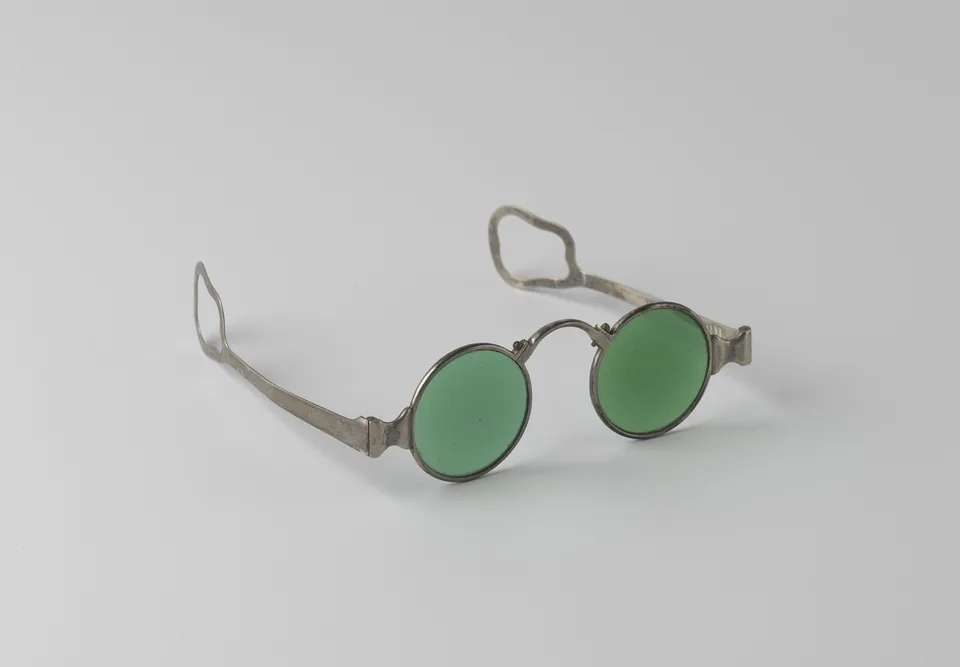
On a later silver pair with green lenses, about 1830–40, the museum points to small silver screws near the bridge. The side arms end in conspicuous shaped loops. Where the first frame had a single support in the middle, this one has fittings on both sides. The green color is plain to see. The object record does not tell us the wearer’s prescription or establish what kinds of light the lenses blocked. It is a mistake to read modern sunglasses specifications into a colored lens.
Some arms could change length
Another Rijksmuseum pair, catalogued to about 1850–90, has silver side arms that slide. The difference is visible: there is a joint between the fixed part and the part that extends. The hinges let the sides turn; the sliders change how far they reach. Both are moving parts, but they do different work.
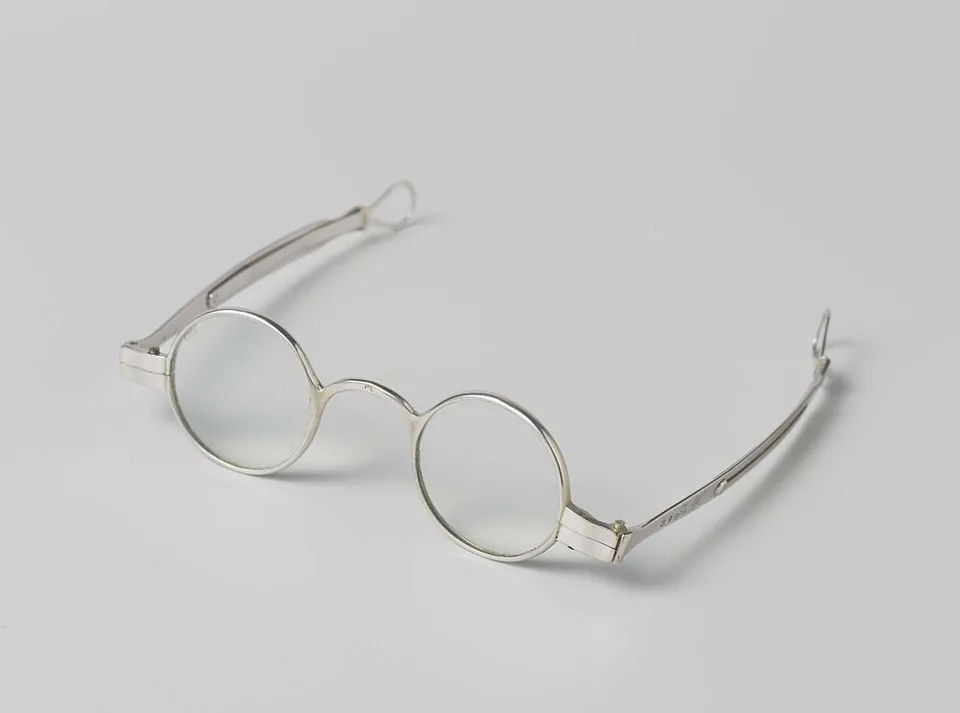
The collection record identifies two sets of initials, K.B. and H.W., on the sliding arms. It also identifies a small wolf’s-head mark with Dutch import and another mark with French import. That is a useful lead about where the silver was marked for import, not a route map. The published record does not give us a sequence of crossings, the identity of either person behind the initials, or a certain place of manufacture. The marks are reported in the catalogue; they are not legible in this overall photograph.
Silver was doing work here that has little to do with the value of its weight. It surrounded fragile glass, took the pins and screws needed to connect moving parts, and carried small marks where most people looking at the glasses would never notice them. Compare the mechanism inside a silver shoe buckle: remove the silver from the garment or the face and you are left with a small puzzle about how the parts once met.
What to look for in old spectacles
Start at the bridge, then go around each lens. Is the central piece just a bridge, or does it carry a pin and a separate support? Are the lens surrounds continuous, clipped or screwed together? Take pictures from the side as well as the front. Do not bend a wire or tighten a screw on a frame with fragile glass just to see how it moves.
Trace each arm to the end. Record any hinges, sliding sections and loops separately. If an arm is missing, a hinge or hole may still tell you it was there. Note exactly where initials and stamps sit, and use the hallmarks guide to help separate a maker’s stamp from a later mark. A photograph taken for sale often gives the lenses the best light; ask for one that gives the fittings the same attention.
That one strange arm is a good place to start. Once you see it rise from the bridge, the question changes from “What kind of glasses are these?” to “What used to hold them in place?” The silver has an answer the glass alone cannot give.
Object records and further reading
- Rijksmuseum, silver forehead spectacles, BK-NM-11072; construction, materials and date range.
- Gemäldegalerie, Anna Dorothea Therbusch’s Self-Portrait, inventory 1925, probably 1782.
- Rijksmuseum, silver spectacles with round green lenses, BK-KOG-1669-A.
- Rijksmuseum via Modemuze, spectacles with sliding side arms, BK-1972-142-A; catalogue interpretation of the marks.