
Before the first guess
The Met’s photograph of Princess Atsu’s incense game lays the set out across a table: the lacquer box, porcelain vessels, slim tools, textile pouches and a folding album. All of it fits into the tiered box. The equipment belongs to a guessing game, but the gold and silver on the lacquer tell another story, about why this particular set was made.
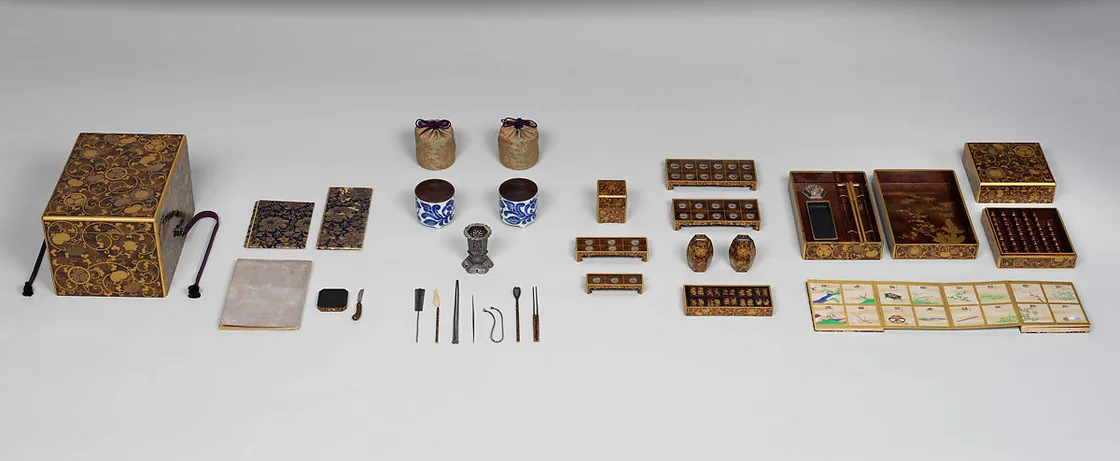
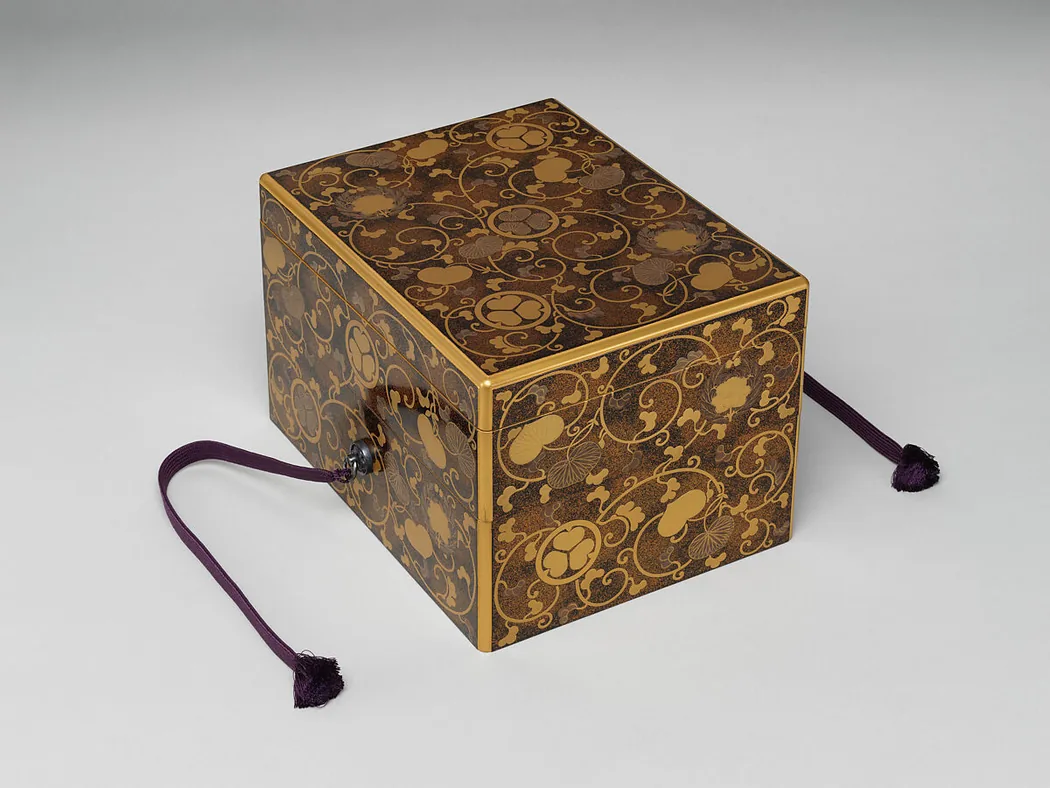
The Met dates the set to 1856, the year Atsu-hime entered Edo Castle as the wife of Tokugawa Iesada, the thirteenth shogun. It was part of her wedding trousseau. The box uses two family crests within the scrolling foliage: the Tokugawa’s circle of wild ginger leaves and the Konoe family’s flowering peony. The museum connects those emblems to the marriage; Atsu had been adopted into the Konoe family. Atsu was born into the Shimazu family. The box bears the crest of her adoptive family, but the Met reads the marriage itself as an alliance between the Tokugawa and the Shimazu.
Three scents to learn, one not introduced
The set is for a ten-round game called jisshukō. According to The Met, players were introduced to three varieties of fragrant wood in a trial, while a fourth was not announced in advance. That is different from simply choosing a favorite fragrance. Recognizing a familiar scent and deciding you have encountered the one you weren’t shown are two different tasks.
A different set at the Cleveland Museum of Art helps explain the visible equipment. Its museum describes a host warming tiny pieces of fragrant wood over hot ash on mica. Guests submit guesses with playing pieces; a game master records the score. The vessels and writing supplies in a set have distinct jobs. This is museum context for the game, not a claim that the exact contents or rules of every historic set were the same.
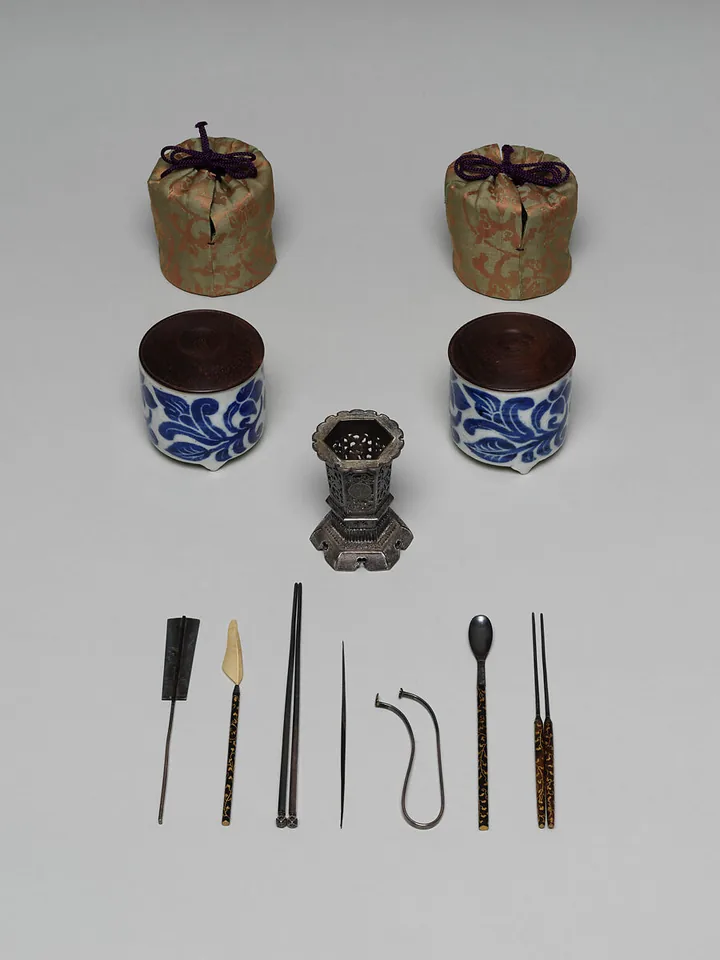
The picture is metal. The box isn’t.
Atsu’s storage box is lacquered wood, not a silver box. The Met catalogs gold and silver hiramaki-e over a nashiji ground. In the museum’s guide to lacquer techniques, maki-e means building decoration with metal powder sprinkled onto damp lacquer. The nashiji ground has a speckled effect likened to pear skin. Here the metal belongs to the finish and the design. It is not a sheet of silver over a vessel, and it is not a silver body.
A separate eighteenth-century incense set at Kyoto National Museum offers a useful contrast: the museum also records silver among the materials of its tools. “Silver” can tell you what part of a design was made from, or what an implement was made from. It doesn’t answer either question until you know which part the description refers to. The Met’s record does not assign a metal to each tool in its group photo, so that identification belongs only to the Kyoto set.
Read the materials one part at a time
If you are documenting a lacquer piece, record the body, decoration, fittings and separate tools in different fields. Photograph each part and where it sits in the box. Don’t assign a metal to an individual powdered detail based only on a photograph, or try to brighten an unknown surface with silver polish.
Compare the lacquer with the iron gourd-shaped incense box. Its maker secured metal sheets in a crosshatched surface instead of sprinkling powder into lacquer. Both objects include silver. The workshop techniques are different, and neither body is made of silver.
See more of the differences in our guide to silver in Japanese decorative arts, or step into a different setting with the little silver funnel in an Augsburg dressing set. There, scent was poured; here, identifying scent was the game.