
Turn it over
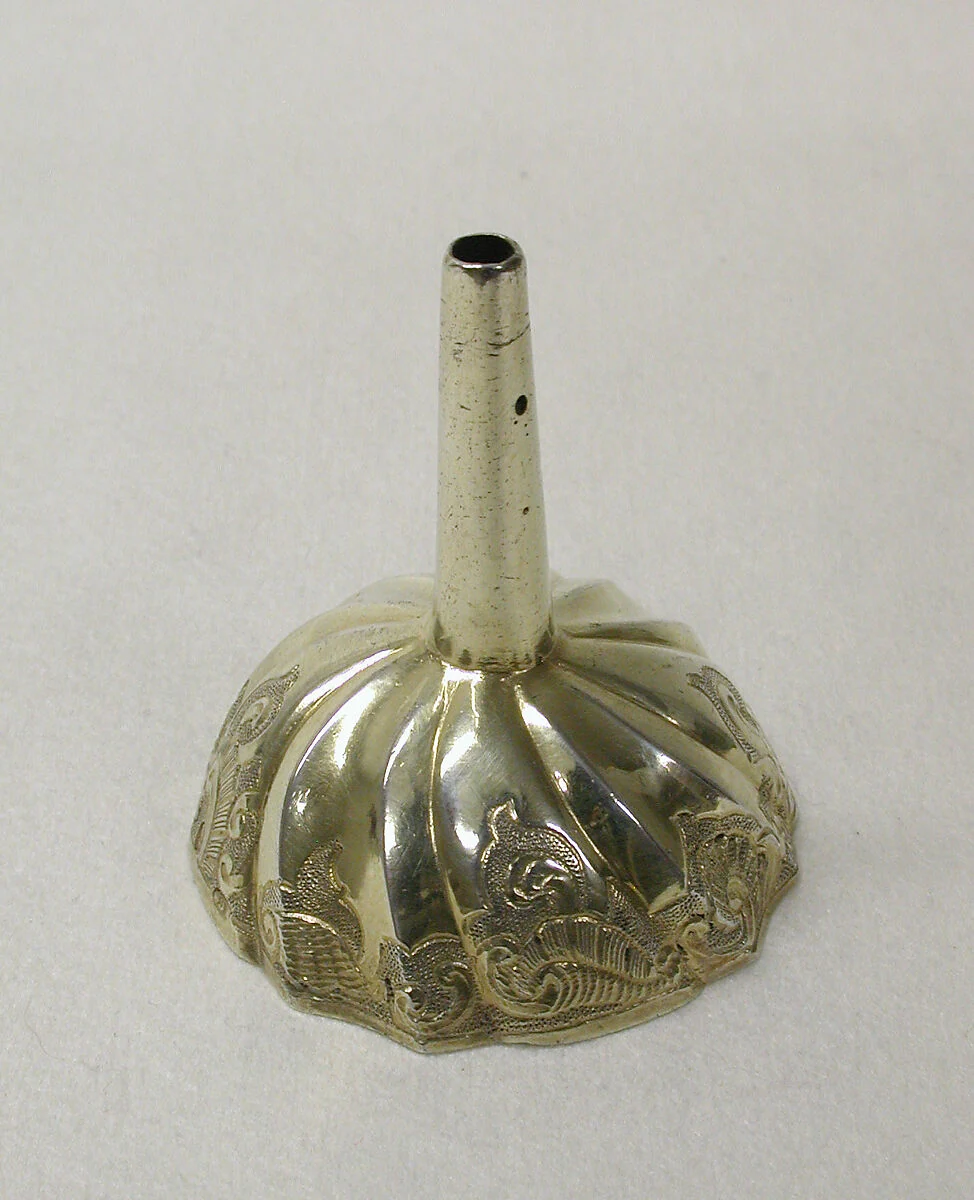
The photograph shows a narrow tube standing on a bell-shaped base. Its gold-colored surface catches the light in broad ribs, with tighter curls of ornament nearer the rim. It could pass for a little candlestick with its cup missing. Now imagine turning it the other way up. The broad part becomes the mouth and the little tube points into a bottle. The Met calls it a perfume funnel.
Johann Christoph Stenglin made it in Augsburg around 1743–45. It is only 5.7 centimeters high and 5.1 across, a tool sized for the neck of a small bottle rather than the mouth of a household jug. The museum calls the material silver gilt: silver with gold on the surface, not a solid gold funnel. The catalogue names the tool without telling us which scent went through it. That distinction leaves plenty to see.
Getting dressed in company
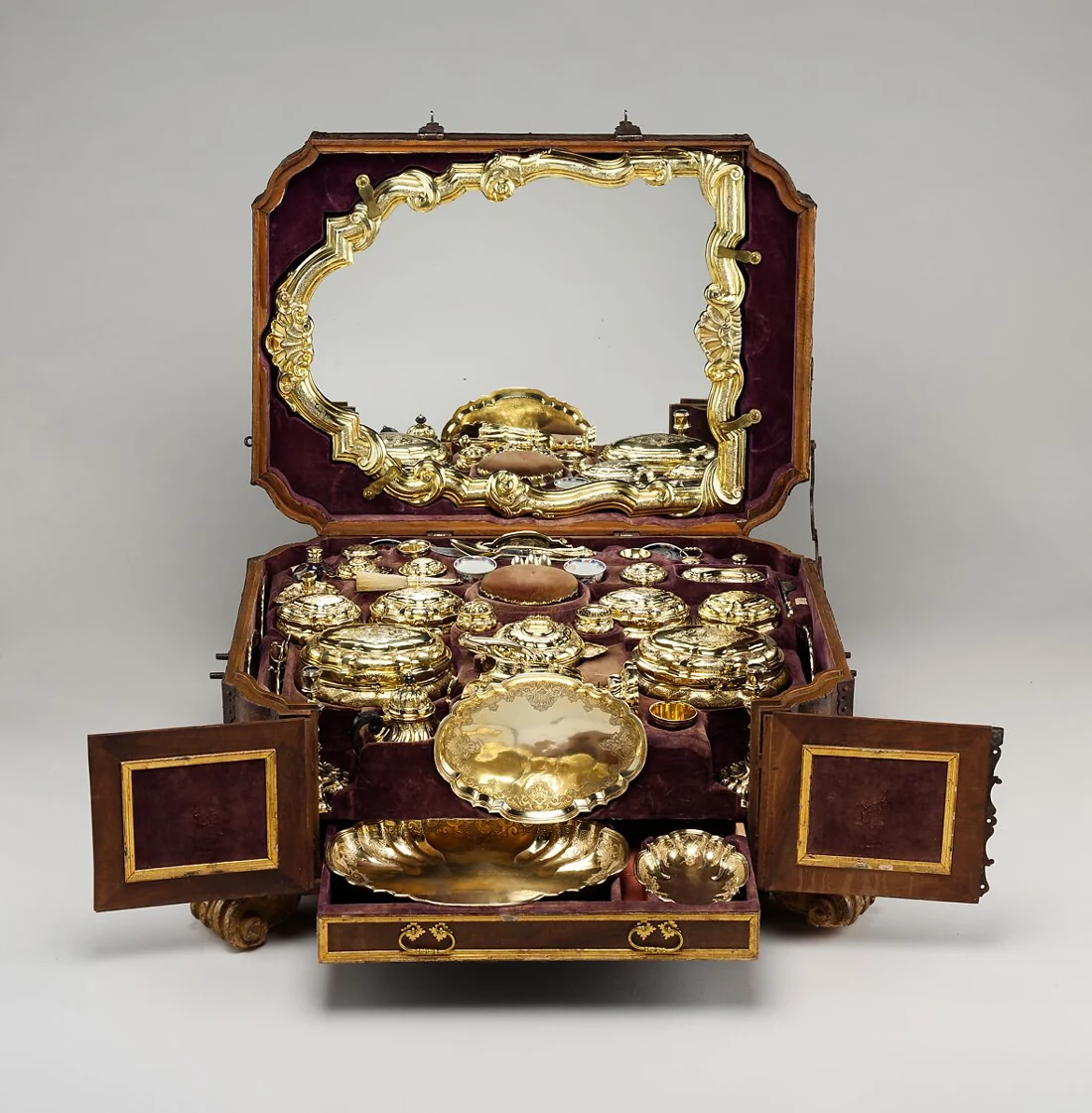
The Met records the funnel as 2005.364.31. Its number falls within the museum’s range for the ensemble, 2005.364.1a–f–.48. This gives a reader something stronger than a resemblance between two gilded surfaces. In the case photograph the raised lid holds a mirror. Open side doors and a shallow drawer reveal more objects, with fitted spaces keeping small fittings close to larger bowls. You do not need to pick out the funnel in the wide photograph to connect it to the set.
For a high-ranking eighteenth-century European aristocrat, dressing could be a ceremony. The museum describes the levée, a formal morning dressing in company, when the accessories an owner handled could advertise rank. The Met traces this ensemble to the counts Schenk von Stauffenberg at Schloss Jettingen. It also describes elaborate sets of this kind as customary wedding gifts given to a bride the morning after the wedding. That is background for the form, not a marriage record for this particular case.
The case made separate tools visible as a group. Even a funnel mattered in a routine that turned the private act of dressing into a performance: it had an ordinary job, it had to be close at hand, and it had to look at home among the other objects.
One case, many makers
Stenglin’s name belongs to the funnel. It does not go on the label for everything under the mirror. The Met identifies fourteen Augsburg goldsmiths across the ensemble, as well as other German artisans and a Japanese maker of Imari porcelain. Its list of materials runs from gilt silver and cut glass to leather, wood, steel and hog’s bristle. Each was there to do a particular job.
Compare Samuel Bardet’s later Augsburg set in our fitted travel and dressing sets guide. Its leather case protects a glass beaker and dining tools, not the equipment for a ceremonial toilette. The cases look like related feats of packing. Their contents answer two quite different questions about what the owner expected to do.
What a perfume vessel can tell us
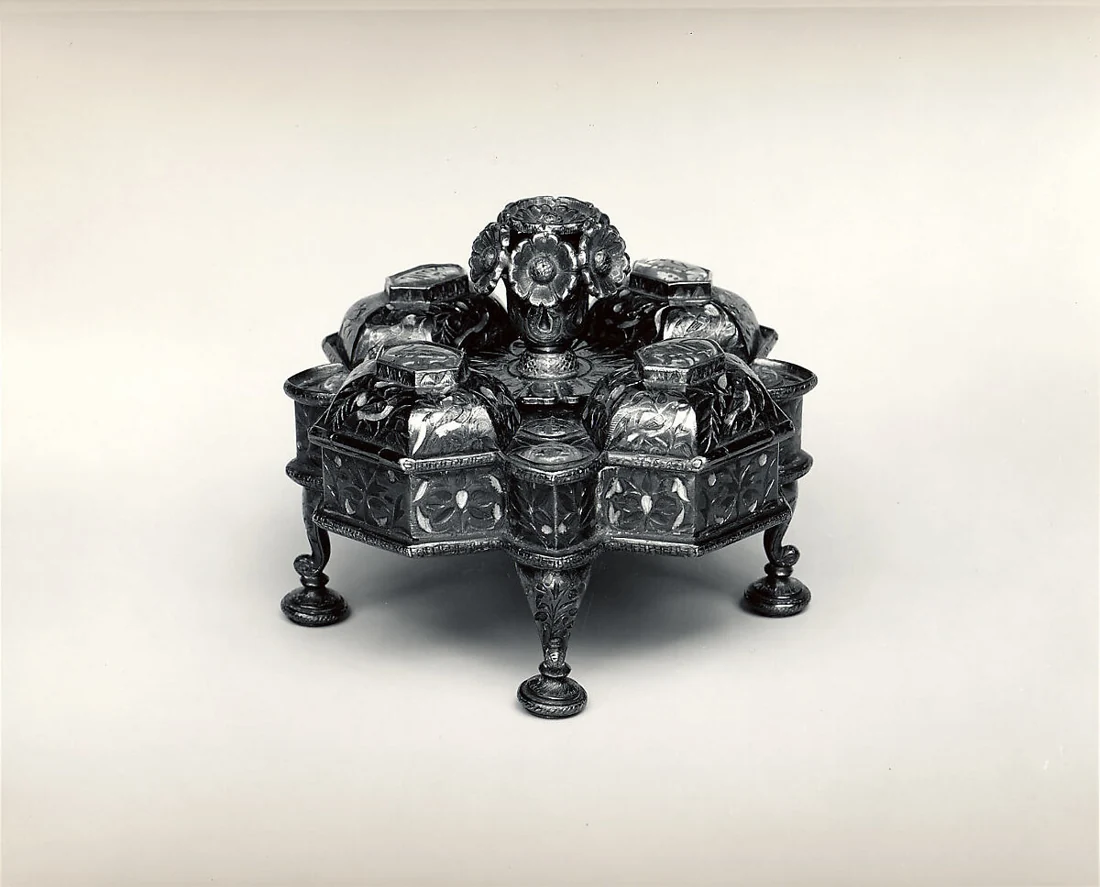
The Met’s perfume container made in Lucknow, in present-day Uttar Pradesh, around 1860 is another way into the subject. The photograph shows a floral central fitting surrounded by a cluster of capped forms. The museum lists silver alloys, enamel and glass. It does not name a fragrance, an owner, or a connection to the Augsburg ensemble. This is a comparison between two kinds of evidence, not a story of one borrowing from the other.
On the funnel, the open tube and broad mouth point to transfer from one vessel to another. On the Lucknow object the museum’s identification points to containment, but the photograph alone is a poor guide to what each element held. A photograph of a chatelaine can pose the same problem: it shows how tools hung together without telling you which are missing, or even which ones began their lives together.
Read the small parts separately
When an old case turns up, take a complete photograph before lifting anything. Record what each recess holds, photograph visible marks on each piece, and separate what fits today from what a catalogue, inventory or early photograph proves once belonged. If the lining is fragile or a fitting resists, leave it in place. A mark on one silver part does not name the maker of the glass, the case, or every tool inside it.
Back at the mirror, the little funnel can tell us something the whole case cannot. The case shows the scale of the display. The narrow tube shows the scale of the task: someone had to get a liquid into a bottle whose neck was very small.
Sources and museum photographs
- The Met: Stenglin perfume funnel, 2005.364.31, maker, date, measurements, material and object photograph.
- The Met: toilet set in original leather case, 2005.364.1a–f–.48, makers, components, provenance, ceremonial use and photograph.
- The Met: Lucknow perfume container, 1982.142.1, date, origin, materials and photograph.
All three photographs are public domain under The Met’s Open Access policy.