
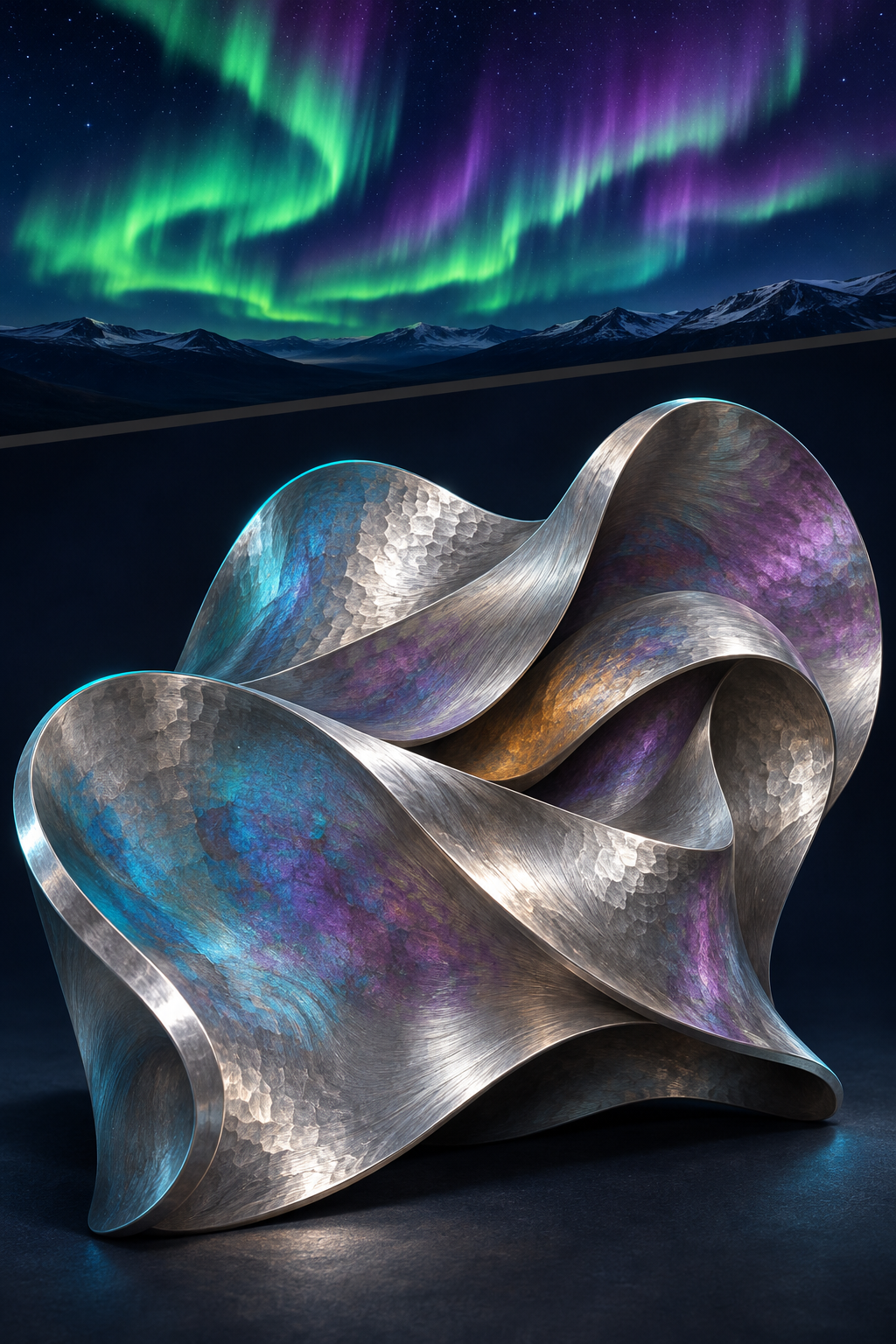
A shared palette invites a closer look
A ribbon of green and purple across the night sky can bring a colorful silver piece to mind. Both reward looking closely. The resemblance is a starting point for curiosity, though, rather than evidence that the colors have the same cause.
On a tarnished silver surface, a thin layer can change the mixture of light reflected toward your eye. In an aurora, excited atoms and molecules high above Earth release light. Keeping those mechanisms separate makes each more interesting.
A very thin layer can change silver’s appearance
The Canadian Conservation Institute explains that silver reacts with sulfur-containing gases to form silver sulfide tarnish. Sterling silver can also develop copper sulfide because of the copper in the alloy. The surface chemistry matters, even when the visible result is an attractive color.
When that tarnish layer is thin, some incoming light reflects from its upper surface and some travels through it and reflects from the silver beneath. The reflected light recombines. Interference changes which colors remain prominent, with the result depending on the layer’s thickness.
This helps explain yellow, red-brown and blue stages during tarnishing before a thicker layer appears black. The sequence describes a changing surface film. It is not a universal chart assigning a particular color to a particular heating temperature.
An artist can make the surface part of the design
Patination can be deliberate. Jewelry maker Lora Hart’s “On the Surface,” published in Studio PMC, describes using liver of sulfur to develop colored and dark finishes on silver jewelry. The treatment creates a surface effect; it does not turn the whole object into a different-colored metal.
A dark finish can also emphasize texture. Tiffany describes its “oxidized silver” as deliberately tarnished and warns that silver polish will strip that finish. In this jewelry vocabulary, “oxidized” is a finish description, not proof that the colored layer is simply silver oxide.
Color is not a reliable thermometer for a silver object. The material, surface condition and treatment must be understood before explaining a result. A finished piece’s color alone does not reveal the maker’s temperature, method or sequence of work.
The aurora makes light in the upper atmosphere
NOAA explains that electrons become energized in Earth’s magnetic environment and follow magnetic field lines toward the polar regions. When they collide with oxygen and nitrogen in the upper atmosphere, they can transfer energy to those atoms and molecules. Light is released as the excited gases return to lower-energy states.
NASA describes green and red auroral light from oxygen, while nitrogen can contribute blue and pink. The gases involved, their altitude and the energy of the interactions affect the display. Emissions can also appear to mix, producing colors such as purple or white.
The visible glow is therefore being emitted by the atmosphere. It is not a metallic tarnish layer reflecting a rainbow, and silver does not cause the aurora. A similarity in color is a visual comparison, not a shared chemical process.
Enjoy the color without erasing the surface
For collectors, the useful next question is whether a surface is original, deliberately finished or changed during storage. The Canadian Conservation Institute notes that some medals were issued with patinas, paint or enamel, and that these original surfaces should be retained. Color can be part of an object’s intended appearance.
Before polishing an unfamiliar piece, check its maker’s description and care guidance. Keep treatment experiments away from collectible coins, antiques and valued finishes. An attractive surface is not a reason to assume it needs improvement, and a photograph alone cannot establish exactly how it was made.
The invitation from the original article still stands: look for color, in the collection and in the sky. Knowing whether you are seeing altered reflection or emitted light gives that shared palette a richer story.
About this edition
Original source and editorial notes
Adapted from original material by Rich Silver. Original publication: Color Transformations: Silver Artistry and Aurora Displays ↗ (2024-05-11).
Reviewed 2026-11-05. Adapted from the article published May 11, 2024. Preserves its comparison of colorful silver and auroras while separating surface chemistry and thin-film interference from atmospheric light emission. Removes the unsupported temperature-to-color heating sequence. Intentional patination is distinguished from conservation of an existing object; this is an explanation, not a workshop treatment recipe.
Sources & further reading
- Lyndsie Selwyn, Canadian Conservation Institute: Understanding how silver objects tarnish, especially Interference colours ↗
- Lora Hart: On the Surface, Studio PMC, Fall 2006, printed pages 5–7; patinas on pages 6–7, hosted by Rio Grande ↗
- Tiffany & Co.: How do I care for oxidized silver? ↗
- NOAA Space Weather Prediction Center: Aurora, explanation of electron excitation and light emission ↗
- NASA Science: Auroras, Why Are Auroras Colorful? section ↗
- Canadian Conservation Institute: Basic Care of Coins, Medals and Medallic Art, CCI Notes 9/4 ↗