
The silver went to New York
The silver was supposed to go to Minneapolis. Instead, in June 1926, it went to New York, where the man hired to find it could show it to people who knew American silver. His name was Lloyd Hyde. In messages to the museum director, he gave two reasons for changing the route: he wanted to satisfy himself that the pieces were genuine, and he thought having them in hand would help him trace what was missing.
Then Hyde showed the silver to Francis P. Garvan, a prominent collector and Yale benefactor. James Ford Bell, the Minneapolis buyer, hurried to New York. As historian Jennifer Carlquist reconstructs from museum correspondence, Bell worried Hyde might sell to Garvan instead. The record supports Bell’s concern, not an attempted purchase by Garvan. Still, it is a wonderfully awkward moment in the life of a museum object: the man meant to bring a scattered set back together had made his own buyer wonder where it might go next.
Made to be seen together
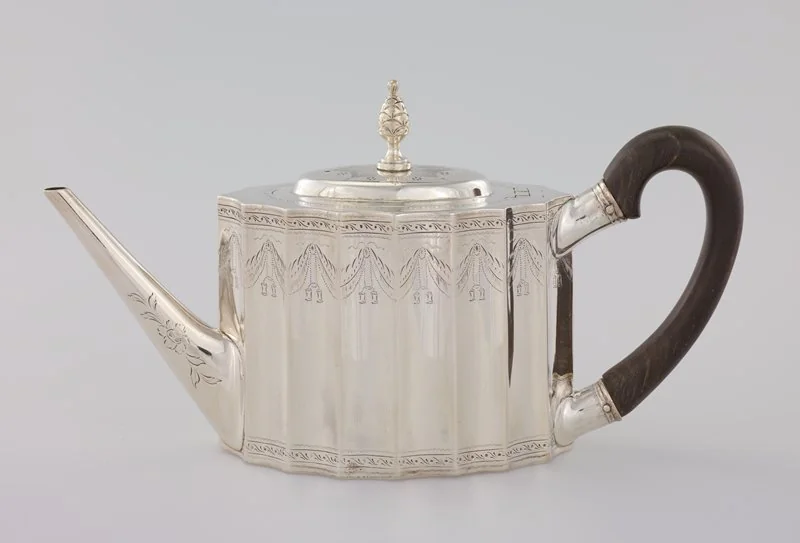
Paul Revere’s workshop created the service in 1792–93 for John and Mehitable Templeman. Look at the teapot: a dark wooden handle stands clear of the body, a run of shallow vertical flutes catches the light, and engraved garlands dip across the silver. The same design vocabulary ties the service together despite the different work each vessel had to do.
The workshop used rolled sheet silver for the main vessels and stands. The lid ornaments and small stand feet were cast separately. The fluted walls and the solid ornament on the lid appear together in the photograph, but they represent different jobs at the bench. The finished vessel makes those decisions easy to overlook. The museum records that the sugar urn and stands carry the Templemans’ intertwined initials, JMT. Those letters name the household; the workshop’s REVERE stamp identifies the maker. The entries in Revere’s ledger are a third kind of evidence: what the customers ordered. No one clue does the work of all three.
A service without a single owner
Inheritance had put pieces in different hands. Descendants in Michigan and Minnesota sent letters and photographs east in 1926, one to Boston’s Museum of Fine Arts and one to the Metropolitan Museum of Art. Meanwhile, news reached Minneapolis. Museum director Russell Plimpton enlisted Bell to buy the silver and Hyde to locate the components and negotiate on Bell’s behalf.
A matching design helps you see why the vessels belong together. It does not explain which objects took which routes, and it cannot tell you who had the right to sell each one. For that, Hyde needed people and their records. After the New York episode, Bell and Plimpton kept working with him, asking him to trace further Revere pieces with Templeman descendants in Baltimore. The deal went through, and the partnership survived the detour.
The Bells lent the service to the Minneapolis Institute of Art and gave it to the museum in 1960. Yet the 1960 gift was not the last chapter. Mia records that two original teaspoons came back into the group much later. One, accession 94.88.1, carries Charlotte Y. Salisbury’s name in the credit line rather than the Bells’. Both names belong in the story. The year a spoon enters a museum does not tell you when it left a family’s table.
The key that stayed with the caddy
By the late 1940s, before the Bells gave the silver to the museum, museum educator Marjorie Benecke was using the silver to teach fourth graders. She showed them how to open the tea caddy with its little key. It had survived with the lock. The most conspicuously precious thing on the table was the silver, but the lock guarded something someone could use up that afternoon: loose tea. A small shell-shaped scoop measured the leaves.
A service is often pictured as a parade of polished objects. Here the surviving key brings it back to a task someone once did at a table: open the box, scoop the tea, close it again. It also puts the later hunt in perspective. Even after the service was scattered, the key and the lock still belonged together.
What to keep with an inherited set
If you inherit silver that is supposed to match, make two records. First, photograph the group as it came to you, including the pieces you suspect were added. Then give each object a line of its own: what it is, where it is marked, what its owner’s initials look like, and who last had it. Keep old photographs, receipts, labels, and handwritten notes with those records. If the family account and the marks suggest different things, write down both before choosing a version.
A group can be genuinely old, genuinely associated with one family, and still contain objects brought together at different times. Collector language like “original to the commission,” “later family addition,” and “association not yet documented” lets each piece keep the history you can actually support.
Keep exploring
Sources
Read the records behind the story
- Mia: collection record for the Templeman teapot.
- Mia: Paul Revere Tea Service, for workshop techniques, initials, and the caddy and scoop.
- Mia: Unlocking American history, for the Gallery Club lesson, loan, gift, and later teaspoons.
- Jennifer Carlquist’s study of J. A. Lloyd Hyde, printed pp. 23–28, for the 1926 disposition and reconstruction based on contemporaneous Mia correspondence.
- Mia: one returned teaspoon, accession 94.88.1.
- American Antiquarian Society: Beyond Midnight, catalogue no. 42, for the service date and accession groups.