
The Name Under the Cup: Four Clues to a Roman Silver Hoard
A narrow spoon, a worked spout, and marks out of sight. Follow four clues to see what ties a group of Roman table silver together.
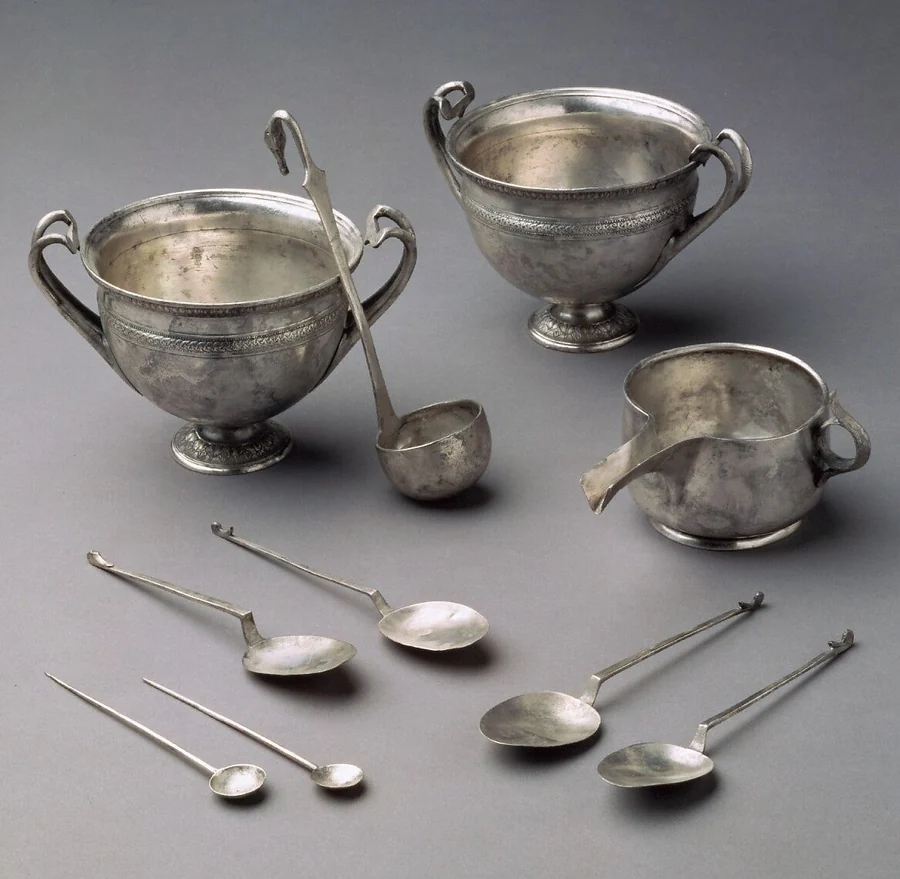
There is a story in the way a piece of silver is shaped. But a spoon cannot tell you where it was dug up, and a pitcher cannot tell you who owned it. What happens when several objects start to tell the same story?
The Met dates this Roman tableware to the mid-first century BCE. The collection is called the Tivoli Hoard after its reported findspot near Rome, not a securely documented excavation. Start with the silver in front of you and work toward the evidence you have to turn it over to see.
The countdown
4 in the countdown
A point suggests a purpose
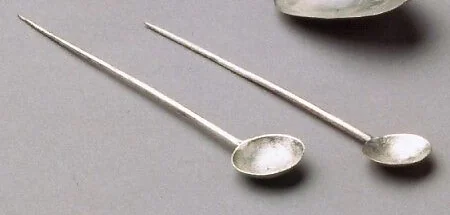
Two pointed spoons at lower left, cropped from The Met’s group photograph. The Metropolitan Museum of Art, Rogers Fund, 1920, 20.49.2–.12. Public Domain. · Image credit and rights Shape A clue to use, not identity
The two pointed spoons at lower left look different from the broader spoons nearby. The points could help lift food out of a shell. The Met discusses snails, shellfish, and eggs for this kind of spoon. The shape helps explain the kind of tableware we are looking at. It cannot say what someone ate or who sat at the table.
Museum record: The Met · pointed spoon · The second pointed spoon
3 in the countdown
The spout shows how it was made
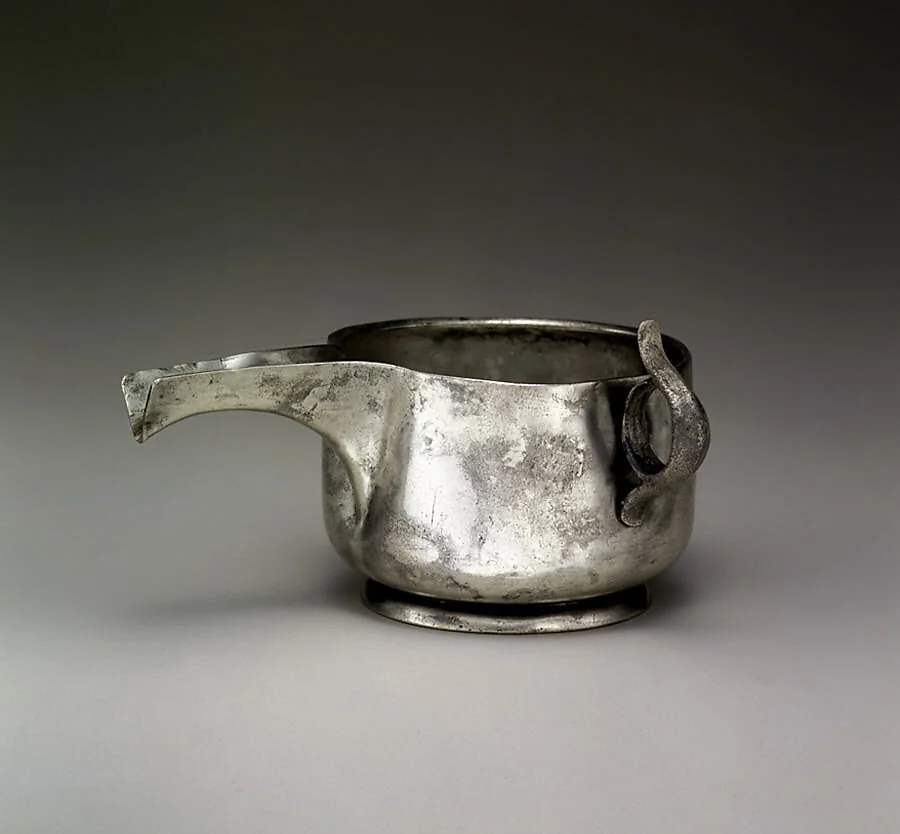
Silver spouted pitcher. The Metropolitan Museum of Art, Rogers Fund, 1920, 20.49.4. Public Domain. · Image credit and rights Construction A clue in the worked metal
The long, channeled spout guides the pour. The ring handle was soldered to the side, a joint The Met’s published study identifies. The object carries no known inscription. Its form and workmanship can be compared with other Roman table silver, but neither names an owner.
Museum record: The Met · spouted pitcher · Curatorial study, figure 3
2 in the countdown
A duck head leads to a mark
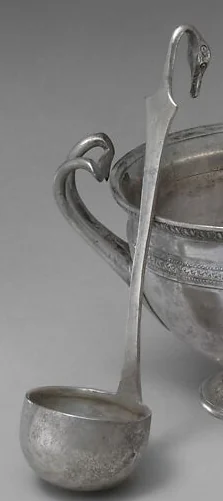
Ladle in a crop from The Met’s alternate group photograph. The inscription is not readable here. The Metropolitan Museum of Art, Rogers Fund, 1920, 20.49.5. Public Domain. · Image credit and rights Dotted inscription A name and a weight
Follow the ladle’s handle up to its hook, which ends in a little duck’s head. The museum’s published study identifies a dotted inscription near the handle’s top and reads it as a name and a weight. The photograph shows the handle, not legible lettering. Does that same name appear on a different piece of silver?
Museum record: The Met · ladle · Curatorial study, figure 2
The grand finale
1 in the countdown
The name appears under both cups
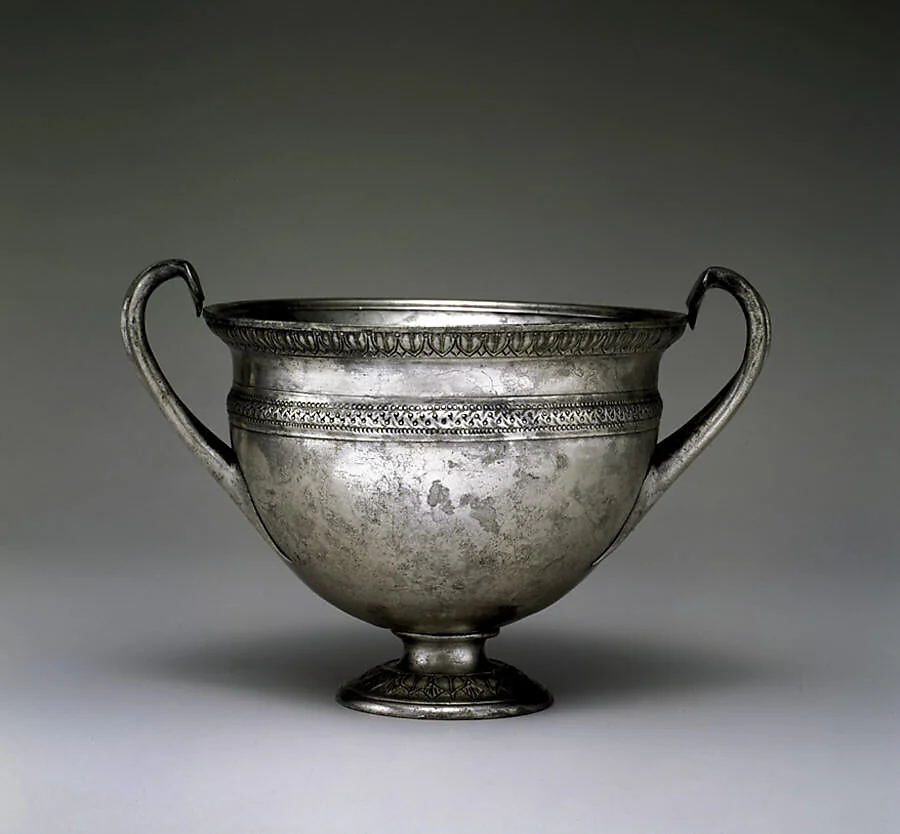
One of the two inscribed cups. The inscription underneath the foot is not shown. The Metropolitan Museum of Art, Rogers Fund, 1920, 20.49.2. Public Domain. · Image credit and rights Sattia The pair bears the same name
The two cups carry dotted inscriptions beneath their feet. Both name Sattia, and both record the stated weight for the two cups together, not the weight of one cup. The museum reads the name as Sattia, daughter of Lucius. Its catalog also reads Sattia’s name on the ladle. That is a specific connection between marked pieces, not a name we can assign to every object in the group. What looks like a decorative matching pair from above has much stronger evidence on the side diners were least likely to see.
Museum record: The Met · first drinking cup · The second drinking cup · Curatorial study of the inscriptions
You’ve reached number one.
Back to the JournalHow the clues are ordered
The four clues move from shape and manufacture to the stronger evidence of inscriptions. This is not the order of discovery or a ranking by size or value.
The catalog groups the table silver by technique, style and marks on some of the pieces. The cups are an inscribed pair; that evidence does not establish the precise findspot, common burial circumstances, or a single owner for all the unmarked pieces.