
Look beneath the tines
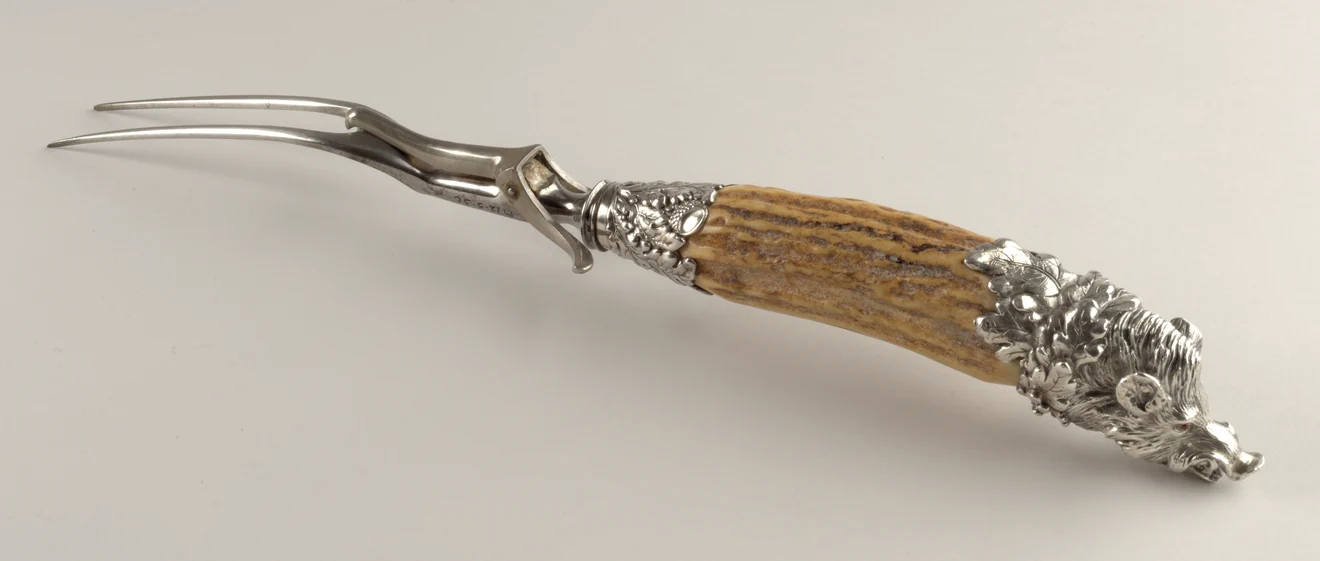
The boar’s head is the part you notice first. The part that changes how the fork behaves is at the other end of the handle. Look beneath the steel shaft near the tines. A small hinged rest folds out so the handle and the support can hold the fork’s working end above the table. Fold it away and the extra piece lies close to the shaft. It’s a little solution to the question of where to set the fork down between cuts.
Cooper Hewitt records this example as a Gorham Manufacturing Company fork from Providence, Rhode Island, made in 1900. The larger of two cataloged forks, it measures 31.5 centimeters. The ridged, amber-brown handle is cataloged as antler and ends in a silver boar’s head. The steel tines are the part that holds the food. A sterling mark on the underside of the boar belongs with the silver terminal; it doesn’t turn the antler handle or the steel into sterling. The photograph shows the hinged piece projecting from the shaft.
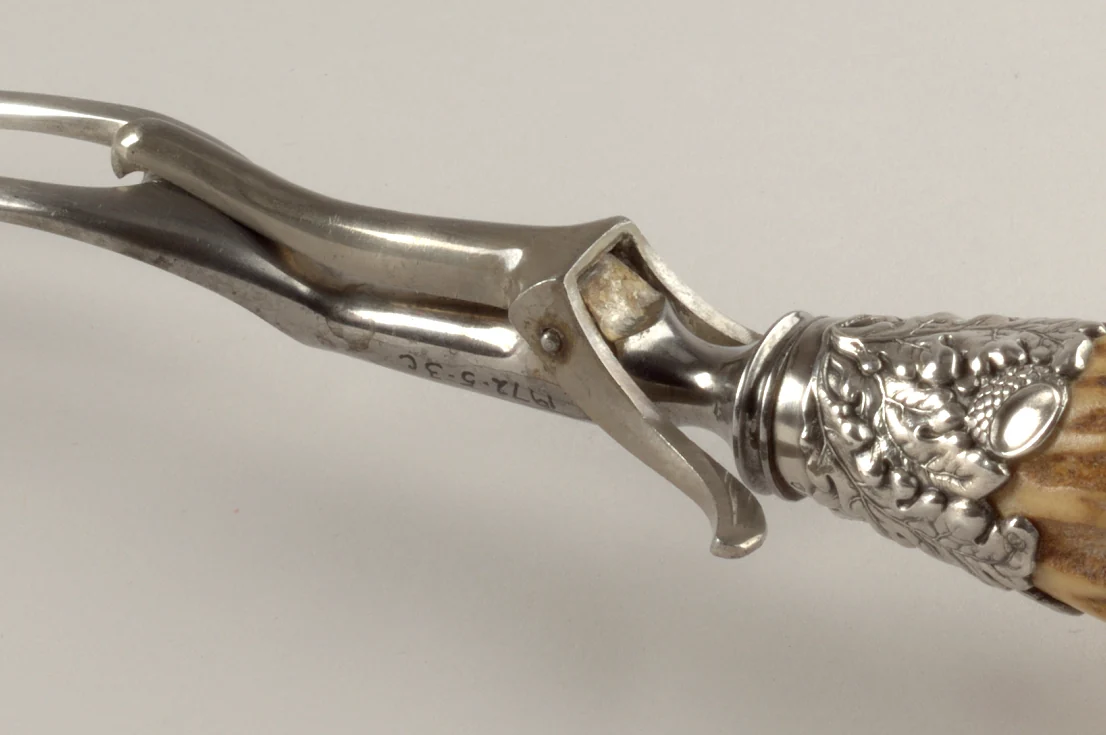
The dates are on different parts for a reason
The catalog transcribes “PAT.JUL.13.80.” and “MAY 29 83” on the hinged rest. A bell-like date symbol near the base of the handle is the mark the museum reads as 1900. The earlier numbers aren’t the production year of the whole fork.
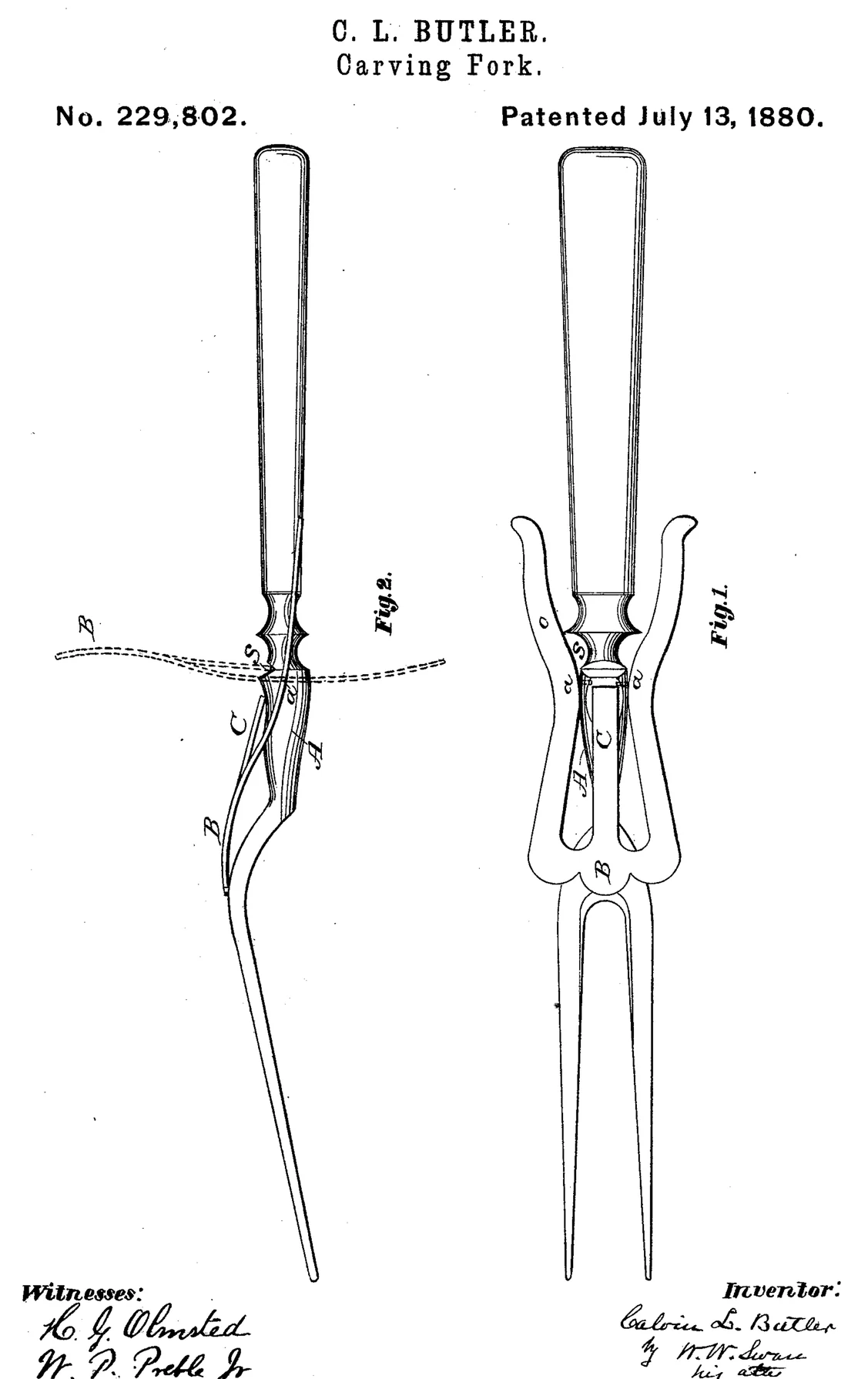
Calvin L. Butler’s carving-fork patent was granted on July 13, 1880. It shows how a hinged attachment worked on a carving fork of the period. That date matches one of the Gorham inscriptions, but the patent plate is not a drawing of this object. The second date, May 29, 1883, remains a clue rather than an identified patent. For another way to read dates that don’t mean what you expect, see Five Coin Dates That Need a Second Look.
When the carver held the bird up
Setting down a fork is one problem. Holding a roast in the air while cutting it is another. At some elite European tables, a skilled carver would spear a joint or fowl and carve it aloft. The Fitzwilliam Museum describes the performance as carving in alto, or aloft. Its early eighteenth-century carving set has long, notched steel tines and square silver grips: one part held the food, the other helped the hand keep its hold.
A 1593 edition of Vincenzo Cervio’s carving book places a turkey and a peacock on the same illustrated page. Lines on the birds mark where the cuts go. What the drawing doesn’t show is how much practice it took to keep a roast steady in the air. The two forks solved different problems. The long tines helped a carver keep a roast in the air. The folding rest helped when the work stopped. The record doesn’t tell us what this Gorham fork actually carved.
What to look at on a carving set
Look along the shaft for a pivot or support, then turn the handle over to see which component carries the mark. Photograph both locations. List the materials by component, and distinguish a patent inscription, a maker’s mark and a maker’s date symbol. Don’t force a stiff hinge or immerse the handle to clean around it. See more specialized utensils at The Silver Table, compare flatware materials, or read our guide to caring for mixed-material silver.