
A kookaburra for laughter
The horseshoe meant luck. The kookaburra meant laughter. Both are still sewn to a Christmas pudding charm card at Museums Victoria, along with a ring, a thimble, a wishbone, a money bag and a button. The little animals and objects weren’t ornaments for the tree. They told you what sort of year you might have, depending on which one turned up in your slice.
That is one Australian version of the custom, preserved in a card the museum dates to about the 1950s. The ring promised marriage, while the thimble carried a less generous prediction by modern standards: remaining unmarried. The same shape did real work in a sewing box. On this card, the miniature thimble had a completely different job. Compare it with the full-size tools in Beryl Collett’s thimble collection.
We know what the card promised because the words survive with the objects. We don’t know who first bought it or whether the charms ever came off the card before it entered the collection. That makes the packaging as useful as the silver. A loose miniature horseshoe could be almost anything; here, you can see what it was sold to do. See the original charm card at Museums Victoria.
The Sunday before Advent
Stir-up Sunday has a church calendar behind it. It falls on the Sunday before Advent, and the name comes from the opening words of an Anglican prayer. The recipe wasn’t in the prayer. But those words made a handy reminder that Christmas pudding needed a head start.
The Royal Mint traces the British sixpence custom to the Victorian era. In its account, family members took turns stirring and making a wish. Whoever found the sixpence was supposed to have good fortune in the year ahead. The reward wasn’t only the value of the coin. A bit of change had become a way for one slice of pudding to tell a different story from all the others.
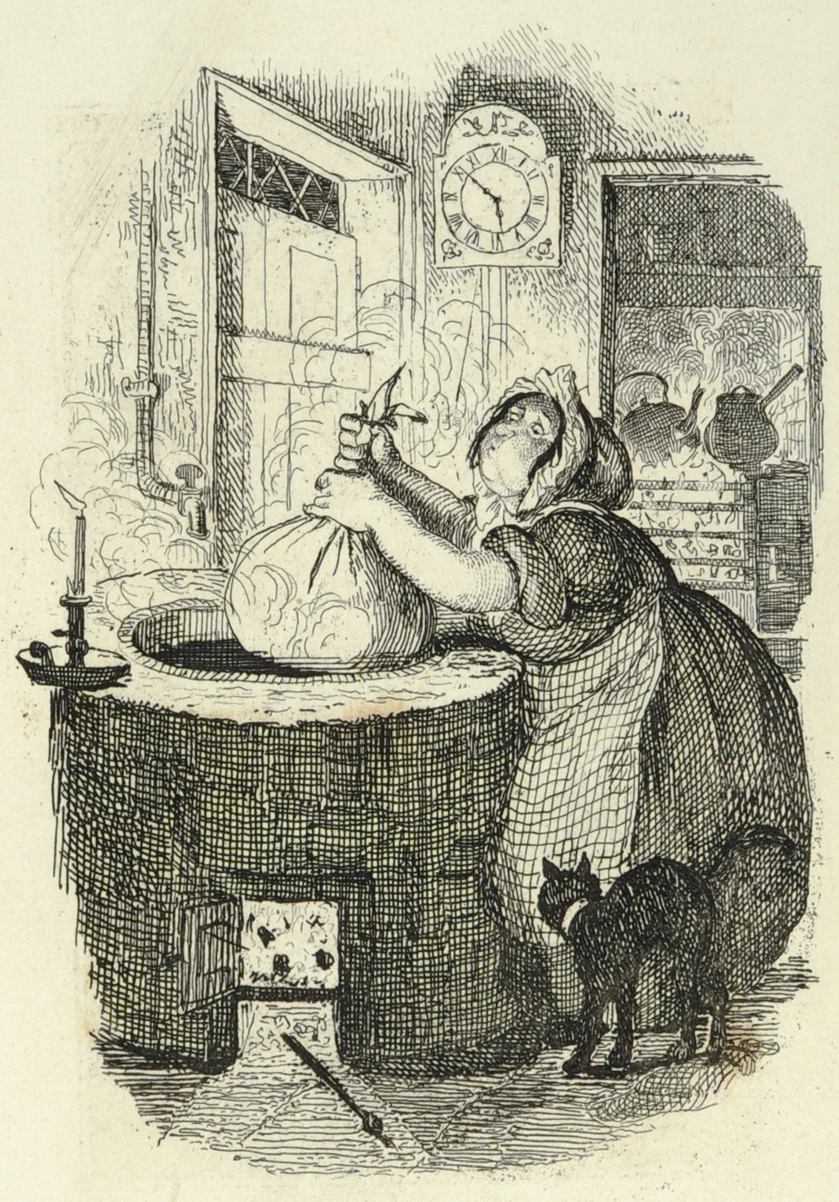
In Robert Seymour’s engraving, the pudding is still tied in a cloth, about to go into a large boiler. It’s the work behind the dining-room moment. Silver at the holiday table doesn’t have to be a large or expensive centerpiece. Here, the smallest thing at the meal was the one nobody could see. Explore more of that history in The Silver Table and the ornament collection.
Is an old sixpence actually silver?
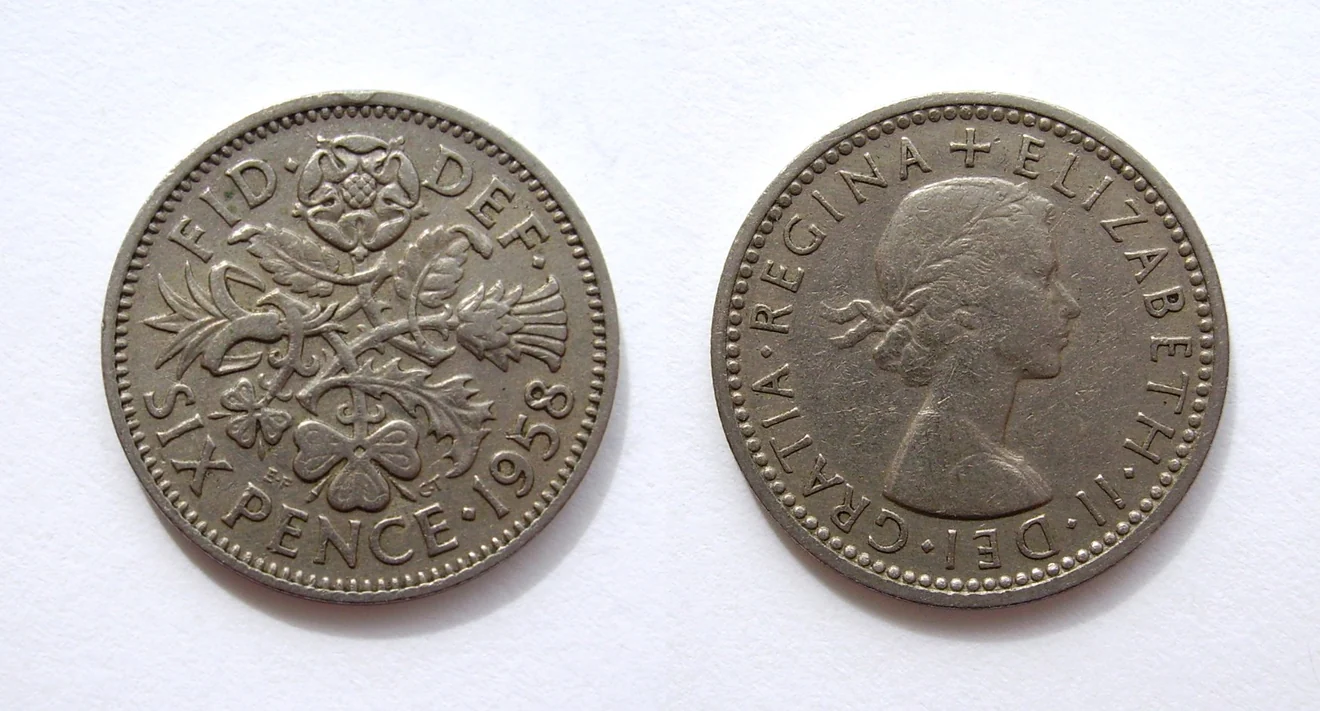
Check the date and the country before calling it sterling. British circulating sixpences went from sterling (.925) to half silver (.500) in 1920; the Royal Mint Museum records the first strikes of the new alloy in April, and 1920 is a transition year. The last circulating .500 silver issues were dated 1946. From 1947, ordinary British sixpences were cupro-nickel, a copper-and-nickel alloy without silver. A 1947 sixpence could still look silver-colored and still go by the same name. Look at a documented 1947 specimen at Museums Victoria.
Those dates don’t apply to every country that issued sixpences, or to modern collector pieces. Start by photographing both faces and keeping any holder, card or family note. A label that says “Gran’s pudding coin” is family history, not a metal analysis. It’s worth preserving both the family story and the information that identifies the coin.
From X-ray film to a proof coin
The Royal Mint revived the sixpence for collectors in 2016 as six decimal pence, not six of the old pennies. In 2024 it announced a small first run using silver recovered from X-ray film. Some of those coins went to the 2025 Trial of the Pyx, where the Mint submits samples for independent checks. The Mint said the silver in that batch came from expired medical and industrial film.
Its 2026 Christmas sixpence is a separate collector issue: a proof, 19.41 millimeters across and 3.35 grams in total, struck in .925 sterling. The Mint identifies the source of its silver as recycled X-rays. That doesn’t make all 3.35 grams silver, and the film source doesn’t tell us where the alloy’s other metal came from. See the 2026 issue in the Mint’s catalog.
If you’ve ever wondered what actually happens to the silver in old film, most of the time we can only talk about quantities. A published recycling estimate can tell us how much metal came back out of a category, not where an ounce went next. This time we can point to a finished object. Silver once used to make images now carries one struck into its surface. Follow the larger story in Where Did 197.6 Million Ounces of Recycled Silver Come From?.
Keep the wish, not the surprise
This is a collecting story, not a recipe. If a sixpence or pudding charm comes out for Christmas today, display it beside the pudding rather than hiding it in food. You can still tell the story, make a wish and pass the coin around. And nobody has to watch the fork.