
Turn the thimbles over
From above, eight thimbles look like variations on a circle. Turn them sideways and it’s harder to mistake one for another. A band of shell catches the light at the rim of one. Solder interrupts the pattern on the crown of another. On a third, letters stamped into the metal point to a maker who tried to solve a problem familiar to anyone who spends hours sewing by hand.
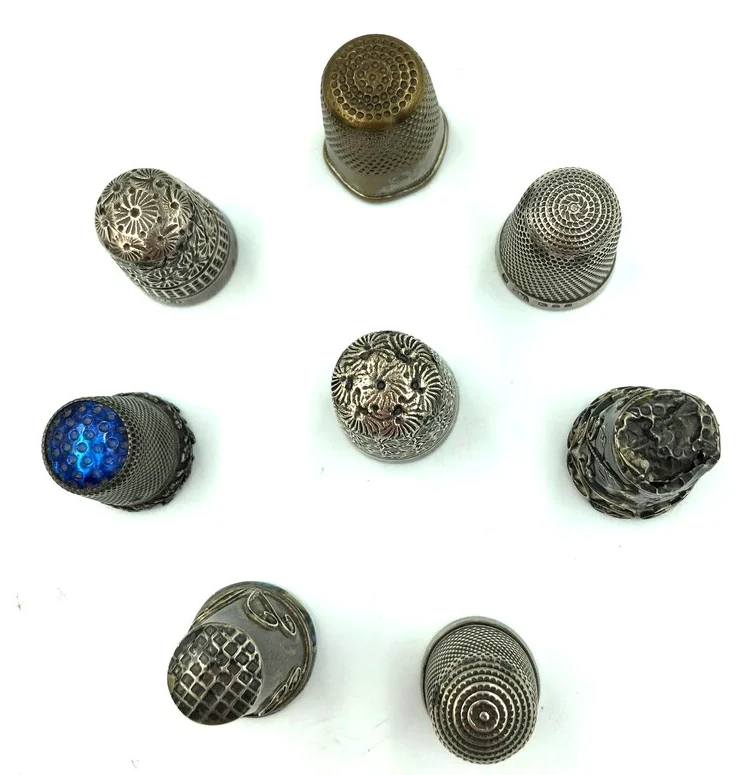
These thimbles belonged to Beryl Collett, a needleworker and lacemaker from Kallista, Australia. She learned handicrafts from her mother, Hettie Collett, a milliner. The museum’s group record says some of the thimbles may have belonged to Hettie first. It doesn’t say which. We know who kept the group, but the pieces don’t all have the same history. The clues are on the objects themselves.
One seam, two different stories
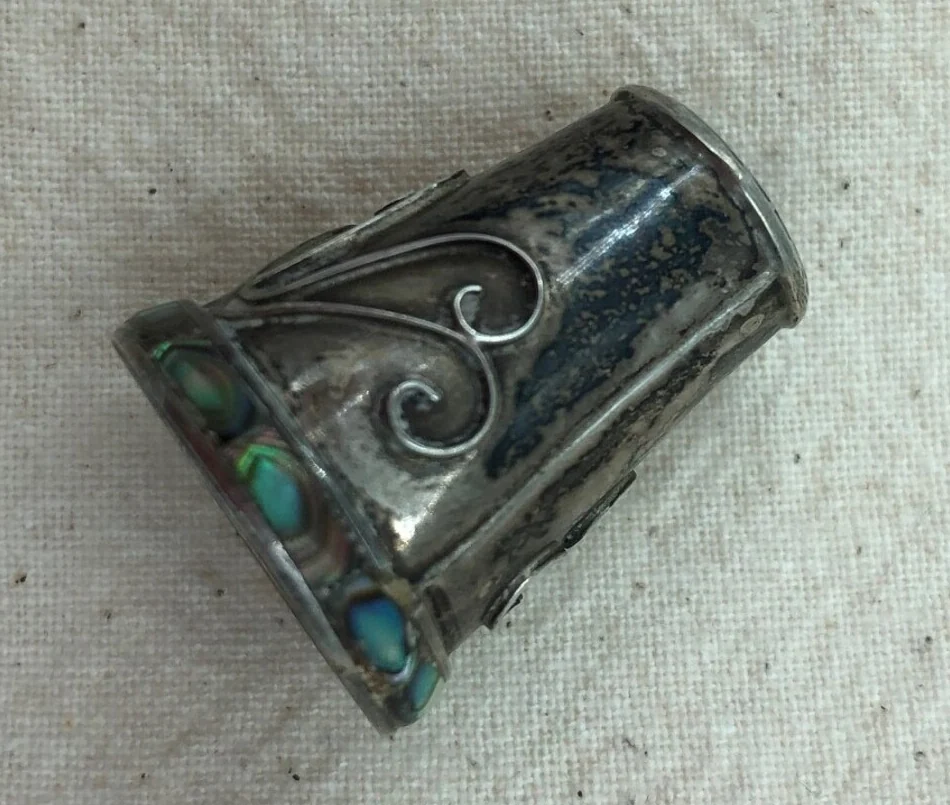
The museum catalogs two of the eight as handmade sterling silver from Taxco, Mexico. On the first, VEMU2107.7, scrolls decorate the side and a narrow band of abalone wraps around the rim. Small indentations cover the crown. The side seam is visible in the museum’s photograph. Inside, the catalog records a four-digit number and other marks that it could not read clearly enough to name a workshop.
The second, VEMU2107.8, is similar in size and also has a side seam, but there’s no shell band. Its most revealing detail is on top. Solder covers part of the crown where the museum records a repair. The seam and the solder patch belong in different lines of an object record: a seam may be part of construction, while the patch tells us the crown was worked on later. It doesn’t tell us who wore it down or who mended it.
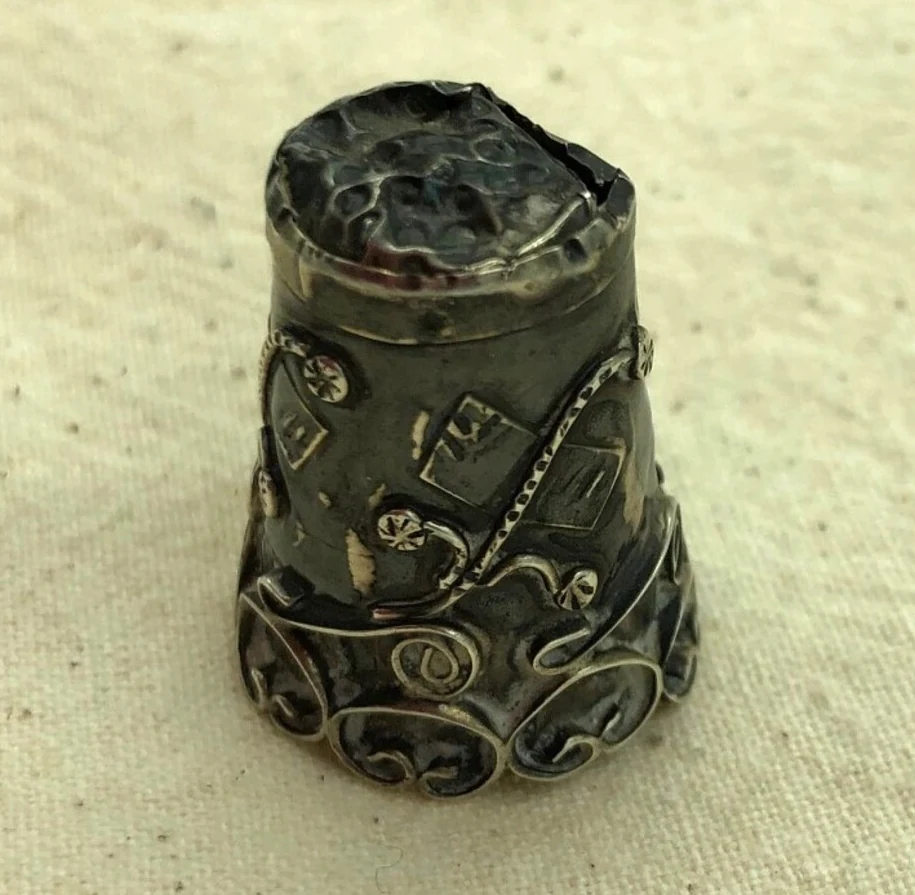
The museum records “15” inside the repaired thimble, followed by marks it couldn’t decipher. It’s tempting to turn a legible number into an identification, but a bare number isn’t a workshop name. The Taxco attribution guide shows why the whole mark and the piece carrying it matter more than the clearest characters alone.
A familiar problem, hidden in the wall
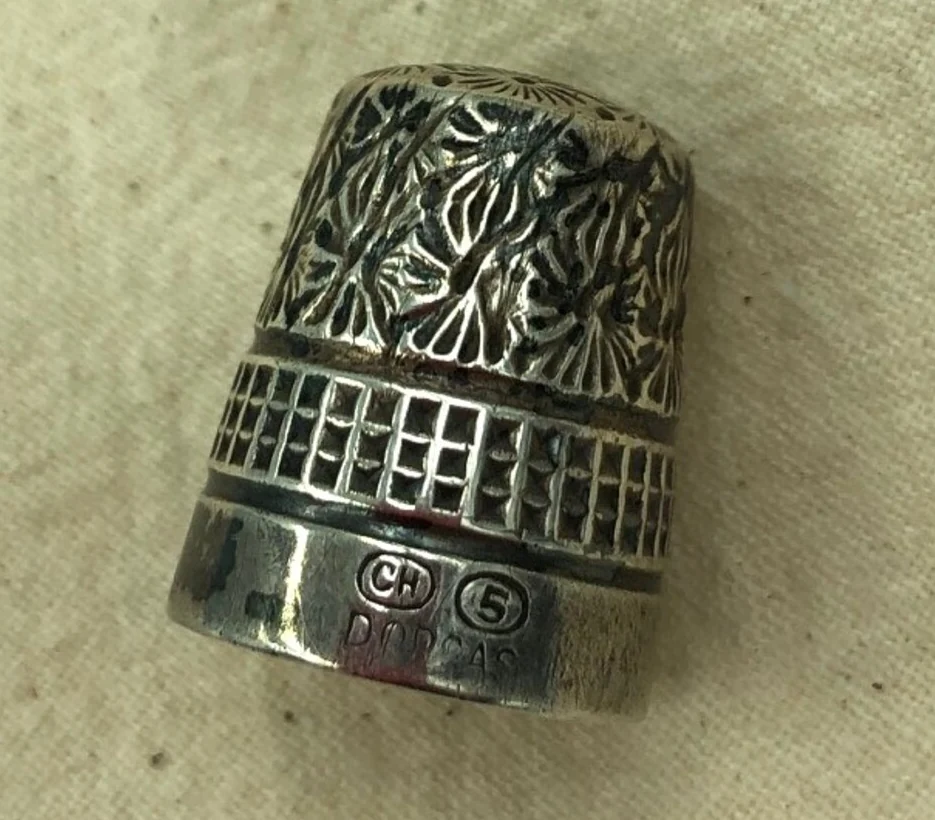
A third thimble gives us more to work with. VEMU2107.3 is a Dorcas by Charles Horner. The museum transcribes “CH 5” and “DORCAS” and identifies 5 as a size. That documented reading is useful precisely because we can’t assume the “15” inside the other thimble means the same thing.
Horner’s 1889 U.S. patent refers to English patent 8,954 of June 14, 1884. In Figure 4, a steel cup sits between an outer casing and an inner lining of precious metal. The inner lining folds over the lower shoulder of the shell to hold the parts together. With that construction, the needle can eventually wear through the outer precious metal and still meet steel. The patent tells us what Horner designed, not what an independent assay or cross-section would find in Collett’s specific thimble.
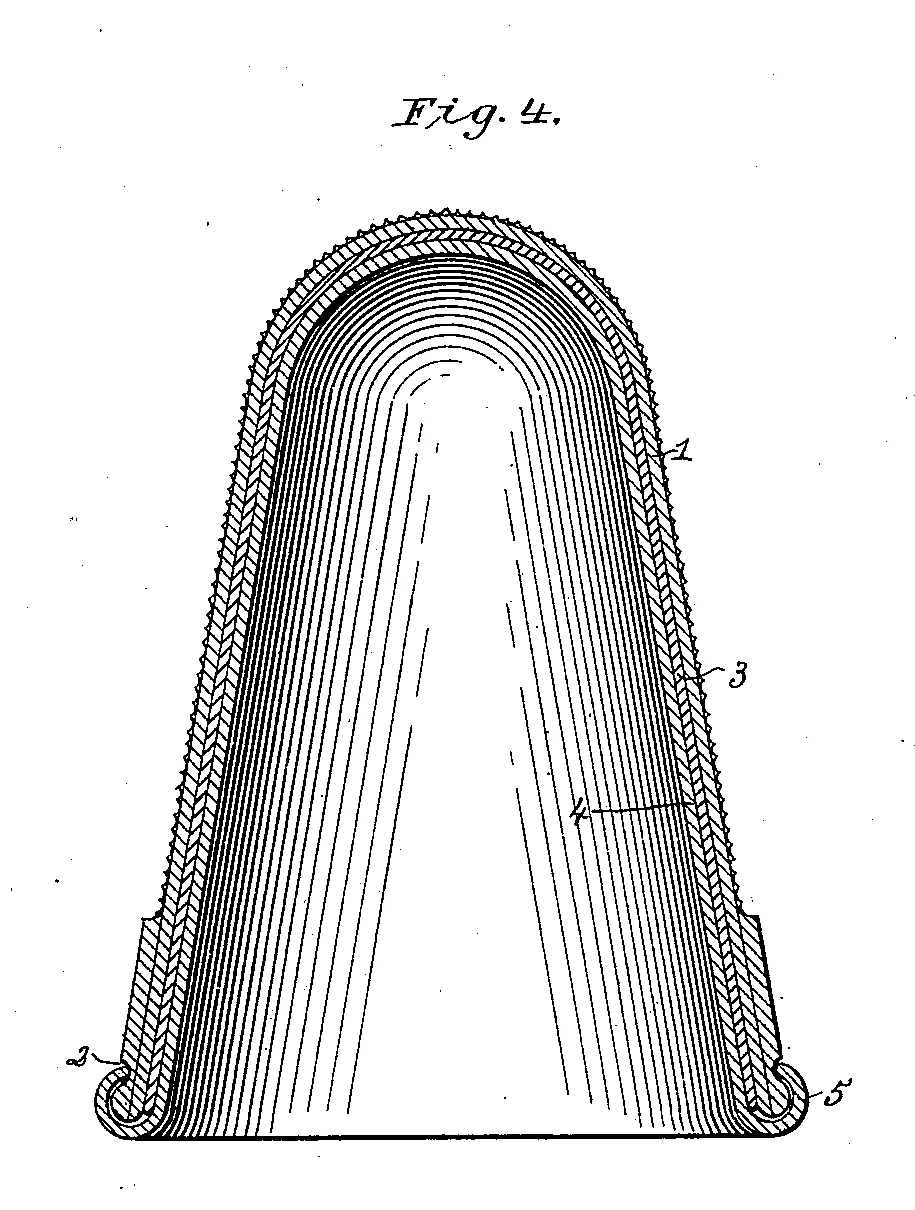
Seen together, the repaired crown and the patent illustrate two responses to the pressure a needle puts on the same small spot: repair the damage, or build a harder layer underneath. One response is visible on an object the museum can photograph. The other is documented in a drawing made to explain the design.
What to write on your own label
Photograph the crown, side, rim and interior. Take one wide shot that keeps the whole thimble in view before making close-ups. Copy a partial stamp exactly as you see it, and keep any interpretation in a separate line. Describe a seam before deciding whether it’s a join or a repair. A magnet may suggest steel nearby, but it can’t assay the metal around it. A shelf label that says “silver-colored metal and shell inlay; maker unconfirmed” can be more useful than a confident guess.
Keep the owner’s name and any family recollection with the object and say where that information came from. “Belonged to Beryl Collett” is a fact with a source. “Beryl wore it through” would be a story we made up. The gap is worth keeping: it leaves us with the patch itself, and the reliable knowledge that someone thought this little tool was worth mending.