
The two proofs that look alike
Put two big Eisenhower dollars on the table. Each shows 1776–1976, each carries the little S below Eisenhower’s neck, and each has the contrast of frosted details against a mirror-bright field. Now look at this pair in a GreatCollections archive: both were graded Proof-69 Deep Cameo, yet one is identified as silver clad and the other as copper-nickel clad. Proof describes how a coin was made and finished. S identifies San Francisco. Neither tells you what is inside this particular dollar.
This is where the name “clad” can mislead. Both constructions are clad, meaning layers of metal surround a core. It matters which layers the Mint put there.
Start with the scale, not the shine
If yours is a loose 1776–1976 dollar, start with the mintmark and weight. The normal Philadelphia (no mintmark) and Denver (D) circulation issues were copper-nickel clad. An S is where you need to look closer: San Francisco made both silver-clad collector dollars and copper-nickel proofs.
The specifications give you a better first clue than color: the silver-clad dollar is about 1.9 grams heavier at the same diameter. The 1970 law gives the dollar specifications, and the 1973 Bicentennial law authorized silver-clad collector coins across three denominations.
| Dollar construction | Nominal weight | Nominal diameter | Nominal fine silver |
|---|---|---|---|
| Copper-nickel cladding over a copper core | 22.68 g | 38.1 mm | None specified |
| Silver-copper cladding over a silver-copper core | 24.592 g | 38.1 mm | 9.837 g, about 0.316 troy oz |
On a loose coin, use a scale that reads to at least 0.1 g, zero it on a stable surface, and take a second reading. Treat the result as a clue, not authentication. Wear, damage, measurement error or an altered coin can complicate the reading. Don’t weigh a slab as if it were a coin, and don’t break open an intact Mint set for the sake of a measurement. Original packaging and paperwork tell you what was sold in the set, although a loose coin and an empty box don’t prove they started together.
A distinct copper-colored stripe on the edge can support a copper-nickel identification, but don’t rely on edge color. And don’t mistake the silver-clad dollar’s 80% silver outer layers for the composition of the whole piece. Its core has a different mix. The entire coin is about 40% silver.
What the Bell and Moon can tell you
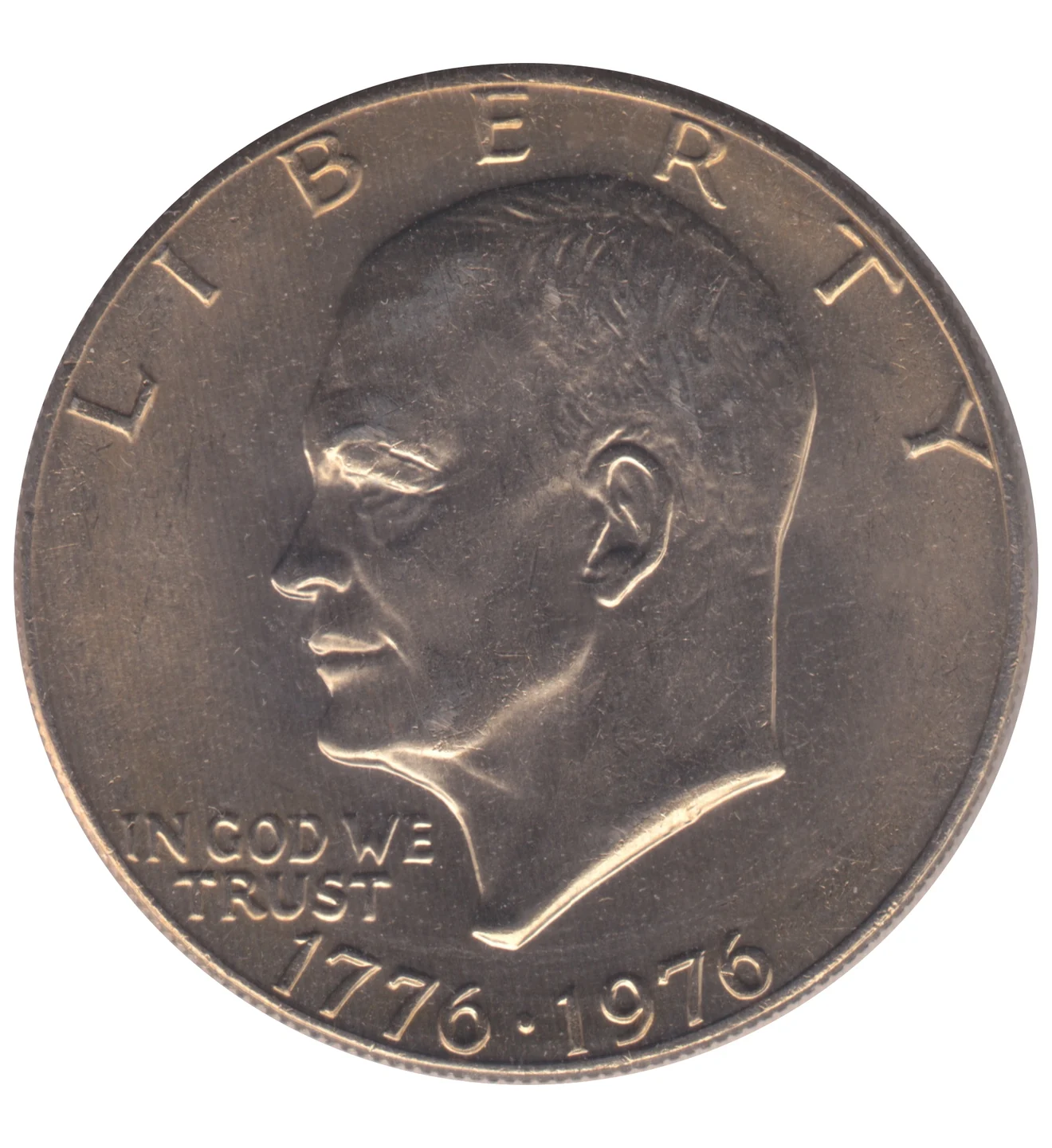
On October 13, 1975, the circulating Bicentennial dollar made its debut. It already read 1776–1976. The Mint expected it to reach commercial banks across the country over the following week or two. Its new reverse showed Dennis R. Williams’s Liberty Bell against the Moon, a design he developed after his sculpture instructor set the national competition brief as an assignment.
The Bell and Moon identify the Bicentennial design, not its metal. The large, blocky reverse lettering collectors call Type 1 doesn’t settle composition either: copper-nickel Type 1 examples exist. Learn the lettering when you want to distinguish varieties. Use weights and records when you want to distinguish metal. See the Mint’s images of the design.
The choice on the order form
The Mint’s November 1974 order schedule already explains why years later there would be two plausible answers in a family coin drawer. There was a three-coin silver proof set for $15 and an uncirculated silver set for $9. The regular, non-silver 1975 proof set was listed as containing all three Bicentennial designs and was listed at $7. You could buy the same commemorative designs without buying silver.
By the October 1975 circulating-dollar announcement, the Mint offered the silver proof set for $12 and the silver uncirculated set for $9. The following fall it wrapped the latter in crimson and white with a view of Independence Hall for holiday sales. That’s why original paperwork can answer a question a shiny coin cannot: it names the product the buyer chose.
The Bicentennial set you could order in 1986
The presses didn’t keep making the coins for another decade. The Mint kept selling sets it had already made. In fiscal 1986, customers still bought 28,379 uncirculated silver sets for $9 each. The next annual report records that sales ended on December 31, 1986, with 4,908,319 of those uncirculated sets sold over the program. That is a sales total, not a count of surviving sets or of every coin struck.
The date on the dollar commemorates one moment. The date on a receipt might be ten years later. And the composition still takes evidence of its own. If you find a loose Bicentennial Ike, record the mintmark, weight and any packaging before giving it a label. “Silver not yet established” is a better record than a confident guess.
Keep exploring
Sources
Mint records, federal legislation and image credits
- Public Law 91-607, 1970 dollar specifications, printed p. 1768 (PDF)
- Public Law 93-127, Bicentennial coinage authorization (PDF)
- U.S. Mint, 1974 White House announcement and original order schedule
- U.S. Mint, October 1975 release notice and revised silver proof-set price
- U.S. Mint, holiday packaging announcement, 1976
- Mint Director’s FY1986 report (PDF) and FY1987 report, printed p. 14 (PDF)
- PCGS: 1976-S copper-nickel Type 1 proof
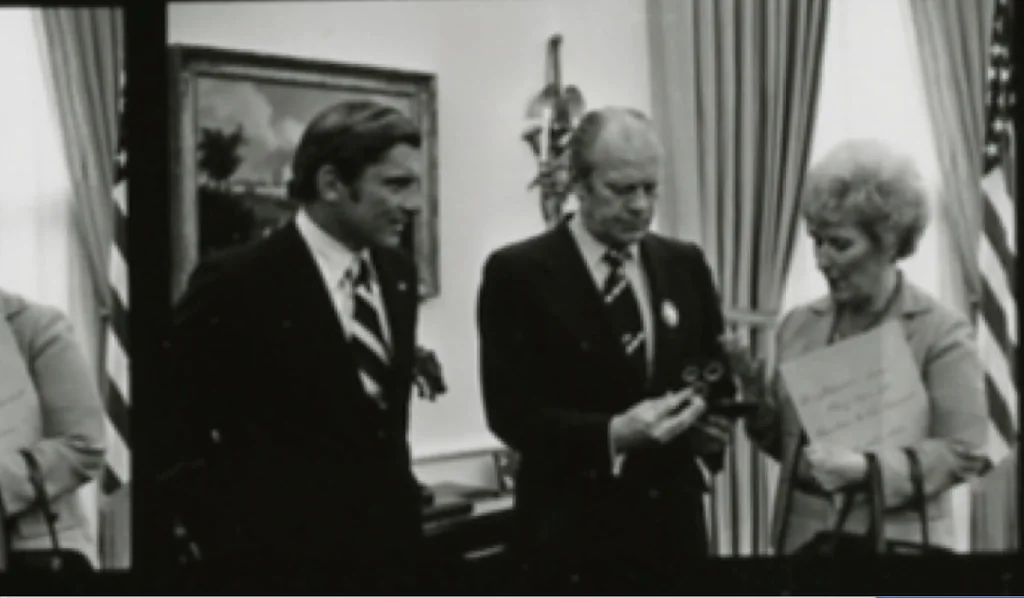
- White House photograph, Ford Presidential Library contact sheet and public-domain image record
- Public-domain photograph of the Philadelphia dollar