
Silver in the middle
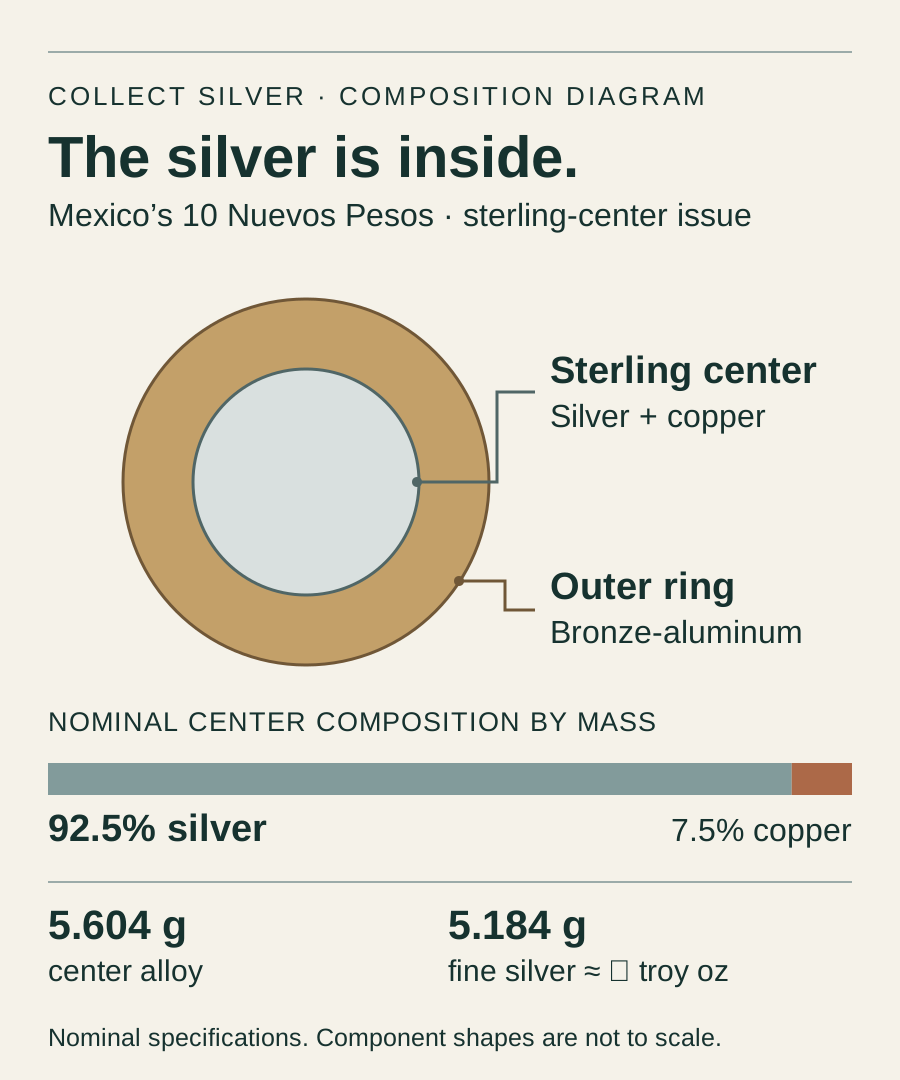
Mexico’s 10 Nuevos Pesos coin put real silver into circulating money in the 1990s. Its pale center was sterling silver, surrounded by a bronze-aluminum ring. This was not simply a silver-colored coin: the center contained a specified amount of the precious metal, about one-sixth of a troy ounce.
The construction makes it an intriguing little object. Two different alloys share one coin, with the silver confined to the middle. The outer ring does not count toward its silver content, and the whole coin is not 92.5% silver.
Why the peso was “new”
The name records a change in Mexico’s money. On January 1, 1993, a new monetary unit took effect: one nuevo peso equaled 1,000 of the previous pesos. Ten nuevos pesos therefore represented 10,000 old pesos. Removing three zeros changed the unit used to express an amount; it did not multiply what that amount could buy.
The coin specifications had been set out in a decree published on June 22, 1992. Banco de México dates the 10 Nuevos Pesos coin’s entry into circulation to January 1993. Those dates describe different steps: establishing a coin’s specifications and putting it into people’s hands.
A small center with a precise recipe
The legal specification calls for a 5.604-gram center made of .925 silver, with copper as the alloying metal. That means 92.5% silver by mass in the center, not a thin silver coating over a different core. The specified fine-silver content is 5.184 grams, approximately one-sixth of a troy ounce.
“Fine-silver content” counts only the silver, while the center’s total mass includes its copper. Multiplying 5.604 grams by 0.925 gives 5.1837 grams, which rounds to the stated 5.184 grams. These are nominal specifications with manufacturing tolerances, not a promise that every individual coin will measure identically.
Read the ring as well as the center
The design gives you more to look for than two colors. Banco de México describes the central image on the denomination side as Tonatiuh, the sun god, drawn from the Aztec Calendar Stone. Around it are “N$10,” the minting year, the Mexican Mint mark and “DIEZ NUEVOS PESOS.” The other face carries Mexico’s national shield.
The “N” is a useful historical clue: this article concerns the 10 Nuevos Pesos issue. A familiar ten-peso denomination or a pale-colored center by itself does not establish that another coin contains silver.
The metal changed, but color is not a test
A decree published on May 7, 1997 allowed a copper-nickel-zinc center as an alternative to sterling silver for the ten-peso coin. Its listed recipe was 65% copper, 10% nickel and 25% zinc, with no silver in that composition. The decree establishes a permitted material change; it is not, by itself, a record of the last year every silver version was struck.
For a collector, the pleasure is in identifying the exact issue. Read the denomination, date and design together, then check the specifications. Here, an ordinary-looking center turns out to be the most interesting part of the coin.
Sources & further reading
Sources reviewed .