
A silver bar with a date hidden in its weight
One silver bar. Nearly two tonnes. In November 2025, a 1,971-kilogram bar made by Sam Precious Metals was unveiled at the Dubai Precious Metals Conference. Even before you ask about its record, its weight gives you something to notice: 1,971 was chosen to commemorate 1971, the founding year of the United Arab Emirates.
The country appears on the object as well as in its mass. The maker says the bar was engraved with a map of the UAE. Together, the number and the engraving turn a very large piece of bullion into a national commemorative object.
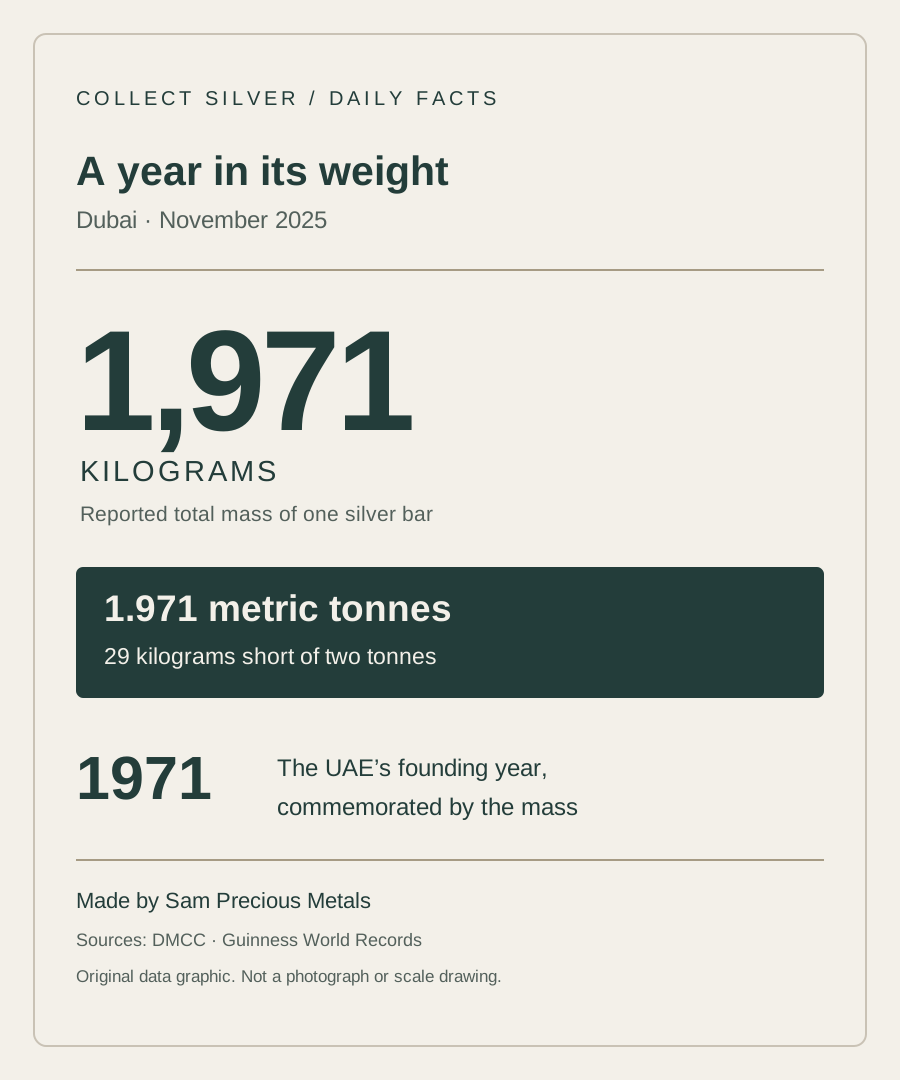
Nearly two tonnes, in more familiar units
The reported mass is 1.971 metric tonnes, just 29 kilograms short of two tonnes. Express the same mass in everyday pounds and it is about 4,345 pounds. In the troy units used for precious metals, it is approximately 63,369 troy ounces.
That last number is a conversion of the whole bar’s mass. It is not a separate assay of its silver content. The distinction matters: weighing an object tells you how much material is there, while fineness tells you how much of that material is silver.
DMCC described the bar as 1.3 metres long. Length alone does not tell the whole story of an object this heavy, and the announcement does not give a complete set of dimensions from which to reconstruct its shape.
What the stated purity means
In its September 2026 follow-up, DMCC described the bar as made from 99.9% pure silver. That corresponds to a fineness of 999 parts per thousand: in that stated composition, 999 of every 1,000 parts by mass are silver.
This is DMCC’s published description, rather than an independent assay reproduced here. Keeping the stated purity separate from the headline weight avoids treating every kilogram of the bar as a kilogram of chemically pure silver.
Making one very large casting
Sam Precious Metals says it refined, cast and finished the bar within its own facilities. Its account describes a specially engineered casting mold, controlled melting and cooling, and structural inspections.
The maker identifies preventing internal stress fractures as one reason for controlling the cooling process. This adds a practical dimension to the spectacle: producing a single huge object involves more than gathering enough metal. The casting has to remain structurally sound as it becomes a finished bar.
A record with a precise name
Guinness World Records lists the achievement under “Heaviest bar of silver,” with a mass of 1,971 kilograms. Its entry names DMCC in association with Sam Precious Metals, places the achievement in Dubai and dates it to November 25, 2025.
That is a documented historical record. Guinness also warns that records can change before its public pages are updated, so this account does not promise that no heavier bar has subsequently been made.
The lasting detail is the number itself. A weight that could have been rounded to two tonnes instead tells a story about a particular year, a particular country and the people who turned that idea into silver.