
Count the handles, not the bowls
Spread thirteen silver spoons into a fan and the bowls catch your eye first. The useful part of the picture is at the other end. Twelve stems terminate in apostles; a thirteenth carries Christ. This is the master spoon. It does not stand for an extra apostle. It completes a different kind of set, one whose order is told by miniature figures rather than by matching ornament.
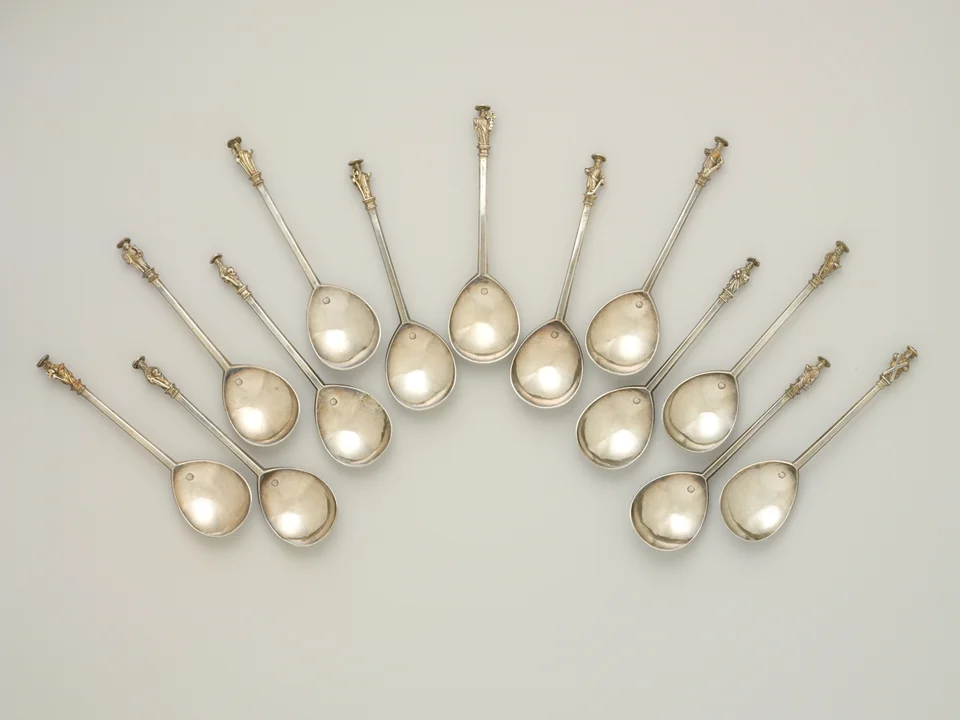
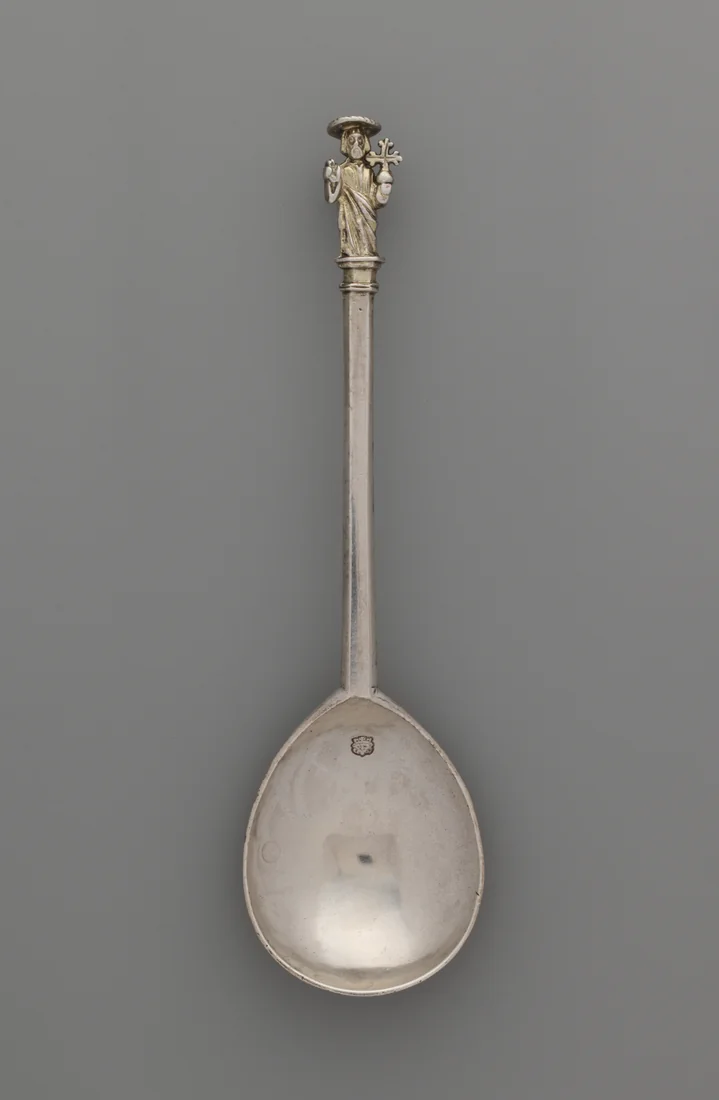
The Metropolitan Museum of Art’s London set makes that distinction easy to see. In the photograph, the small figures look almost interchangeable. Viewed close up, the things they carry do the work of names. The figure on the master spoon holds an orb topped with a cross. The gilding draws attention to the figure, but it’s the orb and cross that identify it. A collector can start with the same question a museum does: what is the figure actually holding?
Why a godparent might buy just one
The Met traces the earliest known mention of apostle spoons to a York will from 1494. It records thirteen gilded silver spoons with figures at their ends. The museum reads the count as evidence that the group likely included a master. That is a useful distinction: the will supplies a number; the surviving objects help scholars interpret what that number meant.
In Tudor England, these spoons became christening gifts. A wealthy godparent might give a whole set, but the Met notes that a single spoon was more usual. The apostle might share the child’s or godparent’s name. Some finials depicted saints who were not apostles, too. A lone spoon in a collection is therefore not necessarily the remnant of a scattered set. It may have been exactly what the giver intended.
In Henry VIII, when Cranmer hesitates to stand godfather to Elizabeth, the king teases him: “you’d spare your spoons.” The joke assumes the audience already knows what a godparent might be expected to give, and what getting out of it might save him. It tells us the custom was recognizable onstage, not what the historical Cranmer actually gave.
The same occasion could call for a spoon naming a saint or a vessel bearing a family inscription. Silver porringers and other childhood gifts show a different way to make an object personal. A silver funeral spoon belongs to another ceremony altogether. Its inscription preserves a name at the other end of a life.
The set is complete. Its dates don’t match.
Look at St. James the Great and St. Andrew side by side. Both are partly gilded silver, and both belong to the Met’s thirteen-piece group. William Cawdell made the museum’s St. James and its master spoon, dated 1592/93. The St. Andrew is the work of Martin Hewitt, dated 1613–14. The interval is roughly two decades, not the difference between the two years written on one catalog line.
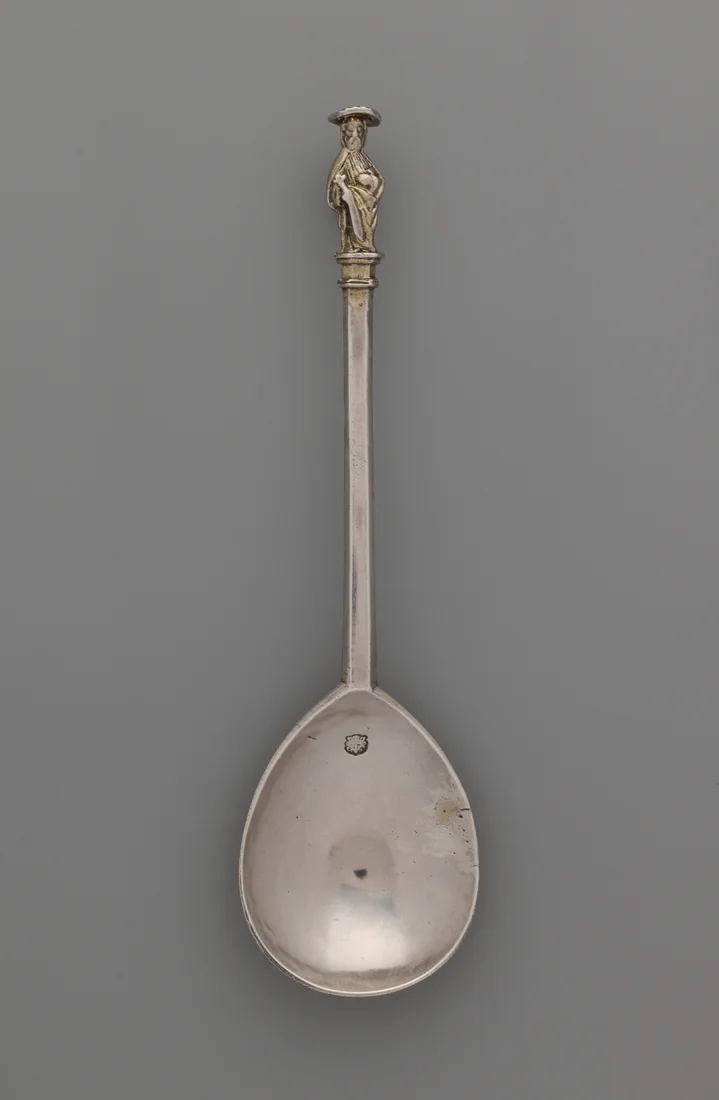
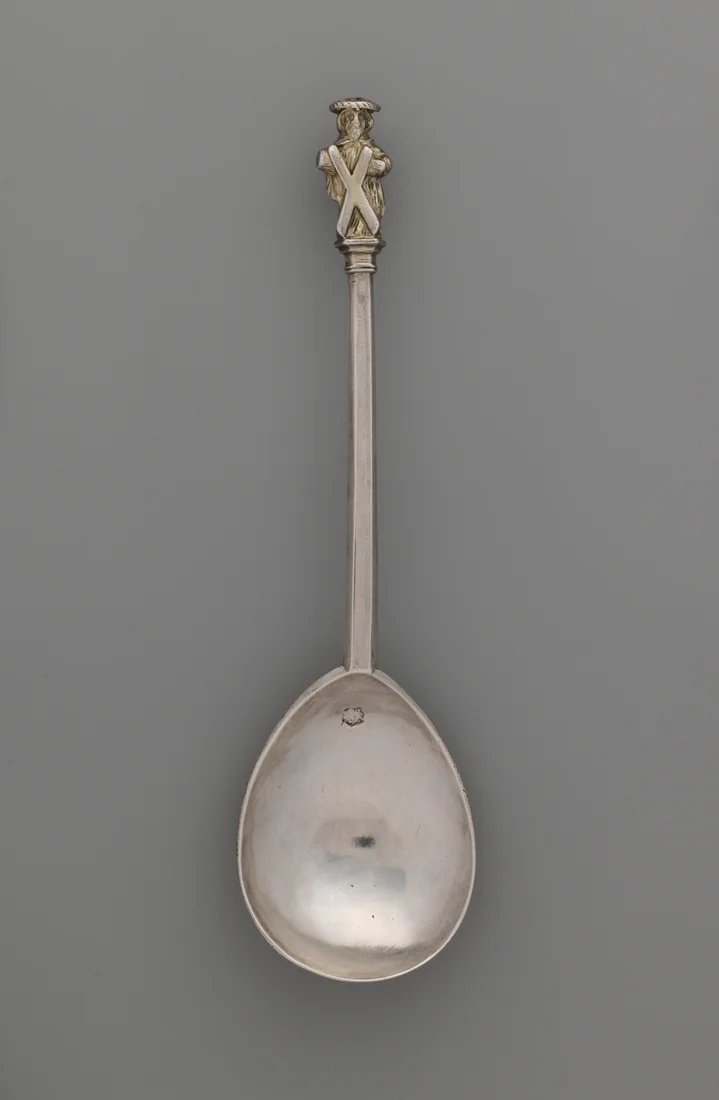
There is a direct connection between the two names: Hewitt apprenticed under Cawdell, and the Met identifies both as specialist spoonmakers. It is tempting to finish the story with a missing original and an apprentice called in to replace it. The dates and the apprenticeship do not establish that. The solid conclusion is enough: the museum has a complete group with two documented makers and different dates. Completeness, matching design, and common date are three different things.
When the clue itself is broken
Another spoon, at The Met Cloisters, is dated to about 1490. The figure holds a broken staff. If the missing part was a halberd blade, it could indicate St. Jude. If it was a spearhead, it could indicate St. Thomas. The museum leaves the identification open and reports unidentified maker’s marks. The spoon is still an example of the form, even though neither the figure nor the maker can be named with confidence.
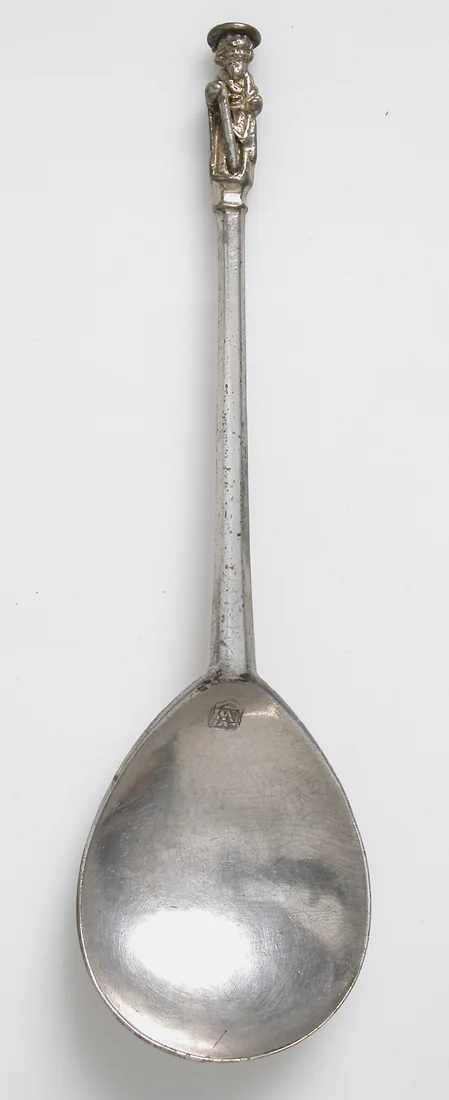
That uncertainty is worth preserving in a family record or a sale description. Photograph the finial from more than one angle and the front and reverse of the spoon in diffuse light. Record what you can see before working out what it means: a broken staff, a partly legible stamp, an area of gilding. Mark the name as uncertain rather than filling in the missing detail. The guide to recording silver marks shows how to make the next comparison without altering the object.
“Apostle” describes the spoon, not the metal
A gilded example in the Met’s collection carries the same type of figure, but its record identifies the material as latten, a copper alloy. It belongs in a comparison of apostle spoons without being an example of gilded silver. Gold color alone tells you neither what lies beneath it nor when a spoon was made.
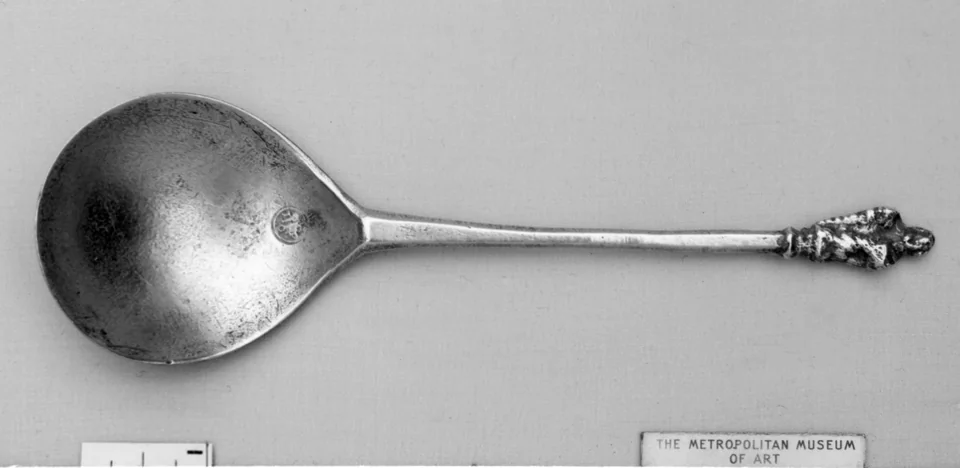
If you’re sorting a drawer or examining a dealer’s tray, separate the questions. First, does the finial support an identification? Then, what do the marks, records, and condition support about the metal and date? Finally, does the evidence show these spoons have long belonged together, or do you simply have several in the same form? A set of thirteen can tell a story about religion, gifts, and a London apprenticeship. A single well-recorded spoon can tell one, too.
Sources and object records
- The Met: William Cawdell’s master spoon, with group photograph; Cawdell’s St. James the Great; and Martin Hewitt’s St. Andrew and the thirteen-piece group.
- The Met Cloisters: the spoon with a broken emblem, with the account of the 1494 York will and the Tudor gift custom.
- The Met: gilt latten apostle spoon.
- Folger Shakespeare Library: Henry VIII, act 5, scene 2, in the Folger edition. The photographs are public domain via The Met’s Open Access collection.