
A christening gift and a bowl for the church
Look into the 1771 bowl before looking under it. Its scalloped walls break the reflection into bright bands, while a small engraved monogram sits at the bottom. There are no apostles at the rim. This silver went to a baptism, but it wasn’t a gift for a child to take home. Johannes Schiotling made the basin for the English Reformed Church in Amsterdam, where it belonged to the congregation’s equipment for worship.
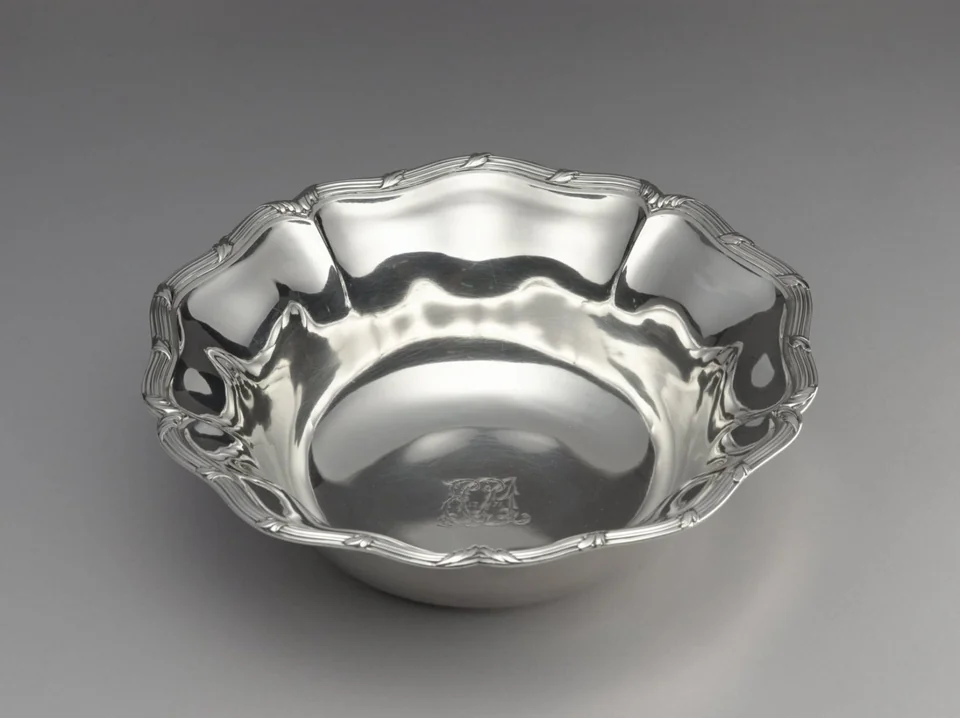
That makes it a useful companion to the silver spoons a Tudor godparent might give at a christening. A spoon could follow a child into a household and eventually pass to another generation. A basin could hold the baptismal water for different families. The two objects make visible different relationships: who gave to a child, and who furnished a place in which many children could be welcomed.
One commission, three different jobs
The basin did not arrive as an isolated piece. The Rijksmuseum records a baptismal basin, a large bread dish and two small ones, and two ebony offertory boxes, all made in Amsterdam in 1771. It credits the banker John Hope with paying much of the cost. That is a record of substantial patronage, not a claim that he personally paid every bill or that his initials appear in the monogram.
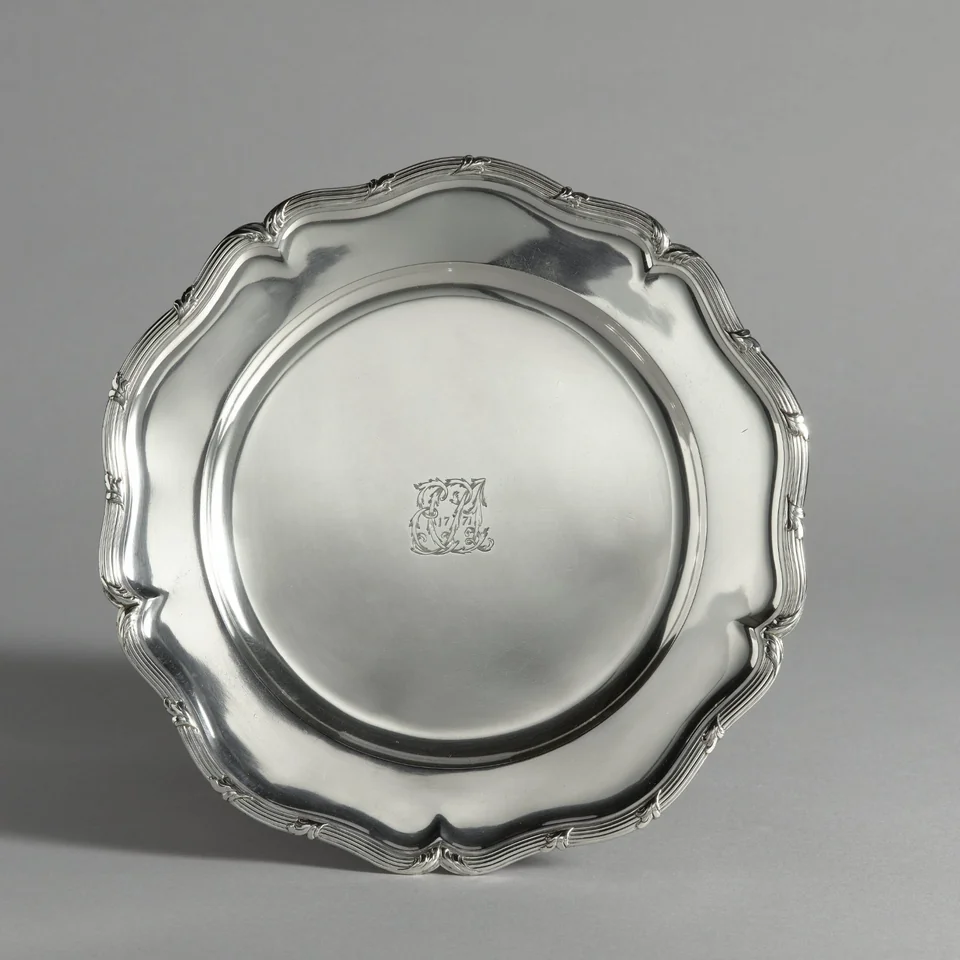
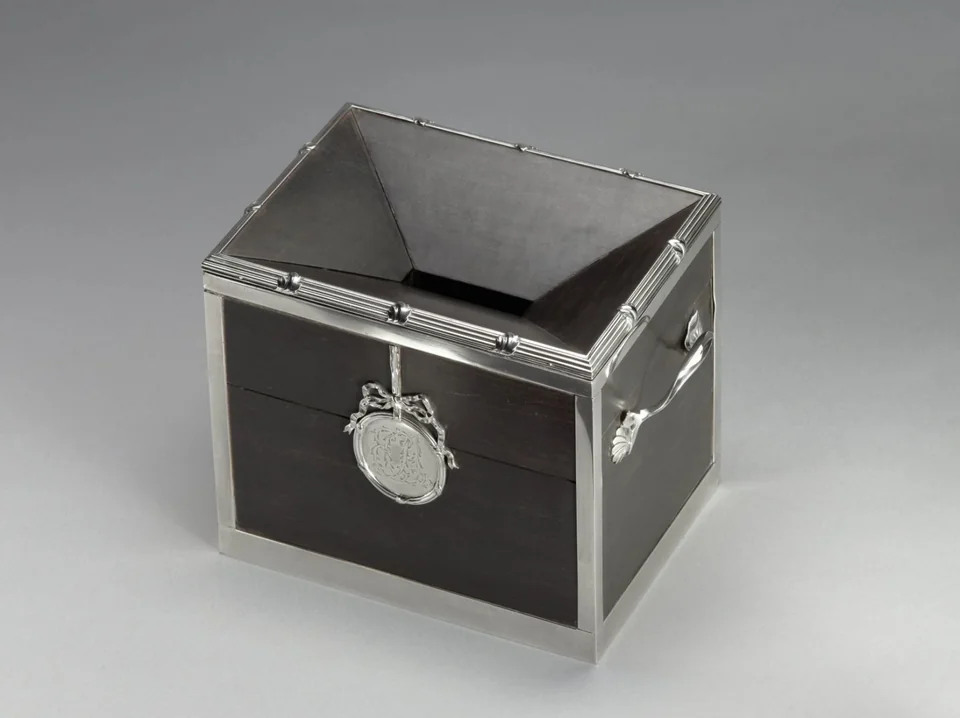
The basin measures 31 centimeters across. A companion bread dish in the museum measures 31.7 centimeters. Size alone would do a poor job of telling them apart. The basin’s deep sides hold water; the shallow dish presents bread for communion. The offertory box belongs to giving rather than baptism or communion. In the photograph, silver outlines the dark ebony and picks out a front ornament, but the object itself isn’t a solid silver box. Each object answers a different practical need without looking unrelated to the others.
What four small marks say
The museum records four marks on the basin: an Amsterdam town mark, the Holland lion as the alloy mark, the date letter M for 1771, and a maker’s mark. These are four pieces of information, not four decorative versions of a maker’s signature. The town names the system under which the object was marked. The lion concerns the silver alloy. The letter helps place the work in time within that system. The maker’s mark identifies the workshop responsible for the piece.
That is why an isolated M, or an isolated lion, isn’t enough to date an unlabelled bowl. There are date-letter cycles and different assay traditions; the mark must be read with its neighbors. Start with the guide to national hallmarking systems and record the shapes and placement together. The marks used here are the Rijksmuseum’s catalogue readings. The front-view photograph is not a photograph of the punches.
The monogram answers a different question
The museum describes an engraved ECA monogram and extensive inscriptions on the basin. It also records the monogram on the bread dish and offertory box. The initials tie the different forms to the same church commission; they are not a metal standard. For a collector, that is a reason to photograph the engraving and the marks separately. A name, monogram, or dedication can help trace a commission or later ownership. It should never be read as an assay mark.
The church’s own history places English-speaking worshippers in the Begijnhof from 1607. By the time Schiotling made the bowl, the congregation had already been there for more than a century and a half. What the 1771 silver documents is a later investment in an existing community, not the founding of the church. The Rijksmuseum’s identification of these pieces as church loans is another distinction worth holding onto: an object can be in a museum’s care without having ceased to belong to the institution that commissioned it.
Could you identify a baptismal bowl by shape alone?
Not reliably. Colonial Williamsburg holds a baptismal bowl by Connecticut maker Samuel Danforth, dated about 1795–1816. It is pewter, not silver. The museum also thinks the pitting inside may point to non-church uses. That doesn’t deny the bowl’s religious form. It warns against imagining that one name accounts for everything a vessel has ever held.
Give an unfamiliar bowl three lines in your notes: what the shape would let it do, what the marks say about who made or tested it, and what the inscriptions or records actually show about its use. For Schiotling’s basin the lines converge. We know the maker, the city, the year, the congregation, and the other pieces that accompanied it. For a bowl without that record, it is fine if one or two of those lines stay open.
Sources and object records
- Rijksmuseum: baptismal basin BK-BR-793-1; bread dish BK-BR-793-3-B; offertory box BK-BR-793-4-A. All three photographs are identified as public domain in the museum’s records.
- English Reformed Church Amsterdam: the congregation and its building.
- Colonial Williamsburg: Samuel Danforth’s pewter baptismal bowl, 2022-204.