
A patent date is not a birthday
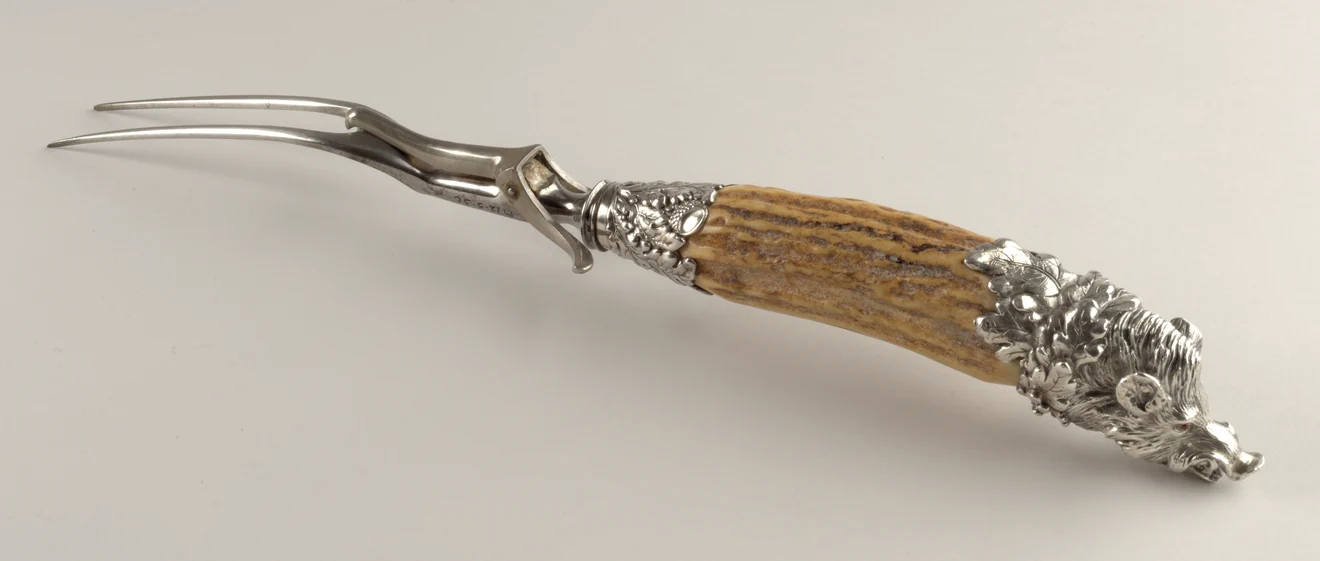
In the Smithsonian’s collection is a Gorham carving fork dated 1900. Its hinged rest carries a date twenty years earlier. No one needs to move the fork back to 1880 to explain it. The earlier date belongs to a patent, not necessarily to the object carrying it.
What exactly was patented?
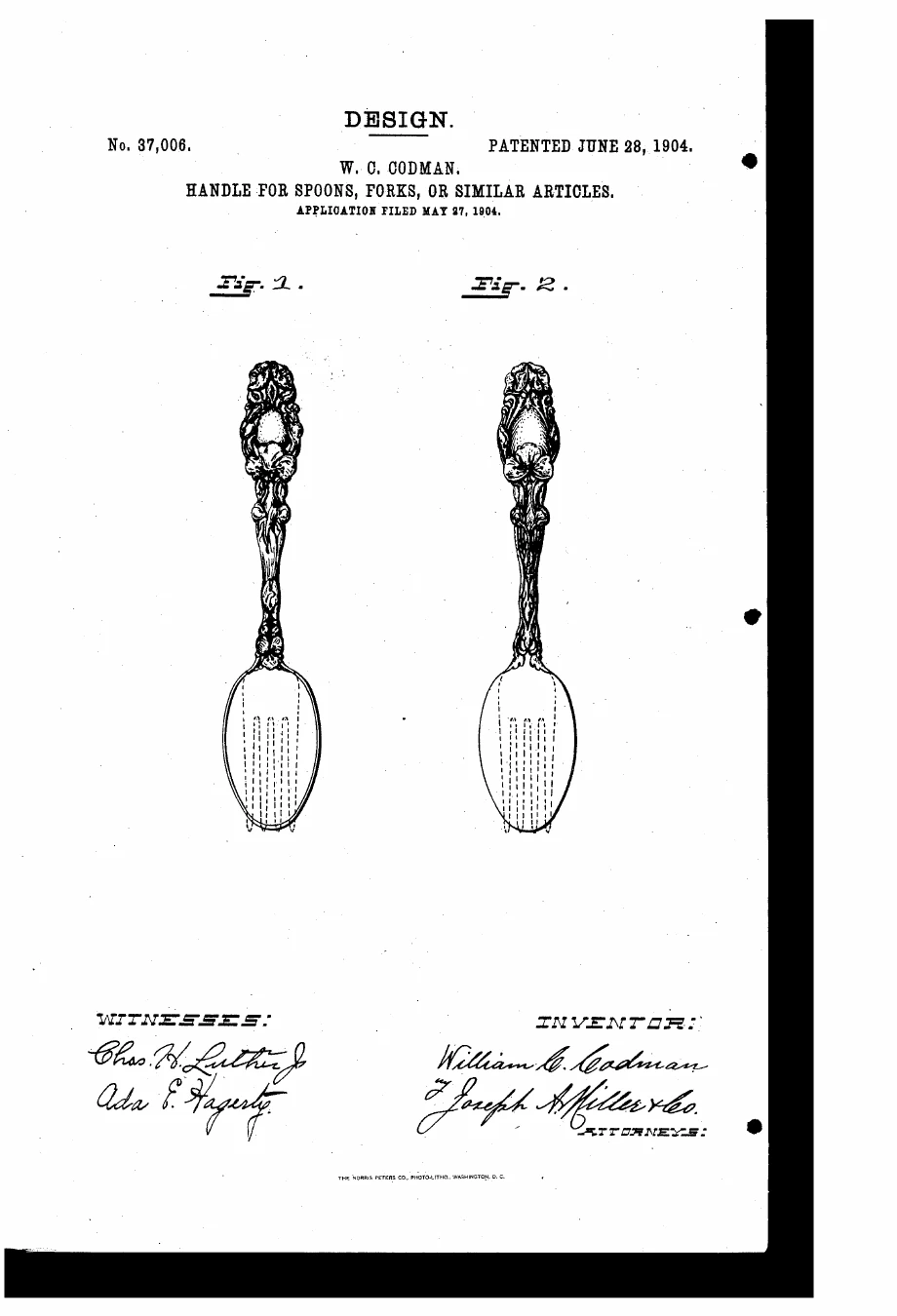
On June 28, 1904, the U.S. Patent Office granted design patent D37,006 to William C. Codman, who assigned it to Gorham. The drawing gives you both sides of an ornamental handle. The claim is about how that handle looks. It is not a catalog of every spoon and fork that used it, and the document does not establish when a particular example left the factory.
Calvin L. Butler’s 1880 patent answers a different question. It describes a working attachment to a carving fork. Compare its mechanical drawing with the hinged rest on the Smithsonian’s 1900 Gorham fork. The museum transcribes two dates on that component. July 13, 1880 matches Butler’s patent; the May 29, 1883 date is not identified here. The earlier patent drawing is not a portrait of the Smithsonian object, and Butler’s patent was assigned to the John Russell Cutlery Company, not to Gorham.
That difference is useful at a flea market. An ornamental patent can give you a profile to compare. A mechanism patent may explain what a hinge, catch or rest does even when the handle on your piece looks nothing like the drawing.
How to follow the clue on your piece
- Photograph the whole object and the exact stamp. Note whether it’s on the handle, blade, button, or a detachable part. Copy punctuation and characters even if you can’t make out the whole date.
- Look up a number first, or start with the full date. Search the date with the object type and an apparent maker name. If that fails, try the object type alone. An inventor or original assignee may differ from the company name on your object.
- Read the claim and compare the drawings. If the drawing only matches the hinge, you have a mechanism lead, not a pattern identification. A strong handle match should include the back and how the ornament ends, not just a flower or shell on the front.
- Date the piece separately. Compare maker marks, catalog illustrations and securely dated examples. Keep a registration date, a patent grant, a date of manufacture and a later presentation inscription in separate notes.
Then read the material marks separately. On the Gorham fork, the sterling mark is on the silver terminal. It doesn’t make the adjacent steel or antler sterling. For the next step, see our flatware pattern identification guide and the full carving fork study.
Sources and images
- U.S. Patent Office: William C. Codman, design patent D37,006, June 28, 1904. Original plate and claim.
- U.S. Patent Office: Calvin L. Butler, patent 229,802, July 13, 1880. Original specification and illustrations.
- Cooper Hewitt, Smithsonian Design Museum: Gorham carving fork, 1972-5-3-c, dated 1900. Object record, inscriptions and CC0 photograph.