
Two numbers for the same silver
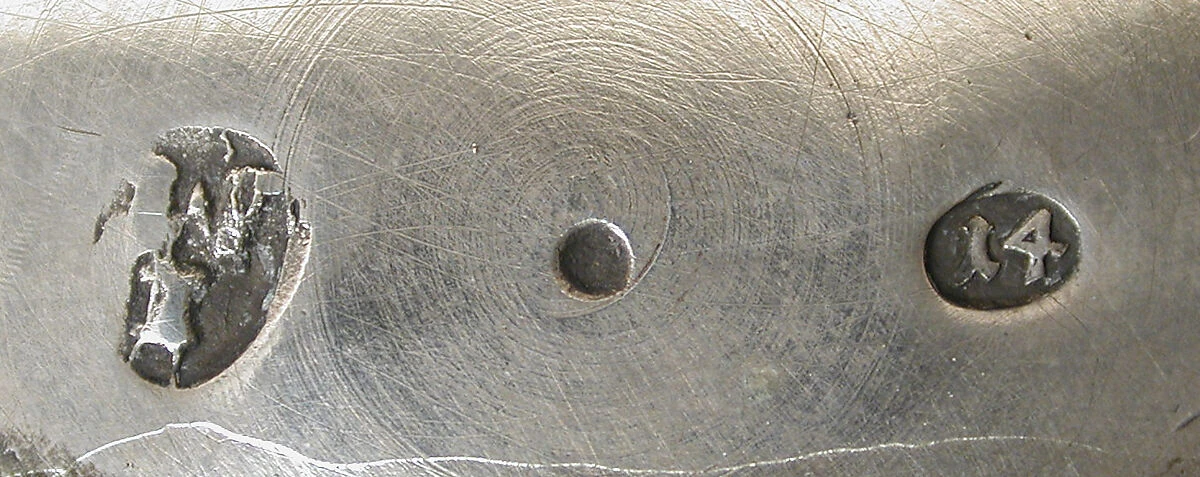
On one piece of an Augsburg traveling set, the number 14 sits in an oval no bigger than a fingernail. It could pass for an inventory number. On a silver-gilt vessel made in Moscow more than a century later, the Walters Art Museum records a different number on the base: 84. Neither is a percentage, and neither tells you the purity until you know what it was counted out of.
Dinner in a leather case
Open the Augsburg case, and the utensils are only the beginning. In the Met’s photographs you can pick out the molded spaces for a beaker, a small spice box and an egg cup. The fork and knife have Meissen porcelain handles. The long marrow spoon and the spice box make better sense when you think of the case as a personal dining kit rather than a set of souvenirs. The Met connects those pieces to the intermediate courses of an eighteenth-century aristocratic dinner.
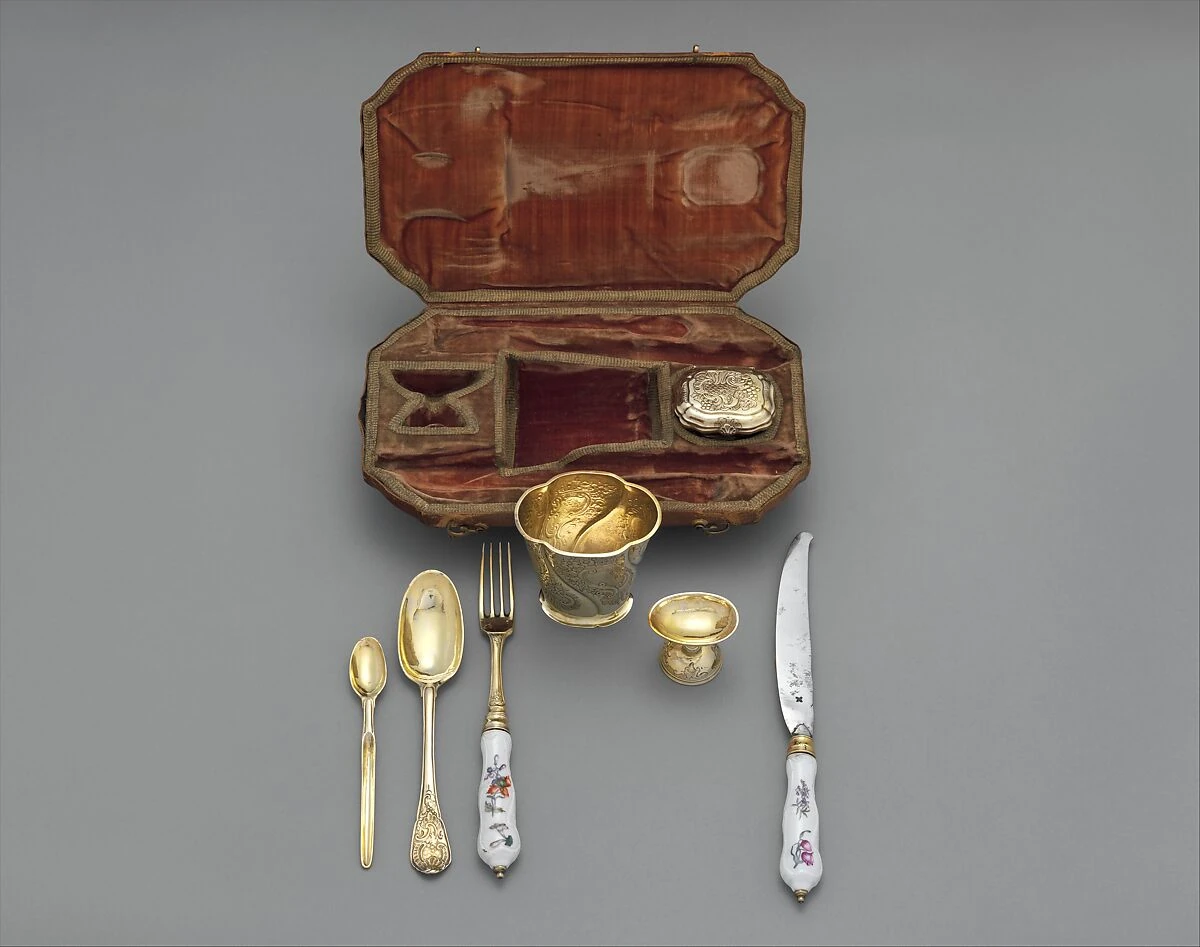
The catalog credits three Augsburg makers: Johann Ludwig Laminit, Johann Jakob Bruglocher II and Johann Mittnacht III. The pieces belong together as a set, but a single name on a receipt would tell you less about their making than these separate credits do. You can see the same division of labor in a different kind of fitted case in our story of the Augsburg perfume funnel.
The Met gives an unusual explanation for what it doesn’t see on the traveling set. Its curator reads the 14 as evidence that a patron supplied silver of 14-loth fineness, above the local norm of 13 loth. On this set, the town mark was not applied; the maker’s mark and fineness were. That is an explanation for a documented object, not a rule that missing town marks can always be waved away.
On the other side of the Russian vessel
The mouth of the 1884 kovsh is a burst of color. The Walters describes a bird inside the bowl surrounded by enamel, with floral arches around the exterior. Turn the object over in the catalog record and the evidence changes: the museum transcribes the base as bearing initials above 1884, the number 84, St. George, and the Ovchinnikov name with an imperial warrant. For this side of the comparison, we’re relying on the museum’s transcription, not claiming to show a photograph of its punches.
The date and the fineness sit near each other, but do different jobs. In the Russian zolotnik system, the whole was 96 rather than 100. Divide 84 by 96 and you get 0.875, just as you do when you divide 14 by 16. The name is a different kind of clue again: the Walters lists the maker as possibly the workshop of Ivan Khlebnikov. The prominent Ovchinnikov name does not by itself settle which workshop did the work.
What if your piece just says 84 or 14?
Start with the entire mark group, not the number. Record each symbol, the order of the punches and where they sit. Photograph the whole piece, the marked surface and the mark close up in angled light. If the object has a separate lid, foot, blade or handle, record exactly which component is marked. A number on a mount tells you nothing directly about the blade next to it.
Then ask what else supports the reading. Does the mark sit beside an identifiable maker or assay symbol? Does the date fit that system? Is the number in a punch, engraved later, or part of a longer sequence? A lone number is not enough to call the object Russian, Augsburg-made, sterling or even solid silver. And a plausible historical identification is still not a measured composition.
For the next step, use the silver marks field guide to separate the marks by job. If your piece carries a decimal number instead, start with what 925 and 925 Italy mean.
The reverse can also happen: two identical numbers on one Viennese tureen mean different things.
Sources and photographs
- The Metropolitan Museum of Art: Traveling set in leather case, 2010.110.78a–h. Object, dates, makers, the curator’s interpretation of 14 loth, and public-domain photograph and punch detail.
- The Walters Art Museum: Kovsh, 44.741. Date, workshop attribution, description and catalog transcription of the base marks.
- Novensia 31, p. 170. An independent object study explaining the 84-to-96 relationship on a historical Russian stamp.