
Two 13s on one tureen
Turn over a small Viennese sauce tureen from the early 1780s and the number 13 appears twice. In the city’s hallmark, it tells you the minimum purity the silver was supposed to meet. In a line scratched into the body, it tells you how much the piece weighed. The same number, on the same object, answers two different questions.
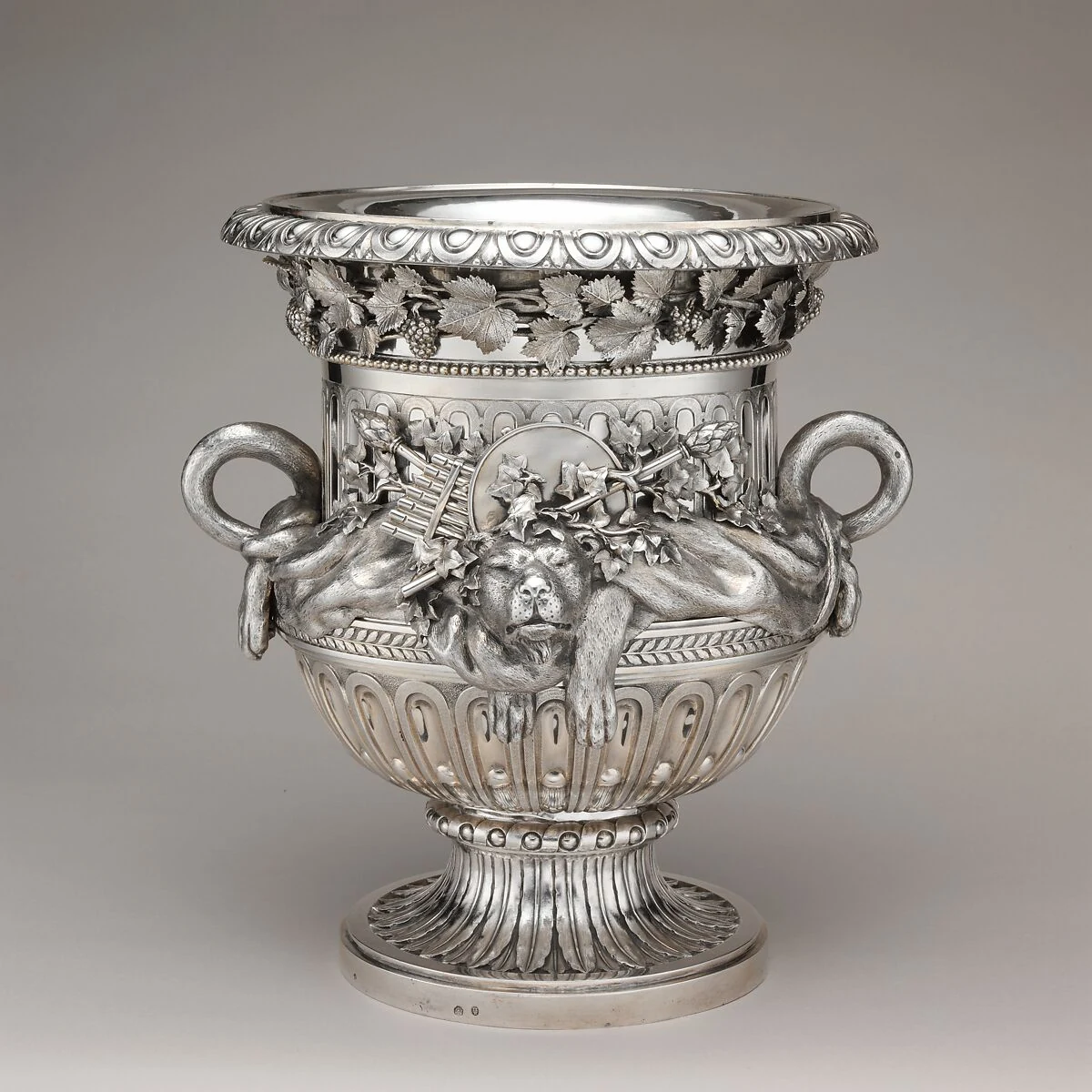
The photograph shows a wine cooler from the same dinner service, not the tureen. The Met’s catalog shows the tureen’s actual punches and engraving in figures 61–64.
Read past the number
In the catalog, Wolfram Koeppe reads the tureen’s engraving as N.1./M.3.13.1.1. Start with N.1: that’s the tureen’s number in the service. Then switch to a different job. The rest records a weight: three Viennese marks, thirteen loth, one quentchen and one pfennig. The thirteen loth alone account for about 228 grams. Together the units come to about 1.075 kilograms, without the stand.
Here, mark is an old unit of weight as well as the ordinary word for a stamp. A Viennese weight mark divided into 16 loth. In the hallmark, that same division was used as a scale for fineness instead: 13 parts silver in 16 parts alloy. The engraving tells you the object’s recorded weight; the punch tells you the minimum share of silver in the alloy. It is not a modern assay result.
How you keep a silver service together
The tureen belonged to the Second Sachsen-Teschen Service, made by the Viennese goldsmith Ignaz Joseph Würth for Duke Albert of Sachsen-Teschen and Archduchess Maria Christina. From above, the Met’s wine cooler is all grapevines and draped lion skins. From below, it’s a numbered piece of equipment with a weight you can still check.
The cooler’s base reads N:5. M.21.6.1. The first part identifies cooler No. 5; the second records 21 Viennese marks, six loth and one quentchen. The Met weighed the cooler at six kilograms, close to what the old engraving records. It also found a matching V on the cooler body and its removable silver liner. Its companion has a matching VII. If the liners and bodies are separated, the inscriptions tell you which go together.
When the Met bought the two coolers in 2002, they were just a pair. The museum dates the identification of the main surviving group in a French private collection to after that purchase. At the 2010 exhibition, the coolers could be seen alongside tureens, candelabra, plates and other pieces from a service that ran to hundreds of objects. The numbers under the pieces show a side of that dinner table the guests would rarely see: how each item, down to a liner, was accounted for.
That’s why a matching number can be useful even when it says nothing about the silver itself. The modern museum accession number, the old number in the dinner service and the purity punch describe three different things. If you’re looking at a dealer’s listing, it’s worth asking which number they’re quoting and where it appears.
What to photograph on your own piece
Take one photo of the entire object, one of the surface that carries the mark and one close enough to read every character. On a piece with a removable liner, lid or stand, record those parts separately. Leave anything stuck in place. Capture the outline of the punch, neighboring symbols and any longer engraved strings. Don’t assume an engraved weight includes a stand or a liner; the scope has to be established for that object.
A bare 13 doesn’t make a piece Viennese, just as 84 and 14 need context, too. The next step is to compare the whole mark group against a documented example. Our silver marks field guide explains how to tell the different kinds apart. The silver servingware guide helps you identify the vessel and its removable parts first.
Sources and photograph
- Wolfram Koeppe, Vienna Circa 1780, pp. 90–91, catalog nos. 19 and 31. Read the weight and fineness key, the two tureen inscriptions, and the two cooler records. The tureen and stand span 1781–82; the catalog’s figure caption and object entry differ on the precise dating of the pictured hallmark.
- The Metropolitan Museum of Art: Wine cooler, 2002.265.1a, b. Object record, modern weight, and public-domain photograph.
- The Met’s 2010 exhibition. The two coolers and the rediscovery of the surviving service.
- The Metropolitan Museum of Art: Companion wine cooler, 2002.265.2a, b.