
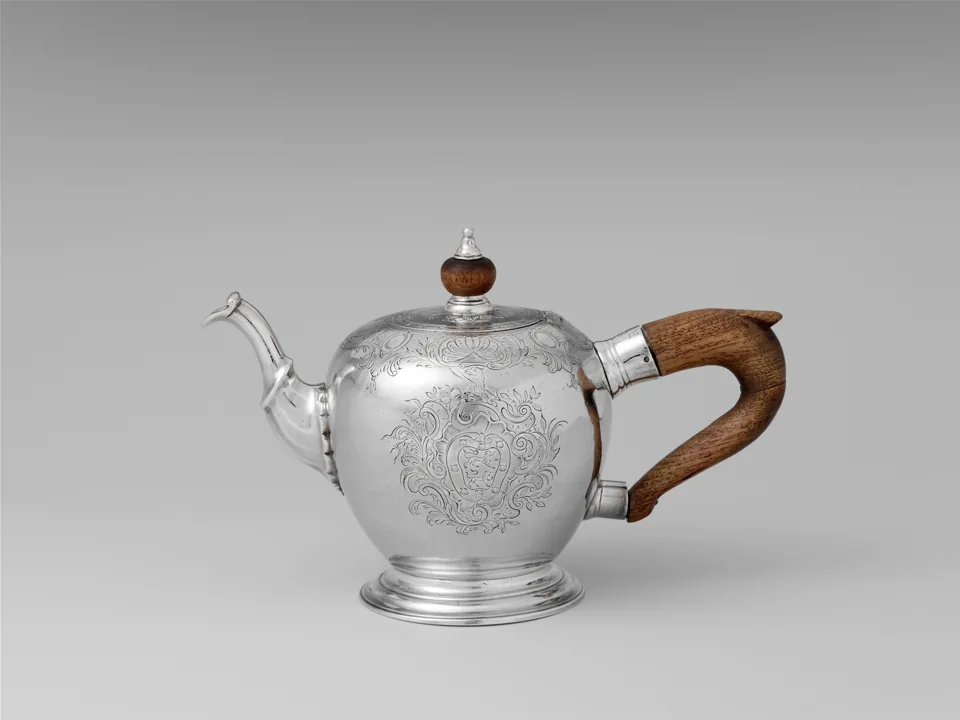
Move the filter outside the pot
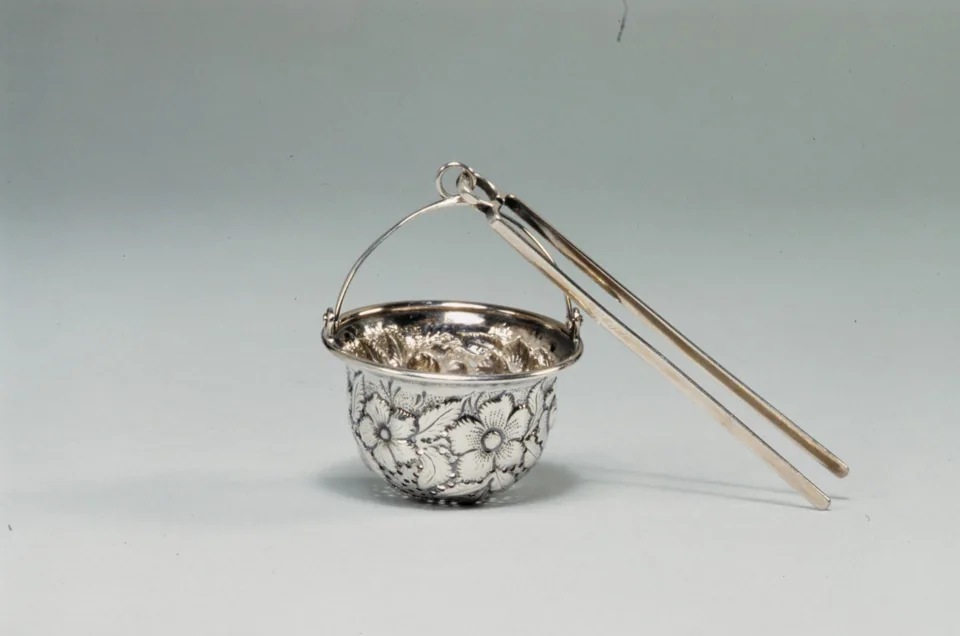
The silverwork on Andrew Ellicott Warner’s tea strainer is out in the open. A small decorated bowl hangs on a fine arch; the long clip is a separate component. At first glance it could look like a tiny basket with an unrelated wire beside it. The Met catalogues both together as the strainer from a nine-piece tea and coffee service made in Baltimore in 1845 for James Hamilton Wilson, the year he married.
A closely related form makes sense of the apparent loose parts. Cooper Hewitt’s record for a Paris strainer by Jean-Baptiste-Claude Odiot describes a suspended bowl and a fork that fits a spout. That record tells us what the attachment is doing on the French example; it does not establish that Warner’s clip attaches in exactly the same way. The important distinction is that this family of devices can intercept the pour outside the pot, instead of screening it before it enters the spout. The French record is linked below, but its photograph is not reproduced here.
Small components can be easy to overlook when a service is photographed as a group. Warner’s teapots are conspicuous; a hanging filter and a clip less so. The Met notes that Chinese export porcelain supplied models for the shapes of some vessels in the set. The little strainer is a reminder that the set’s connections are not just visual. Some of the pieces worked together even though a collector might now meet them under separate catalogue numbers. The silver tea-set guide follows this idea across the tray.
Move it again, to the cup
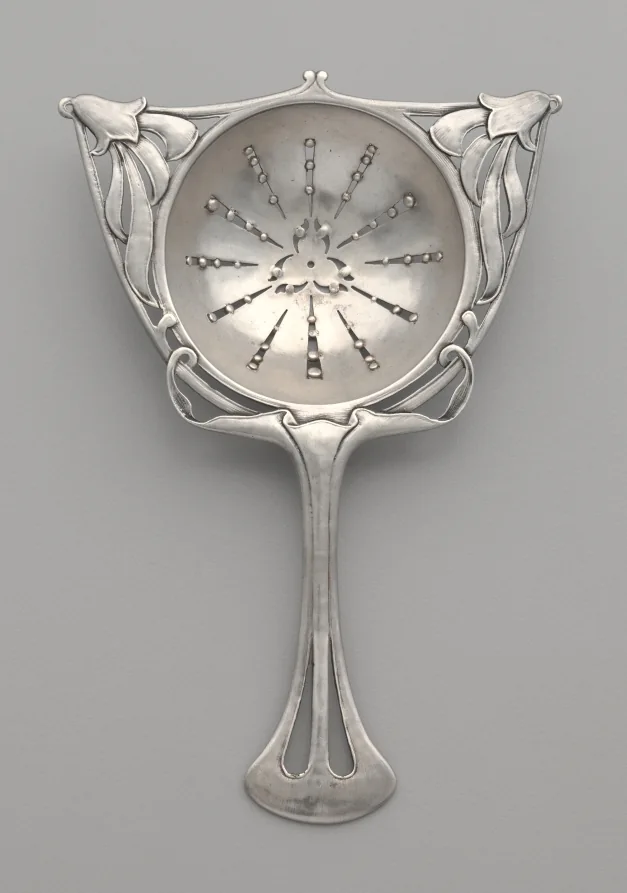
The Cleveland Museum of Art’s Cleveland tea strainer, probably designed and made by Horace Potter and Potter Studios around 1910, puts the perforations on display. Look for dots and slits radiating from a flower in the shallow bowl. Stylized flowers outside the bowl support that composition, but the pierced bowl is where liquid can pass. The visible holes are the working surface and a large part of the design.
A handle gives the person pouring a place to hold a separate strainer rather than requiring a match to a particular spout. With a loose strainer, the cup becomes the place to think about fit: where does it rest, or where can it be held steady? Do not assume every wide shoulder was made to sit on every cup; on an unfamiliar piece the dimensions and bearing points are better evidence than the name in a listing.
A strainer and an infuser also describe different tasks. An infuser holds leaves while they steep. A strainer intercepts leaves or other solids before the drink is served. A perforated container with a lid and a shallow pierced bowl can both be linked to tea while doing different jobs.
Could that strainer have been for punch?
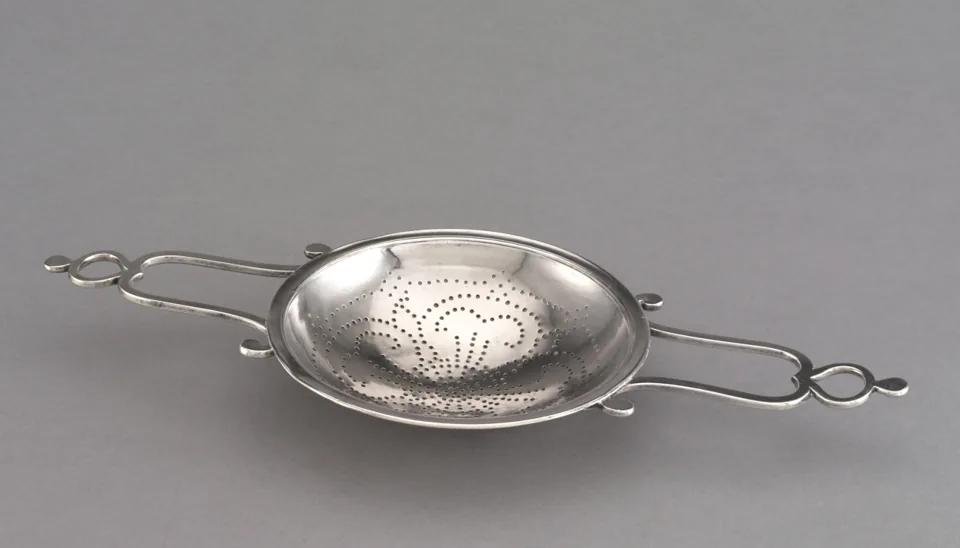
Paul Revere’s silver strainer at the Cleveland Museum of Art is about 11 inches across its two handles. The museum connects this form with removing lemon seeds, cloves and other debris from punch. Across the bowl are two long openwork arms, quite different from the short reach of Potter’s tea strainer. The larger span changes which vessels it could plausibly sit across and gives room to hold or lift it from two sides.
The comparison is not a dating test. Piercing, a long handle or even a convincing resemblance to another object does not settle what an unfamiliar piece filtered. Ask what could pass through, what the bowl could rest on or hang from, and which operation it makes easier. Look at the dimensions with a ruler, not just a close-up photo. Then compare to an example for which a museum record, service history or period description supplies more than a look-alike.
The strainer was one part of serving punch. The punch ladle with a shilling set into its bowl shows a different part of the operation, and why it pays to turn the implement over rather than guessing from its silhouette.
What to photograph if you find a silver strainer
- Photograph both faces of the pierced area. Include the holes and the edge of the bowl. For a built-in teapot filter, take a photograph through the open lid only if it opens freely; do not force a hinge or try to clear a blocked hole with a pin.
- Show where the load goes. Include the handle, tabs, hooks, fork or clip in the same photo as the bowl. Photograph loose fittings separately too. A part that looks decorative in one view may be the one that actually carries the weight.
- Record size before assigning a use. Overall span and bowl diameter answer different questions. Photograph any mark in place. If you cannot identify the original service, record the relationship as unproven rather than finding a matching pot by eye.
The next time a silver teapot looks almost too ordinary to stop at, look at the meeting of the spout and the body. Then ask where the leaves would have gone. It is a question so small that the answer can fit in 34 holes.
Sources and museum records
- The Met: Josiah Austin, Teapot, 1745–55. Construction, interior star piercing and ownership evidence.
- The Met: Andrew Ellicott Warner, Tea Strainer, 1845. Materials, clip, service and commission.
- Cooper Hewitt: Odiot Tea Strainer, 1819–38. Description of suspension and fork; record only.
- Cleveland Museum of Art: Tea Strainer, ca. 1910. Attributed Potter example and dimensions.
- Cleveland Museum of Art: Paul Revere II, Strainer, ca. 1760. Punch use and dimensions.