
A shilling under the punch
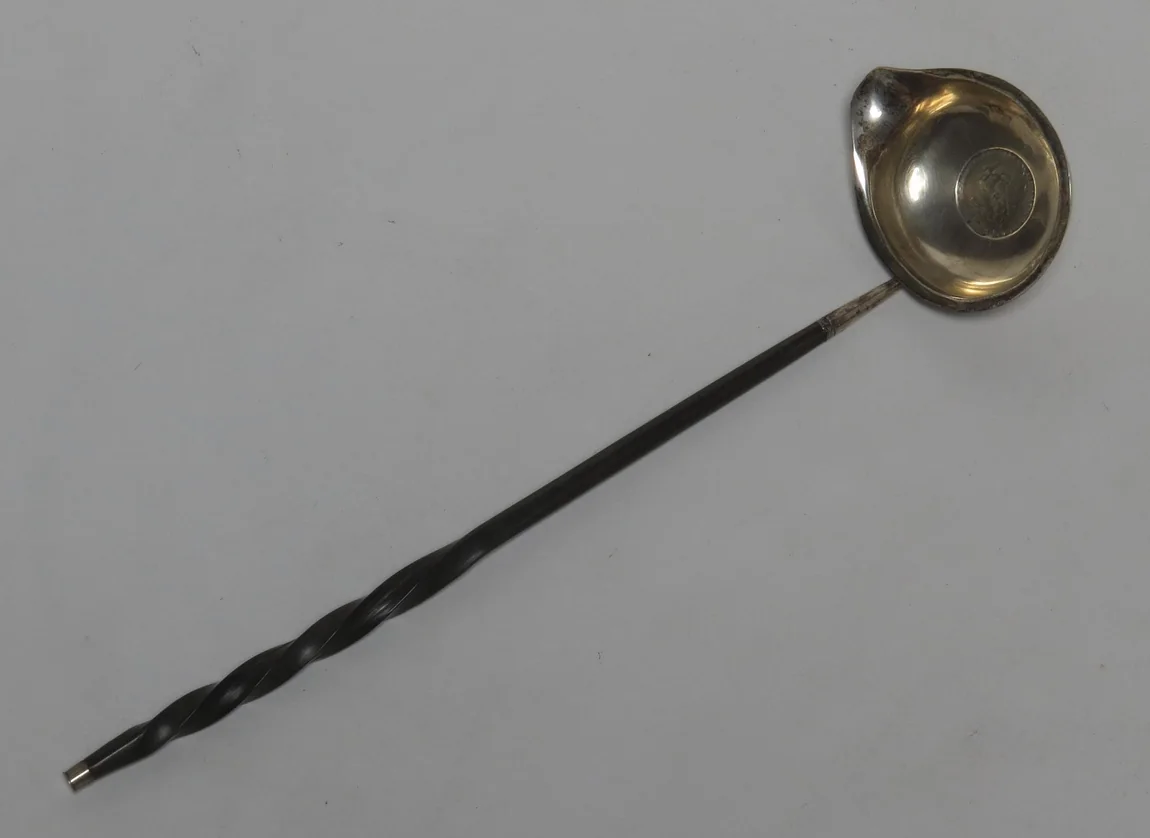
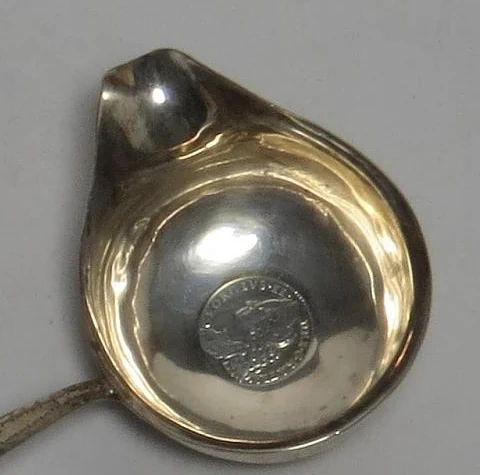
As the last liquid left the bowl of this ladle, the next thing you might have seen wasn’t a polished patch of silver. It was a king. A George II shilling sits at the center, still recognizable as a coin rather than melted into anonymous metal. The Smithsonian records the shilling as 1758 and the ladle as 1787.
If the coin were the only thing you dated, you would put the utensil almost thirty years too early. The ladle’s other date comes from a group of small punches hidden below the pouring spout. The person who looks only into the bowl misses the part of the object that does most of the dating.
Turn the spout over
The Smithsonian describes five marks on the underside of the 1787 ladle’s spout. A crowned leopard’s head points to London, a lion passant indicates the silver standard, and a small letter m belongs to a particular London hallmarking cycle. The museum also notes a right-facing sovereign’s head and an uncertain maker’s punch.
The second little profile isn’t a tiny copy of the one on the shilling. It’s a duty mark. The Goldsmiths’ Company Assay Office records the introduction of the sovereign’s head in 1784, when Parliament reintroduced a duty on silver. The orientation changed in 1786. So the portrait inside the bowl belongs to money issued under George II, while the punch below the spout belongs to silver marked in the next reign.
The workshop reading still has a question mark. The Smithsonian records an attribution to George Giles and considers George Gray the more likely maker. It also notes that the handle was broken off and repaired. Keep those findings separate: a clear coin date does not resolve an uncertain maker’s stamp, and a hallmark year does not date a later repair.
The discrepancy wasn’t a one-off
Another London ladle at the Smithsonian carries a George II sixpence dated 1757 and is dated 1786–87 by its own marks. Its date letter is l, not m. The little bowl has a spout, a shank engraved with the conjoined initials TR, and a long twisted baleen handle. It offers another example of a silver worker putting an older coin where someone using the utensil might discover it.
Why put a coin there? The Victoria Gallery & Museum at the University of Liverpool considers possibilities such as reinforcing a thin bowl or following a fashion, perhaps to personalize a gift. Its own punch ladle illustrates a limit to easy answers: the coin in that silver bowl is gold, a Portuguese piece dated 1780. The example shows why the inset can’t be explained simply as a way to add more silver to the bowl. No source establishes why a particular customer wanted the inset on either of the two Smithsonian ladles. The old coin is evidence of a choice, not a note explaining it.
Which part are you dating?
If you have one of these at home, photograph the full utensil, the inset from both sides where visible, the underside of the spout and the handle socket. Keep the coin, the punches, any engraved initials and any signs of repair in separate lines of your notes. Compare the complete punch group, including letter case and shield shape, with the appropriate assay office’s historical tables. Don’t infer a date from a letter alone, or assume that every old-looking mark belongs to the same episode.
A coin date can set the earliest possible date for that coin’s insertion, not by itself the date of the whole object. If you cannot show that the coin and the bowl began together, say so. Likewise, an apparently black handle could be a different material from the example here. Don’t remove the coin or scrape the handle just to check. The useful record is 1758 shilling; London ladle dated 1787; handle repaired. Three parts of the story can coexist in one small object.
Keep exploring
Sources
Museum and assay office records
- Smithsonian National Museum of American History: London ladle DL.304210.0001, bowl and inset, five punches, qualified maker attribution and later handle repair.
- Smithsonian National Museum of American History: London ladle DL.383728, sixpence, dating, spout and construction.
- Goldsmiths’ Company Assay Office: History of hallmarking, duty mark and change of direction.
- Victoria Gallery & Museum: A Ladle’s Tale, punch ladle with a gold Portuguese coin and explicitly tentative purpose theories. Link-only images.