
The dark blue fragment
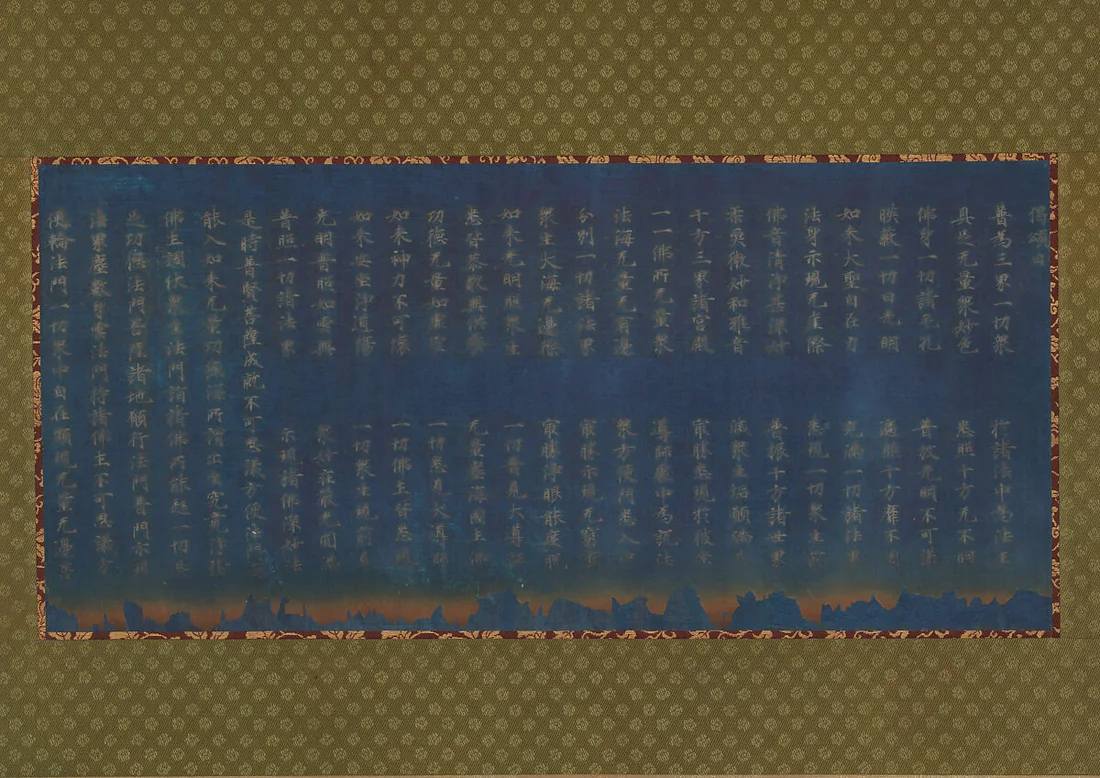
Across a rectangle of dark blue paper, characters fall in pale vertical columns. At the bottom, the support breaks into an irregular edge. The damage has not made the words into ghosts. Much of the writing is still there, just above the place where the sheet gives way.
The Metropolitan Museum of Art identifies this as a fragment of the Flower Garland Sutra, known in Japan as the Kegonkyō. It dates the fragment to about 744, the year it records a set of sixty handscrolls being donated to Tōdaiji Temple in Nara. The paper is dyed with indigo. The letters themselves are made with a silver pigment. In this object silver is not a frame for the words. It is the substance of the words.
What had to happen before a letter
The Met’s account describes copying scripture as a way to acquire spiritual merit, not only for the donor or scribe but also for people who made the materials. Copying an extended text could occupy many hands before anyone reached the final character. Paper had to be made, prepared and dyed; a person with the skill to write in metallic pigment put the lines in place. The picture supplies no name for the writer. It does let us see the discipline of the repeated spacing.
What exactly made the mark? For a later group of Korean manuscripts, The Met describes powders of silver and gold mixed with animal glue. Think of suspendable particles held against the paper by a binder, not metal poured hot from a crucible or foil laid over already-written words. That description is evidence for the Korean example discussed below. There is no comparable binder analysis in the Japanese fragment’s online record, so the Korean preparation is not a recipe we can assign to the Nara scribe.
The fire and the mount
In 1667, a fire damaged the temple complex’s Nigatsudō, or Second Month Hall. The Met’s account identifies surviving sections of the damaged scrolls as the Nigatsudō Burned Sutras. Some fragments were later cut into smaller pieces; the museum’s older acquisition essay records the cutting as part of their later history. That means the edge of a fragment cannot be read as though every loss was made at the same instant in the fire.
Today this section is mounted for hanging. It was not written as a freestanding rectangle in a patterned border. The original object was a handscroll, opened in stages. The present mounting makes this stretch of text visible at once while recording a later decision about how to preserve and show it. The old writing, the areas of loss and the mount are three distinct things on one wall.
What the gold does
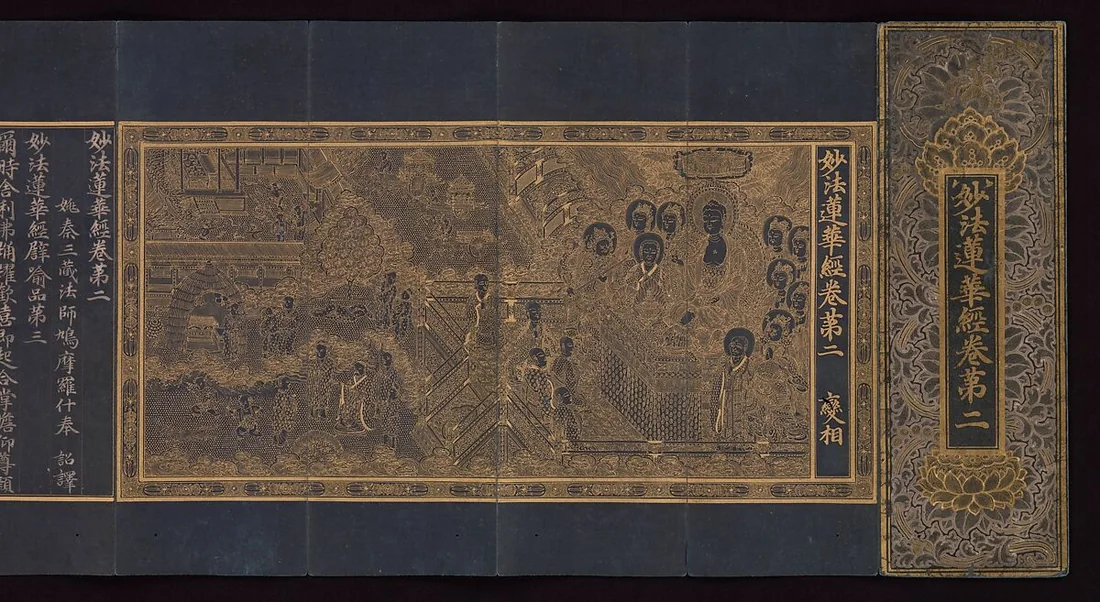
A Korean manuscript of the Lotus Sutra in the same museum is a different scripture, a different object and about six centuries later. Its long strip of indigo-dyed mulberry paper folds into an accordion rather than rolling into a cylinder. It opens with an elaborate image. The Met describes the text as written in silver and the frontispiece as drawn in fine gold. At the right, the Buddha teaches; toward the left, a scene of the burning house belongs to a parable. The building in this picture is not the Japanese temple in the other object’s history.
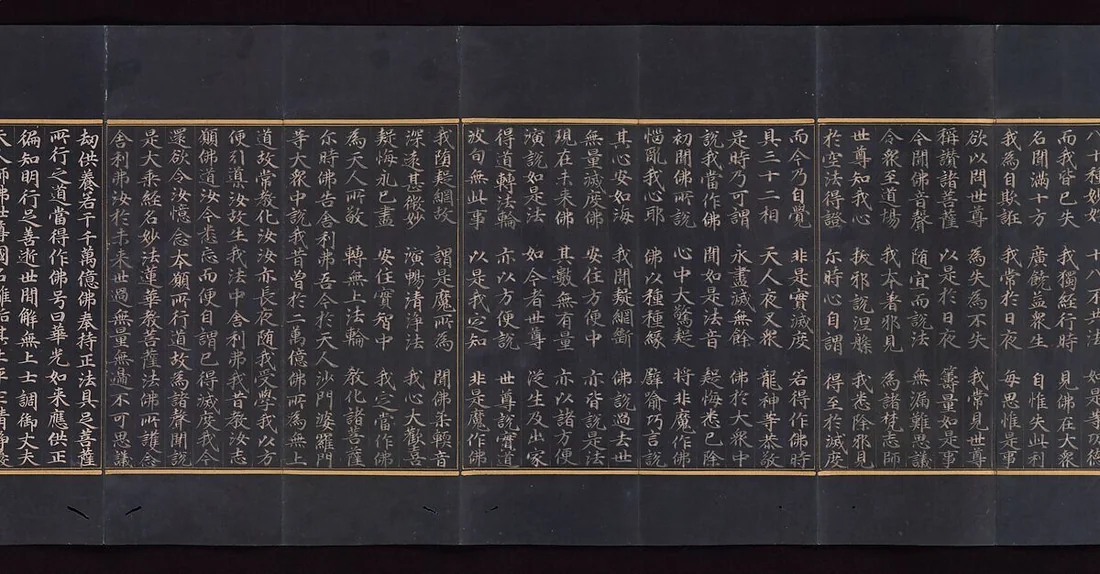
When the text takes over from the picture, the metal changes. The page no longer asks you to find a figure or follow an illustrated episode. It asks you to read a succession of characters. Gold and silver help give those two encounters a different appearance, without leaving the indigo ground behind. The surviving book does not establish that every scriptorium used the metals in the same way.
Read the material, not just the color
A photograph can show an irregular edge and columns of lettering. It cannot tell you the composition of the pigment or the treatment history of the sheet. Start from the object record, then add what the particular image shows. Notice the color of a stroke without making it a chemical diagnosis. A dark patch is not, by itself, proof of silver tarnish. Even if silver is documented, care techniques for silverware are not care techniques for a manuscript: the marks sit on a flexible support and depend on their attachment to it.
These two objects ask the same simple question of a reader: what is the metal doing here? In the Japanese fragment it carries the writing across a sheet the fire did not entirely take. In the Korean volume the silver script follows a picture in gold. In neither was a large piece of metal needed. The metallic particles were enough to make a page worth looking at closely.
Related reading: Silver in historic photographs: paper, binder and silver · How silver is decorated: separate the observation from the conclusion
Sources
Manuscript records, primary sources and image credits
- The Met: Nigatsudō Burned Sutra, object, dates, medium, fire and practice of copying.
- The Met: Notable Acquisitions 1980–81, p. 83, handscroll origin and subsequent fragment history. Follow the current online record for the object credit and measurements.
- The Met: Illustrated manuscript of the Lotus Sutra, Volume 2, accordion format, image scenes and installation.
- The Met: Recent Acquisitions, 1994–1995, p. 80, identifies the silver text and gold illustration by medium.
- The Met: The Arts of Korea, a resource for educators, powdered pigments mixed with animal glue on the Korean manuscript; not evidence for the Japanese fragment’s binder.