
The silver you do not see
A coin puts silver on display. A working electronic contact or reflective coating usually does the opposite: it uses the metal in a particular place, for a particular job. The finished object may look nothing like the pieces in a collector’s cabinet.
That is the starting point for industrial silver. A thin film, an alloy, a conductive paste and a light-sensitive compound are different materials, even when silver connects their stories. To understand a use, ask three questions: what form is the silver in, what does it do, and why was that form chosen?
Moving charge where it matters
Among elemental metals at ordinary room temperature, silver is exceptionally good at conducting electricity. That makes it useful where current must pass through a deliberately designed contact or path. It does not mean an entire device has to be made of silver.
The Royal Society of Chemistry lists electrical contacts, printed circuits, batteries, and soldering and brazing alloys among silver’s uses. These are distinct applications: a conductive contact, a chemical battery system and a joining alloy do not use the metal in the same way.
A device’s performance also depends on its construction and operating conditions. Knowing that silver is a good conductor does not tell us how much a particular phone, car or charger contains. It is a reason to look at the component and its specification rather than assign an ounce figure to the whole object.
Solar contacts, and the effort to use less
In many silicon solar cells, silver-containing contacts collect the electrical current generated by the cell. Their geometry and composition matter: engineers want effective current collection while controlling material use and manufacturing cost.
A useful example comes from Fraunhofer ISE in 2025. Its researchers combined a silver-copper paste on the front of experimental silicon heterojunction cells with copper paste on the rear, alongside fine-line printing. The result sharply reduced silver consumption. This was a specific research design, not a statement about the recipe inside every panel for sale.
The example shows why “more solar” cannot simply be translated into a fixed future quantity of silver. Cell designs change, manufacturers reduce material per unit, and substitutes are tested. Silver’s usefulness and efforts to use it more sparingly are parts of the same engineering story.
A surface that works with light
An optical mirror needs a reflecting surface, not a thick slab of precious metal. Silver can be deposited as a thin coating, with the surrounding layers and substrate chosen for the application. Some mirrors put their reflective coating on the front surface; others place it behind glass.
Edmund Optics describes protected silver coatings as useful across visible and infrared wavelengths, while also explaining that silver tarnishes. Protective overcoats help, but the working environment still matters. Aluminum and gold coatings serve other combinations of wavelength, durability and cost.
That is why a mirror specification includes a wavelength range and coating type. A reflectance number from a precision optical component should not be transferred to a tarnished coin, a polished spoon, or every object called a silver mirror.
When a silver compound records an image
Photographic film gives silver a different role. Kodak’s filmmaking guide describes silver halide crystals absorbing light and forming a hidden, or latent, image that becomes visible during processing. Here the useful behavior comes from light-sensitive chemistry, rather than a shiny metallic surface.
The processing route matters too. Black-and-white development can build a metallic silver image. In the color-negative process described by Kodak, development forms silver and dyes, and later steps remove the silver while retaining the dye image. It would therefore be misleading to assume that every finished film photograph contains the same kind of silver image.
For a collector, this is a striking connection: the metal associated with a coin cabinet also helped make the photographic record around it. The material’s form changes the job it can do.
Working inside chemical manufacturing
Silver can also help a reaction happen selectively. Shell describes silver-based catalysts used to make ethylene oxide from ethylene and oxygen. Ethylene oxide can then be used to produce ethylene glycol, a raw material for polyester and PET.
The silver in this example belongs to a manufacturing catalyst. It is not an intended ingredient of the finished polyester fiber. A shirt’s polyester label does not establish that the shirt contains recoverable silver. The connection is a production step, and that is interesting enough without turning it into a hidden-metal claim.
Medical applications need product-specific evidence
Selected medical products use silver chemistry. An FDA record from 2007, for example, describes AQUACEL Ag, a wound dressing containing ionic silver. A named device with specified uses is much more informative than a broad claim that silver is “healthy.”
Antimicrobial activity does not automatically establish a better clinical outcome. The 2023 IWGDF/IDSA guideline suggests against using silver preparations to address diabetes-related foot infections, a conditional recommendation based on low-certainty evidence. That is a particular clinical context, not a verdict on every possible silver material.
Nor do medical dressings justify swallowing colloidal silver. NCCIH reports no known benefit from taking silver by mouth and warns that it can cause argyria, a usually permanent blue-gray discoloration of the skin. Collecting the metal and choosing a treatment are very different activities.
One element, many carefully chosen forms
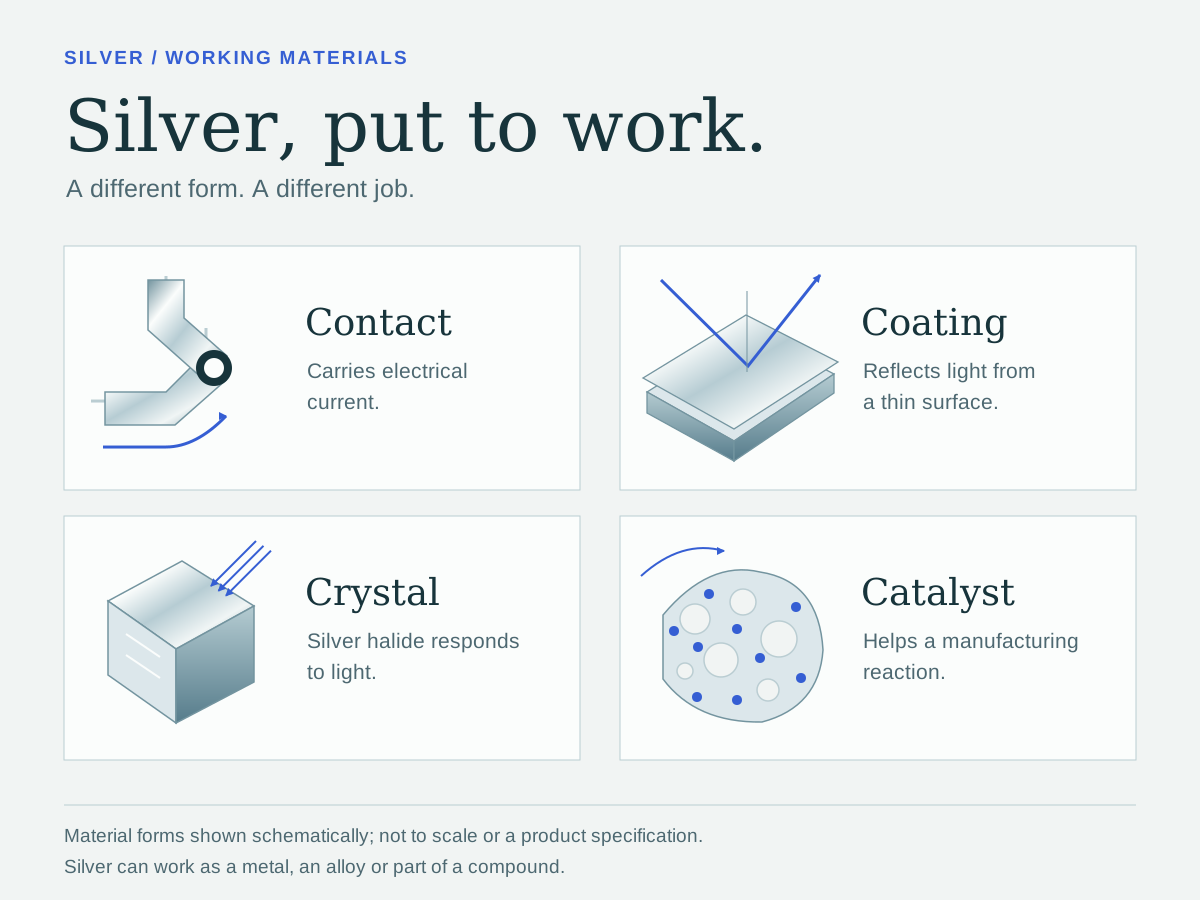
Across these examples, the important question is less “Does this product use silver?” than “What is the silver doing?” A solar contact carries current. A mirror coating redirects light. A photographic crystal responds to exposure. A catalyst assists a manufacturing reaction.
The original article’s central point survives that closer look: silver is both a precious metal and a working material. Its practical uses deserve attention without becoming a claim that every application is indispensable, every product contains a large quantity, or industrial demand guarantees a higher price.
About this edition
Original source and editorial notes
Adapted from original material by Rich Silver. Original publication: Silver Powers the Modern World ↗ (2026-07-07).
Reviewed 2026-11-05. Adapted from the article published July 7, 2026. Preserves the broad industrial-use story while distinguishing elemental silver, alloys and compounds. Conductivity comparisons are limited to ordinary room-temperature metals; optical performance depends on coating and wavelength. Selected medical products are not evidence for general health claims. The 2025 solar example is a research result, not a universal production specification. No demand forecast or silver content per vehicle is inferred. This full overview complements the short industrial-use fact and links to detailed journal articles.
Sources & further reading
- Royal Society of Chemistry: Silver, uses and properties ↗
- Fraunhofer ISE: Silicon heterojunction solar cells realized with record savings in silver, 2025 ↗
- Edmund Optics: Metallic Mirror Coatings ↗
- Kodak: The Essential Reference Guide for Filmmakers, How Images Are Formed on Film and Processing, PDF pages 34 and 143–144 ↗
- Shell: Ethylene Oxide Catalysts, page updated October 31, 2025 ↗
- FDA: AQUACEL and AQUACEL Ag 510(k) summary K063271, April 2007 ↗
- NCCIH: Colloidal Silver: What You Need To Know, updated April 2023 ↗
- IWGDF/IDSA: Guidelines on the Diagnosis and Treatment of Diabetes-related Foot Infections, 2023, recommendation 23 ↗