
Two matching glasses. One mark.
The Corning Museum of Glass has two little Alvin Manufacturing Company cordial glasses, dated 1900–1915. Clusters of grapes and leaves decorate both. Both have bare glass underneath their feet. But look at their stems: Corning records a worn Alvin mark and “PATENTED 999” on one, and no mark on the other.
On this pair, 999 most likely means a claim of 999 parts silver per thousand for the overlay, or 99.9 percent. The museum does not report a test establishing that purity. The claim is about the silver on the vessel, not the vessel as a whole. A scale would weigh the lead-glass body, too.
Why read it that way?
On a different Alvin piece, a grapevine pitcher, the auction catalog records both a “PATENTED” inscription and the longer “999/1000 FINE.” That wording gives us a comparison, not an assay of the cordials. It also makes more sense of why the shorter 999 appears beside the patent wording.
An Alvin advertisement reproduced from an 1897 trade journal claimed rights to U.S. patent 472,230. That patent, issued in 1892, concerns a method of decorating glass; it is not an assay or proof of which process was used on a particular surviving piece. The RISD Museum’s exhibition on overlay notes that it did not know of a formal transfer of the patent. The ad tells us what Alvin said. It does not establish which patent the cordial inscription refers to.
Where to look, and what to write down
| Documented object | Location | What the inscription tells you |
|---|---|---|
| Alvin cordial pair, 1900–1915 | Stem of one glass | Worn Alvin mark and PATENTED 999. An inferred fineness claim for the silver; the other stem is unmarked. |
| H. C. Fry compote, 1922–1927 | Etched into the glass foot | ROCKWELL in a shield. A decorator’s identifier can be on glass; the shield is not a purity mark. |
| Gorham decanter, 1913 | Glass base, silver top, side decoration | P. Dawson / Dufftown Glenlivet on the glass; STERLING on the silver top; JSH as a monogram on the side. Three clues, not three names for the maker. RISD also records a mark on the bottom edge of the silver on the body. |
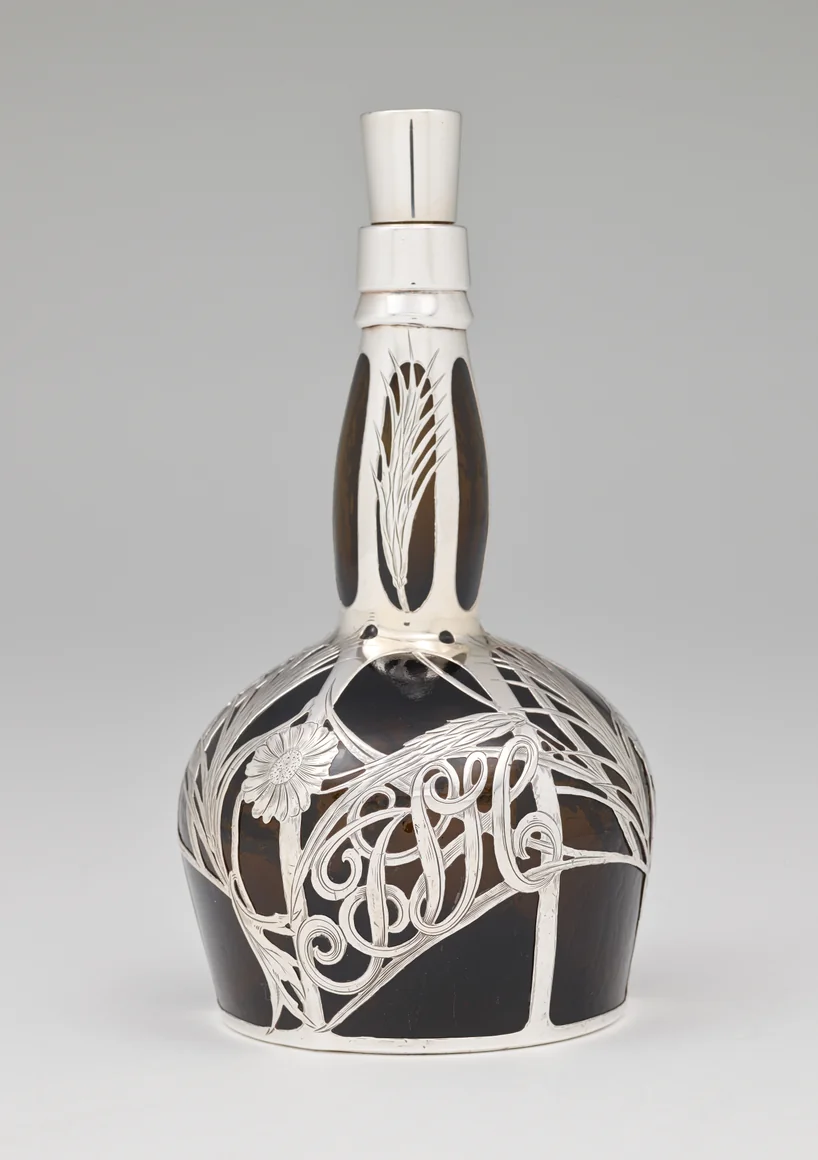
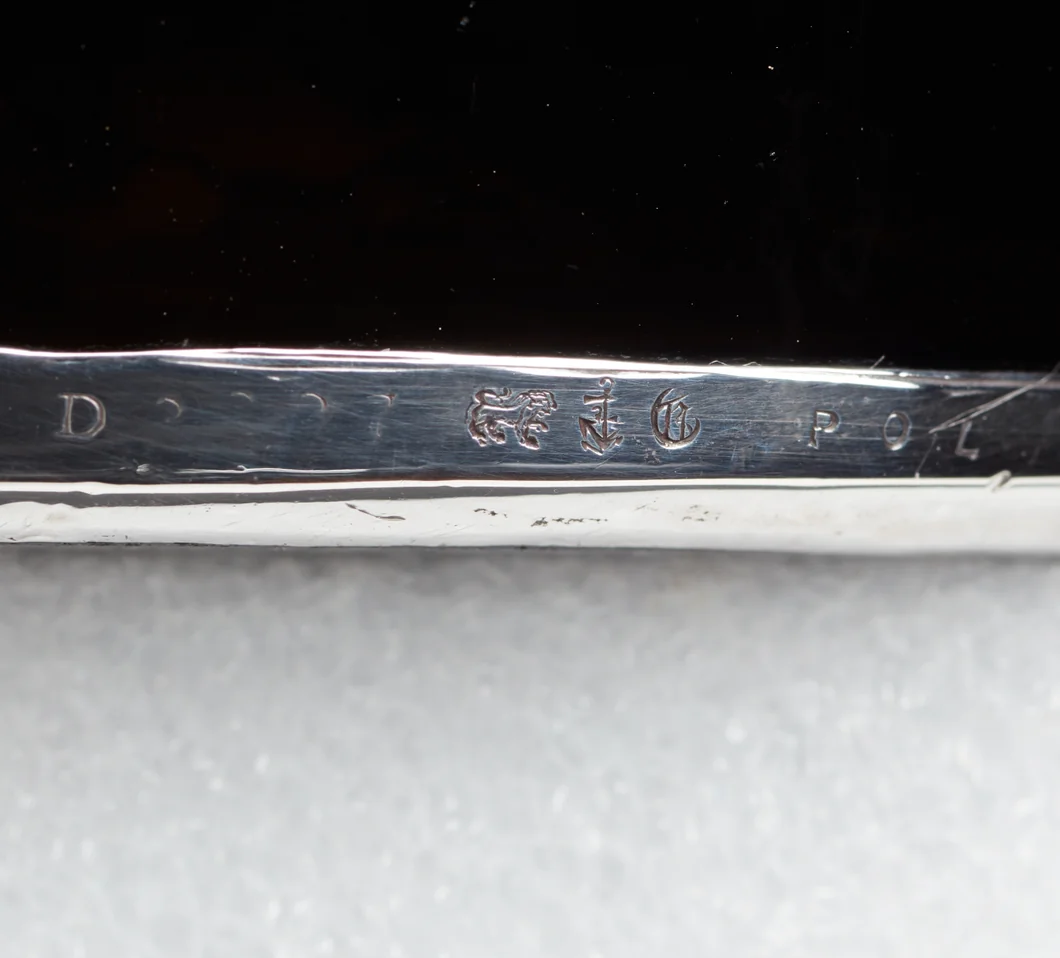
The division of labor is even clearer on Corning’s pair of red and green cologne bottles from 1899. Corning credits T. G. Hawkes & Company for the glass and Gorham for the silverwork. It identifies A. M. as the owner’s initials. The same acid-etched number appears on the body and stopper of each matching bottle. A name, a monogram and a number can answer different questions even on a single vessel.
If you find a piece like this
Photograph the whole piece, then the foot, the stem and the edge where glass meets silver. If it has a stopper, photograph it separately only if it lifts easily. Write each mark down exactly and note which part carries it. Use a light from the side instead of trying to polish a faint stamp clear. Keep a date, attribution or purity claim tentative if its evidence comes from a different example. For a pair, look at both pieces before using a blank stem to rule out a maker.
For related forms, see our silver and glass bottles guide. To compare the different meanings of marks, see sterling and silverplate markings and our guide to patent dates on silver.