
A coin dated 1928 was held back until 1933. By the time it went on sale, most of the batch had already been melted. The half dollars that escaped the furnace still carried a covered wagon, a low sun, and the old date. In a collector’s tray they looked almost like coins you could have bought in 1926. It was the small print in metal that made them a different proposition.
Two sides of a westward journey
Start on the wagon side. The oxen and their wagon crowd into the lower half, leaving the sky to a fan of rays. Turn the coin over and the proportions change. A standing Native American figure and bow cross a map of the continent; the denomination sits below. The U.S. Mint credits James Earle Fraser with the wagon side and Laura Gardin Fraser with the map side. The Smithsonian’s silver example, shown here, names both engravers.
Laura Gardin Fraser’s later Washington portrait took a very different path: first into gold, then onto a circulating quarter.
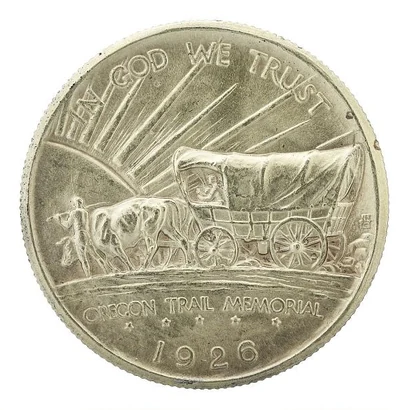
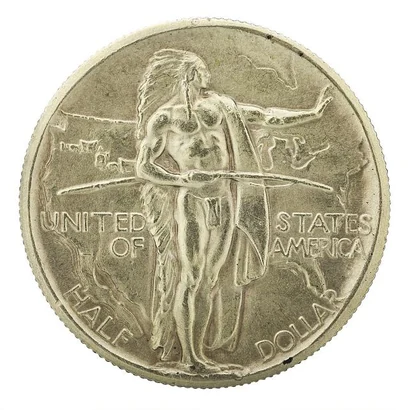
The wagon side makes the trip look like a clean line toward the horizon. On the other side, an outstretched arm crosses that line of movement. That tension is worth looking at even if the coin cannot tell us exactly what the gesture meant to its designer. The law honored the pioneers. The National Park Service’s history of the trails records another side of westward migration: the loss of land, resources and independence for Native nations. The coin puts a Native figure in the foreground, but it is still a 1920s commemoration, not a full account of the trail.
Six million allowed, not six million made
The 1926 law authorized up to six million silver half dollars. The Oregon Trail Memorial Association could obtain them at face value and order them in batches, rather than taking the whole allotment at once. That made a small silver coin a fundraising tool: the association could sell it for more than the 50 cents it paid. It also meant there was no reason, in the wording of the law, that the date on the first batch had to be the last.
Ezra Meeker, identified as the association’s president in the 1926 House report, had crossed the trail himself. In his own account, The Ox Team, he paired his 1852 journey with a retracing in 1906. The association’s campaign was not simply about selling a picture of a wagon. The law’s stated purposes included marking places on the trail and erecting monuments. What took Congress by surprise was how long the coin kept coming back after the first issue.
The date survived. Most of the batch didn’t.
A 1937 House committee report, page 4, describes what happened. It says about 50,000 were struck in 1928, about 44,000 were remelted in 1933, and about 6,000 were left to offer. Those are the committee’s figures, not a count of survivors. The committee was making a case against repeated commemorative issues. Its price table lists the 1928 issue at $2 originally and $5.25 by the time of the report. Those are historical reported prices, not present-day values or proof of what each buyer paid.
But that report gets an important detail wrong for collectors. It puts the 1928 run at San Francisco. The Mint’s own coinage tables place it at Philadelphia and give a gross figure of 50,028. They list a separate San Francisco run in 1926. The 1928 coin, unlike that 1926-S, carries no S. Use the committee report to follow the dispute about melting and prices; use the Mint’s tables and the coin itself to identify the issue.
In 1933, when some 1928-dated coins finally became available, Denver struck fresh ones dated 1933. The Mint identifies that Denver run as the branch’s first commemorative coinage. A buyer could therefore encounter two versions of the same design in close succession, but one carried a date five years older than the other. For the 1928 batch, the date told buyers when it had been struck, not when they could get it.
The Treasury’s fiscal 1937 report records another 12,000 issued under the same authorization. And 1937 was not the end. The Mint’s chronology runs through 1939, with gaps. In 1937 the House committee complained that a collector was expected to buy each date and mint. You do not have to share its frustration to see the point: a coin designed to mark one historic trail had become a series of editions.
What to check on the coin in front of you
The Mint’s tables give the standard as 192.9 grains and .900 fine silver. That’s about 12.5 grams total and 0.362 troy ounce of pure silver before any wear. The silver weight is the same standard across the issues; it does not explain why one date and mint might attract more collectors than another.
- Start with the date on the wagon side. Then turn the coin over and look for a small mint mark just left of the ground beneath the figure. An unmarked 1928 is what you should expect. The date and mint matter together; the wagon design alone does not distinguish the issues.
- Ask what a published number counts. An authorization is a ceiling. A gross mintage counts what was struck. A net figure may subtract recorded melts. A surviving-population estimate asks a different question, and a grading-service census is not a count of all survivors.
- Decide whether you want a design or a set. A single well-preserved example lets you study both Frasers’ work. Building a date-and-mint set is a different project. Do not buy a second version just because the name sounds different, or skip it because the imagery looks the same.
There is another piece of Western silver whose intended job was to mark one moment: the Nevada silver spike made for Promontory. The spike and the half dollar both turned a westward journey into something people could hold. The difference is that the spike marked a day. The coin’s story kept changing with every new date.
For a later example of when the design alone cannot identify the silver issue, see the Bicentennial Eisenhower dollar guide.