
Look at the hammer
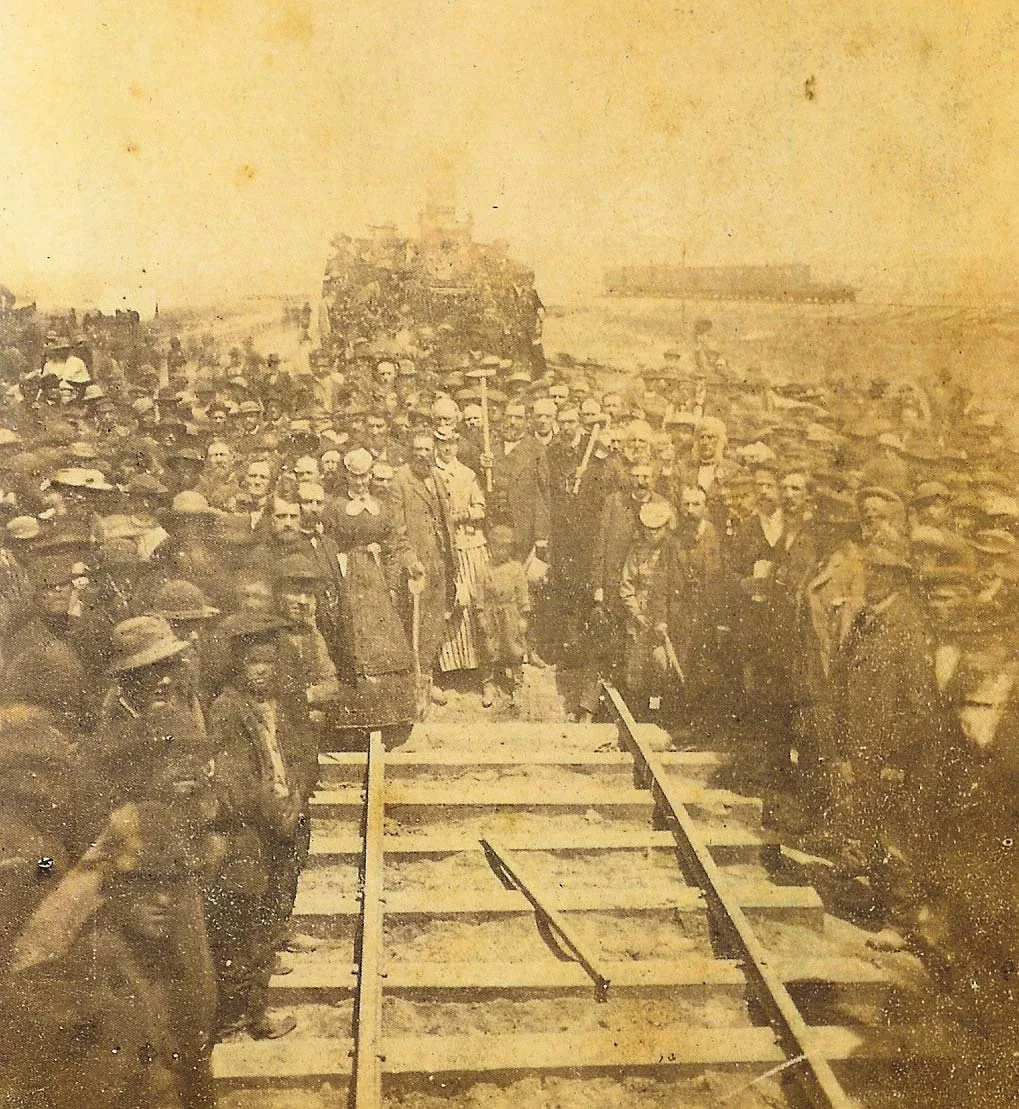
In Alfred Hart’s photograph, the rails lead your eye straight to a crowd. A locomotive towers over the men in the distance. At the center stands Leland Stanford, president of the Central Pacific Railroad, holding a hammer. The National Park Service identifies it as the silver-plated maul prepared for the ceremony. For all the sparkle in the story that followed, that object was not made of solid silver.
It was May 10, 1869, at Promontory Summit in Utah Territory. The Central Pacific and Union Pacific were joining their tracks, and people from both companies had gathered to mark the occasion. California’s gold spike would supply the enduring name for the event. But the hammer in Hart’s picture, and a separate spike rushed from Nevada, tell a different story about what silver was doing there.
Nevada’s spike nearly missed the train
The National Park Service traces the silver spike to Frederick A. Tritle, a Nevada railroad commissioner who placed the order on May 5. Virginia City assayers E. Ruhling & Co. provided the silver. Robert Lodge forged the spike in a blacksmith shop. Forging shaped the metal with blows rather than pouring molten silver into a mold. The first result was rough and carried the assayers’ stamp.
Even a ceremonial spike needed transportation. It was hurried to Reno in time to reach Stanford’s eastbound train. The work wasn’t quite over, either. After the ceremony, the spike went back to Virginia City, where Nye & Co. polished it and engraved the dedication to Stanford. The words present Nevada’s silver as the link between the iron of the East and the gold of the West. They now look inseparable from the object, but they weren’t what its first audience saw.
The exact Nevada spike is pictured in the National Park Service’s object guide, credited to Stanford’s Cantor Arts Center. It is not the hammer shown in Hart’s photograph, nor is it the spike that stayed under a rail.
The same metal, two different jobs
The maul came through different hands. L. W. Coe of the Pacific Express Company had San Francisco toolmakers Conroy & O’Connor make it. Vanderslice & Co. plated it with silver. A forged silver spike and a silver-plated hammer were both appropriate for the ceremony, but silver runs through one and covers the outside of the other. You cannot learn which is which from a bright surface, much less from the colors of an old photograph.
The event’s hardware was more varied than its name. Alongside Nevada’s spike were two gold ones and a spike from Arizona made with an iron core and gold and silver on the outside. A polished laurelwood tie had holes prepared for the presentation. Precious-metal spikes could be set into it as ceremonial objects rather than left in place as track fastenings. The Park Service describes the special spikes and tie being taken up and the permanent fastening made with ordinary iron spikes.
The country heard the news by wire
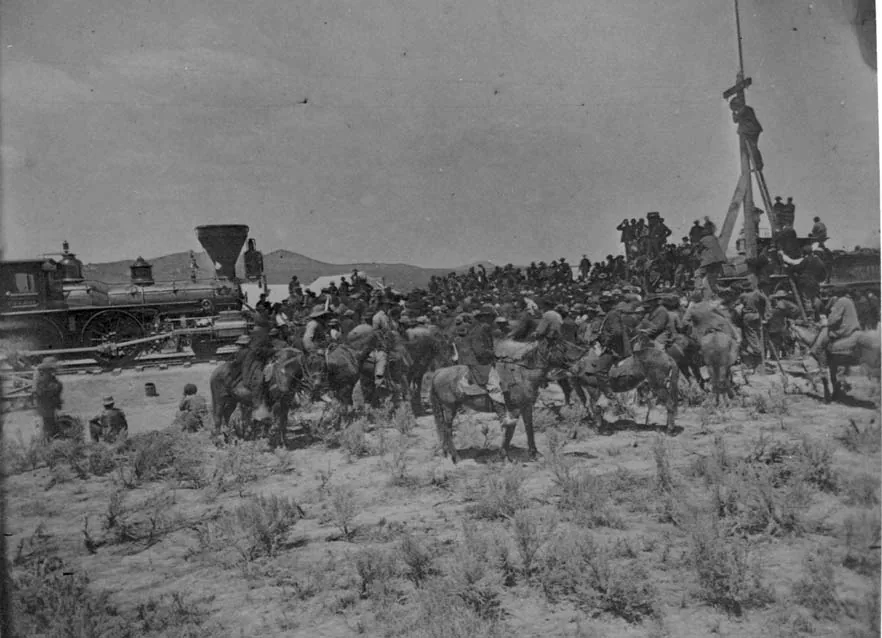
The railroad was not the only line being joined to the day’s events. Telegraph crews readied a setup to carry the signal of a hammer blow to people far from Utah. In another Hart photograph, a crowd presses toward the site and men are high on a telegraph pole. The equipment that would carry the moment out of the valley was right there among the spectators.
Descriptions differ on how the taps reached the wire. A detailed Park Service study cites a contemporary account that credits Stanford and the golden spike. The Park Service’s public history describes the demonstration with an iron hammer and iron spike after the ceremonial pieces were removed. What the record establishes is the telegraphed news of completion, not that a solid silver hammer sent it. The next day, Washington’s National Republican printed a dispatch announcing that the final spike was driven and reported bells ringing in Philadelphia.
What the photograph leaves out
Hart caught the ceremonial tools in the hands of the officials. He did not capture the years of work it took to put those rails there. The Park Service’s historical study places Chinese track layers at work on the last rail before the formal ceremony. Laborers did the work of building the railroad; officials and photographers arranged the moment that would stand for it.
That gap is part of what makes the objects worth reading. The Nevada spike records a state’s claim to the celebration. The silver plate on the maul records how a tool was dressed for it. The inscription tells what people chose to remember, and when they chose to put it into metal. To read the story, start by asking which object a source actually shows, which part is silver, and which marks were added afterward.
Keep exploring
Sources
Historic photographs, the Park Service and contemporary reporting
- National Park Service: Four Special Spikes, Nevada spike, workshop details, maul, tie and presentation sequence.
- National Park Service historical study, Promontory Summit, May 10, 1869, printed pp. 21–25 and frontispiece, for Hart’s photographs, labor and contemporary descriptions of the telegraph. Preserved PDF copy.
- National Republican, May 11, 1869, Library of Congress, contemporary telegraphic dispatch and celebrations.