
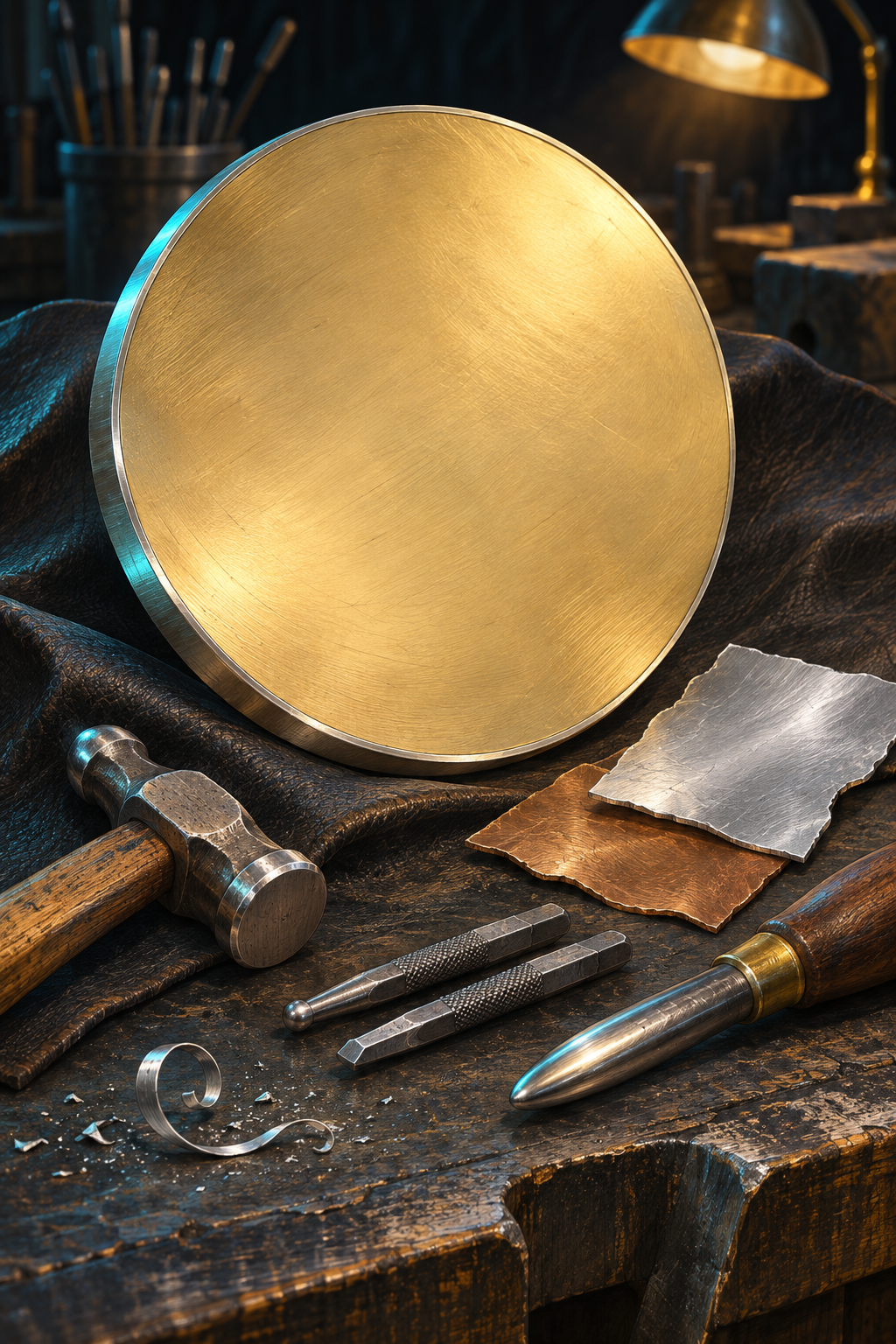
The craft behind the podium
An Olympic medal brings several stories into one object: an athlete’s achievement, a host’s design, and the skill of the people who worked the metal. For anyone interested in silver, there is another attraction. The material beneath a modern gold medal’s surface can be silver, giving the metal a place on two steps of the podium.
Looking closely means going beyond the color. Which Games produced the medal? Who designed and made it? Is it an athlete’s award or a commemorative object? Those questions reveal more than a general claim about what an “Olympic medal” contains.
When first place meant silver
At Athens 1896, the first modern Olympic Games, first prize included a silver medal, an olive branch and a diploma. Second place received bronze; third place received no medal. The Olympic Museum’s reference piece was designed by Jules-Clément Chaplain and made by Monnaie de Paris. Its edge bears the mint’s cornucopia mark and the word ARGENT.
The familiar gold, silver and bronze sequence for the first three places began at St Louis 1904. Solid-gold awards belong to this early history: Guinness World Records identifies Stockholm 1912 as the last Games to award them. The Olympic Museum’s Stockholm gold reference medal weighs only 26 grams. It is a useful contrast with today’s much heavier silver-based awards, and a reason never to apply one modern specification to every historical piece.
A minimum is not a complete recipe
The IOC’s June 2018 Host City Contract requirements specified silver of at least .925 fineness for first- and second-place medals, with at least six grams of pure gold gilding the first-place award. Read the two quantities separately: .925 describes the silver material’s purity, while six grams describes the gold coating’s mass.
Those are dated requirements, not an assay of every finished medal. A host may choose a higher silver fineness, and a medal may include other materials. “Gold medal” does not establish solid-gold construction, and “silver medal” does not establish 100 percent silver. Nor does “bronze” guarantee a single copper, tin and zinc recipe across Games. For a particular object, the edition’s documented specification comes first.
Tokyo 2020: electronics become awards
Tokyo’s medals offer a well-documented example. The Japanese Olympic Committee reported approximately 556 grams for gold and 550 grams for silver. The Olympic Museum records 450 grams for bronze. These are three different weights, not one standard weight assigned to every color.
The Olympic Studies Centre identifies Junichi Kawanishi as designer and Japan Mint as manufacturer. It lists the gold medal as silver with more than six grams of gold, and the bronze award as red brass containing 95 percent copper and 5 percent zinc. Here, the sporting name “bronze” and the metallurgical description need to be read together.
The metal also carried a public connection. The IOC describes extracting precious metals from small electronic devices donated across Japan for the Tokyo medal project. Recycling provided feedstock for new medals; the devices themselves were not simply pressed into medal shapes. This is a story about recovering useful material as well as honoring athletic effort.
Paris 2024: a jewel with an iron center
Paris took a different approach to connecting an award with its host. Each medal incorporated an 18-gram hexagon of original Eiffel Tower iron. The IOC gives total weights of 529 grams for gold, 525 grams for silver and 455 grams for bronze. That iron matters when interpreting the weight: it cannot be counted as silver.
The Olympic Studies Centre lists .925 silver and six grams of gold for the gold award, alongside its iron insert. Chaumet designed the medals, and Monnaie de Paris manufactured them. The raised rays around the center were struck into the surface, giving the design relief and changing the way it catches light.
The French Olympic committee’s workshop account describes repeated strikes, heating between strikes, and individual engraving and ribbon fitting. The ribbon sits in a groove rather than a conventional hanging loop. These details make craftsmanship visible: the finish, relief, insert and attachment all have to work together in the completed object.
Identify the object before valuing it
For a collector, begin with the Games, the medal category and the maker. Compare both faces, edge inscriptions, dimensions and material descriptions with an official reference. Keep the ribbon, case, award documents and ownership history together when they survive. An attractive surface photograph alone cannot establish who received a medal.
A Sotheby’s and Goldin catalogue entry for a Helsinki 1952 gold medal offers a useful example of careful description. It records the edge hallmark and worn gold plating, but explicitly says the event for which it was awarded is unknown. A documented uncertainty is more useful than an invented athlete connection.
Quantity needs similar care. A country’s medal-table tally, the number of athletes receiving physical medals, and the number a mint produced are different measures. Team events alone explain why a podium result cannot be treated as a count of individual objects.
Metal value is only one part of the story
A metal-value estimate starts with the identified components and their precious-metal content, then uses prices for a stated date. Multiplying the entire object’s weight by the gold price would badly misdescribe a silver-gilt medal. Even a careful materials calculation does not establish what a collector will pay.
A useful collecting assessment also asks about condition, documented ownership, the particular Games and the strength of any athlete attribution. Compare like objects and distinguish an auction estimate from an actual result. These are questions for evidence, not a shortcut to an investment promise.
The original article’s appeal remains: Olympic medals reward a closer look. Silver, gold, copper alloys and even historic iron become objects that preserve a sporting moment. Understanding their construction helps us appreciate both the makers’ work and the achievement the medal represents.
About this edition
Original source and editorial notes
Adapted from original material by Rich Silver. Original publication: The Fascinating World of Olympic Medals: The Craftsmanship, History, and Value ↗ (2024-08-07).
Reviewed 2026-11-05. Expanded from the article published August 7, 2024. Corrects the universal pure-silver and fixed-bronze claims, the Tokyo silver-medal weight, and the confusion between medal-table totals and physical medals. The .925/6 g minimum is attributed to the dated June 2018 IOC contract, not asserted as an unchanged rule since 1912. Stockholm 1912’s last-solid-gold status is attributed to Guinness and paired with an Olympic Museum object record; no claim that every 1912 first-place award was identical is made. No current melt price, price forecast or appraisal is offered. Adds craft, identification and collector-value coverage beyond the existing Olympic silver short fact.
Sources & further reading
- Olympic Museum: Athens 1896, first-place silver medal, reference 140119 ↗
- IOC: Olympic innovations, St Louis 1904 ↗
- Olympic Museum: Stockholm 1912, gold winner’s medal, reference 140233 ↗
- Guinness World Records: Last Olympic gold medal ↗
- IOC: Host City Contract, Operational Requirements, June 2018, pages 279–281 ↗
- IOC FAQ: Responsibility for Olympic medal design and approval ↗
- Japanese Olympic Committee: Tokyo medal unveiling, July 24, 2019 (Japanese; Kyodo report) ↗
- Olympic Museum: Tokyo 2020, bronze winner’s medal, reference 160358 ↗
- Olympic Studies Centre: Olympic Summer Games Medals from Athens 1896 to Paris 2024, Tokyo 2020 and Paris 2024 entries, pages 36 and 38 ↗
- IOC: Tokyo 2020 highlights the possibilities for a circular economy ↗
- IOC: Paris 2024 Olympic and Paralympic medals revealed, February 8, 2024 ↗
- French National Olympic and Sports Committee: Inside the manufacture of Paris 2024 medals, June 26, 2024 (French) ↗
- Sotheby’s and Goldin: 1952 Olympic Helsinki Gold Medal, 2020 auction, lot 99 ↗