
Look at what’s on the lid
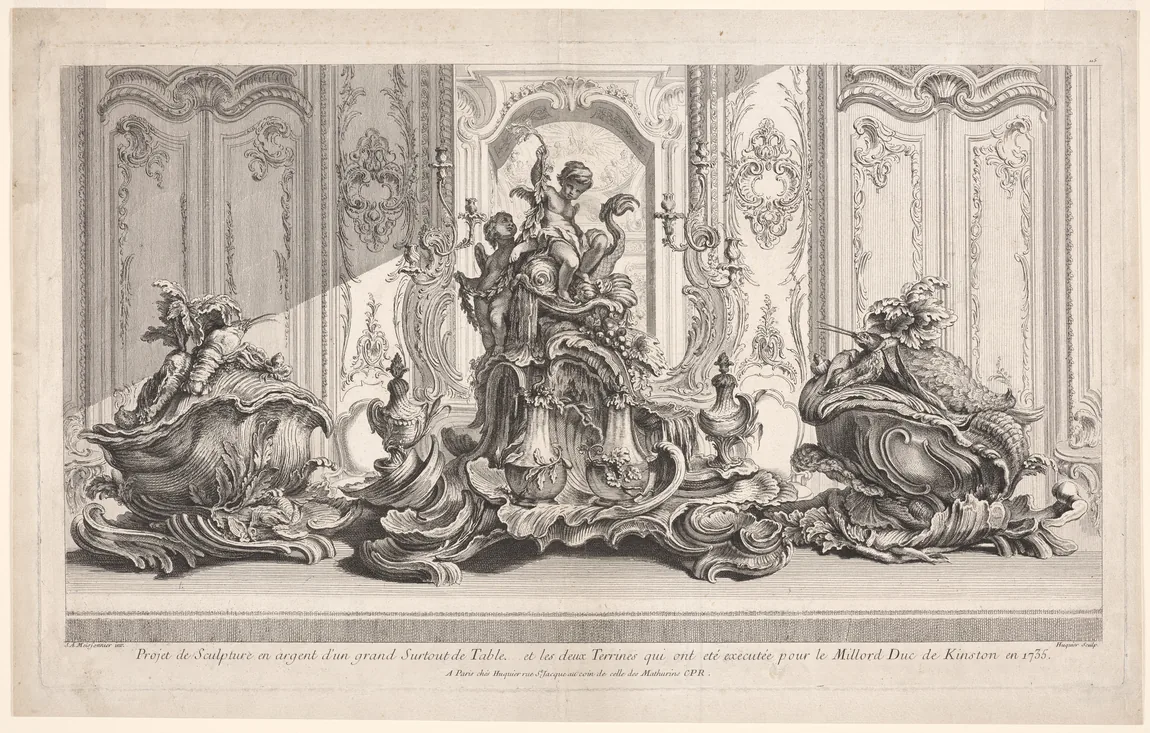
In a French print from the 1730s, two silver tureens seem to stand on either side of a great centerpiece. The caption names a real customer, the Duke of Kingston, and the pair of tureens made for him. It looks like a record of what stood on his table.
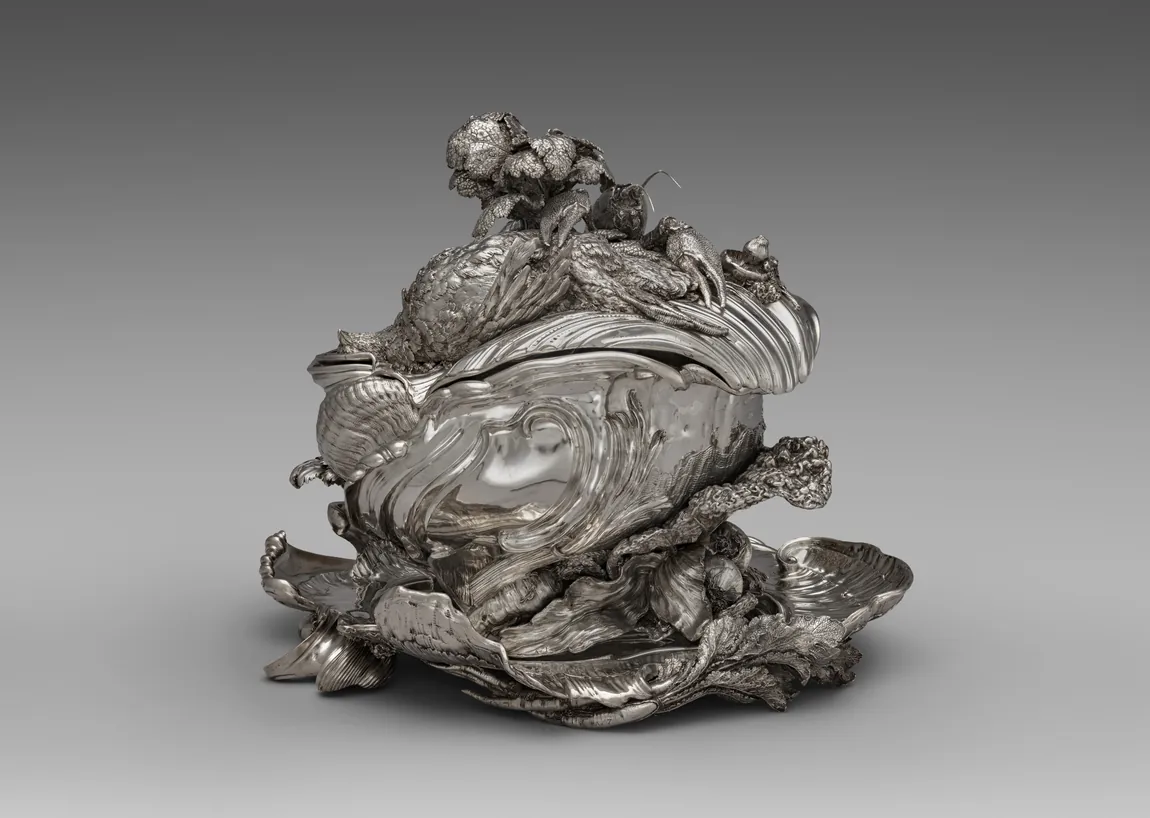
But look at the creatures on the lids. One of the surviving tureens carries a crab. The Cleveland Museum of Art’s version carries a long-bodied crustacean with conspicuous claws, which the museum identifies as a crayfish on its object page. The museum reads the two vessels in the print as separate views of its own tureen, not portraits of both surviving pieces. The grand centerpiece may never have been made at all. The print is evidence of a commission and of what the designer wanted people to see. It is not an inventory photograph.
A soup course dressed as sculpture
The patron was Evelyn Pierrepont, the second Duke of Kingston-upon-Hull. He commissioned the pair in Paris in the 1730s from Juste-Aurèle Meissonnier. The Cleveland museum dates its vessel to 1735–38 and calls it a pot-à-oille. The French oille was a stew; Cleveland’s curators connect the ingredients with the animals and vegetables on the cover. The museum says real specimens supplied details for some of the cast elements. A crustacean’s claws and the veins of a leaf were not abstractions here.
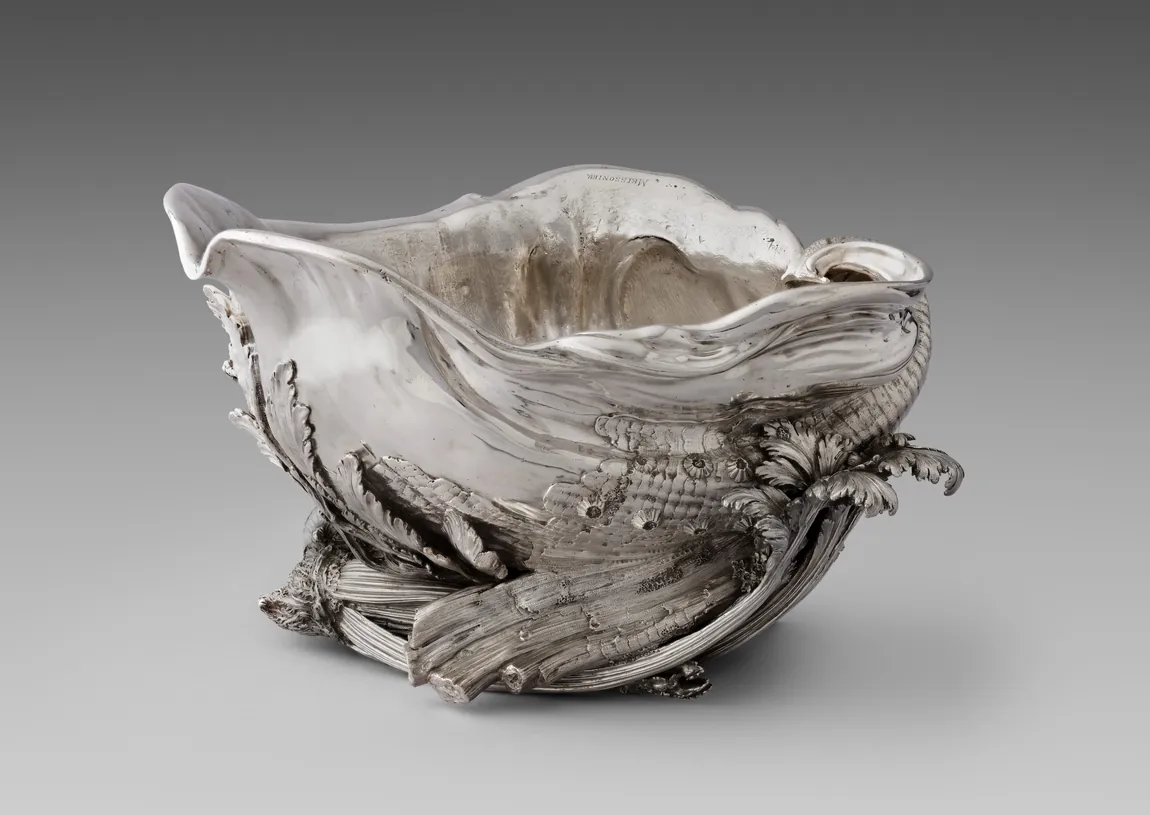
Take away the lid and the shape of a serving vessel comes back into view. The bowl has a smooth interior, a rim pitched like the edge of a shell, and an exterior crowded with stalks and leaves. Cleveland’s tureen weighs nearly 44 pounds, or 20 kilograms. It takes the form of a vessel for serving food, but it makes a formidable piece of sculpture. Christie’s describes vegetable leaves becoming handles on the other tureen. The forms make serving and looking inseparable.
The signature is only one name
Cleveland credits Meissonnier as designer and Pierre-François Bonnestrenne and Henry Adnet as makers. The signed stand gives something more personal: Meissonnier identified himself as an architect. The museum interprets the choice as a claim to a status beyond that of an artisan. The inscription and the makers’ marks belong in the same story. They answer different questions about who designed, who made and who claimed the work.
The Christie’s catalogue shows how the evidence keeps changing even after the eighteenth-century names are accounted for. It documents the other tureen’s body, cover and stand separately. It also lists an insert with a much later inscription: a liner signed by Ubaldo Vitali and dated 1998. “A signed eighteenth-century tureen” can be a sound description of the main object without being the date of every part inside it.
Sold together, then apart
The records trace both tureens back to the duke and then to Elizabeth Chudleigh, his widow. Several links in the later Russian ownership chain remain qualified in the catalogues. The paths converge securely in the published record at Christie’s in Geneva, where the two were sold together in November 1977. The buyer, dealer Peter Zervudachi, separated them. One entered the Cleveland Museum of Art; the other passed into the Thyssen-Bornemisza collection and sold again as a single tureen in 1998, when the Blaquier-Arrieta family acquired it.
The paths are visible again in two places. Cleveland included its tureen in the exhibition Juste-Aurèle Meissonnier: Rococo Goldsmith in Focus, scheduled through March 14, 2027. The museum also offers a digital 3D view following new conservation work and photography. Christie’s catalogued the other tureen for a December 1, 2026 sale in London. Open that lot record to compare its crab, fish and duck with Cleveland’s lid. Neither record places the two surviving tureens together.
How to read a pair that no longer sits together
Compare small details before making big claims. A shared shell form and related ornament can suggest that two objects belong to a commission. A crab on one cover and a crayfish on the other help keep their identities straight. Marks and inscriptions can trace who made a piece; an auction record tells you when the pair appeared together. The print can show how Meissonnier presented his work without telling you what each finished vessel looked like. Keep those kinds of evidence separate and you can recognize a pair without mistaking one piece for the other.
Keep exploring
Sources
Museum records and sale catalogues
- Cleveland Museum of Art: Covered Tureen on Stand, 1977.182, full object, attribution, inscription, provenance and digital model.
- Cleveland Museum of Art: bowl, 1977.182.a, lid-off collection photograph of the same object’s bowl.
- Cleveland Museum of Art: Huquier etching after Meissonnier, 2000.76, period image and the two-views identification.
- Christie’s: lot 6616796, the other tureen, its decorative motifs, later liner and recording of the 1977 and 1998 sales.
- Christie’s: December 1 sale overview.
- Cleveland Museum of Art: exhibition and dates; conservation and 3D photography.