
The candle and the little mirror
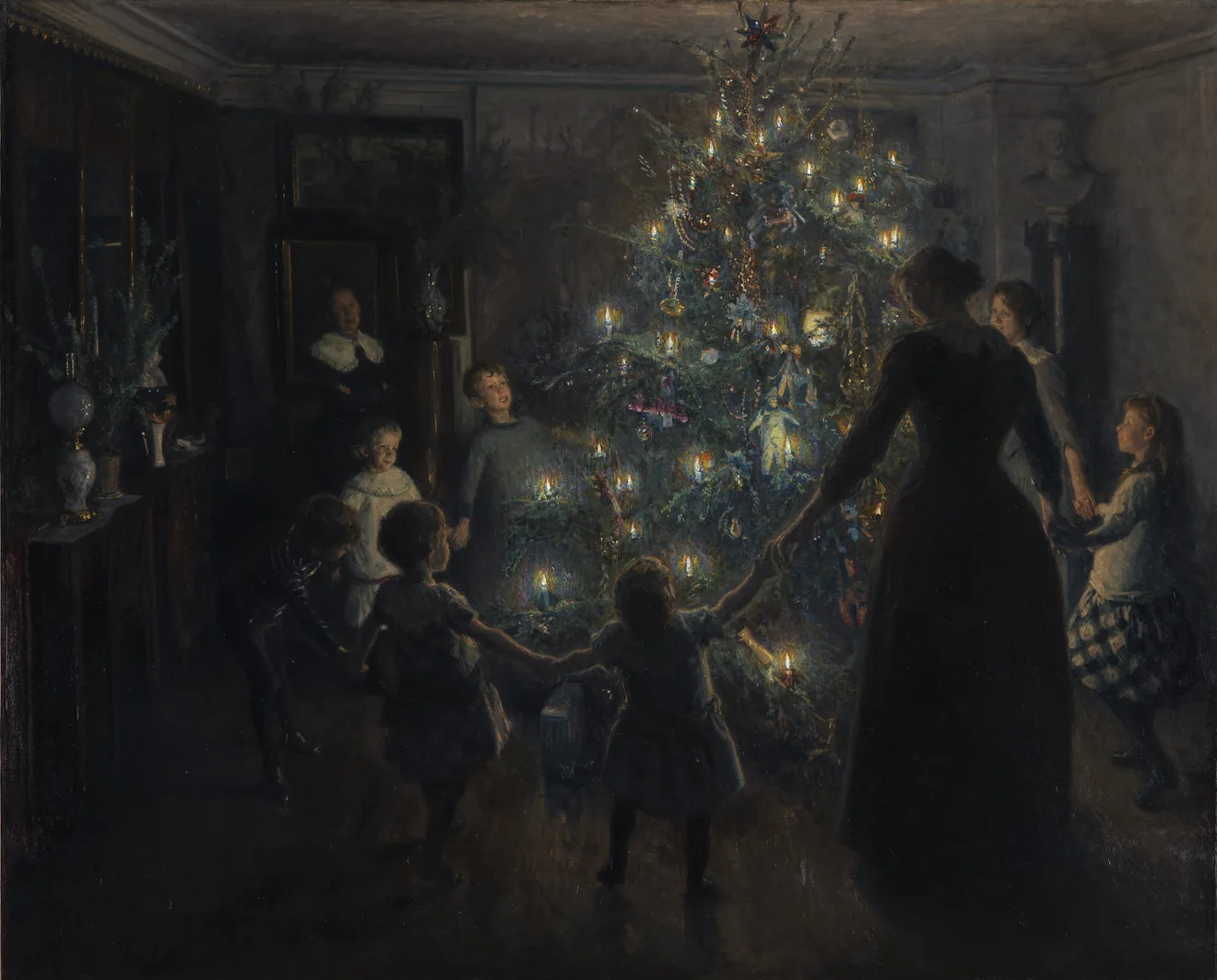
In Viggo Johansen’s 1891 painting Glade jul, light comes from the tree itself. Small flames break up the darkness, and the room falls away around them. The painting is Danish, not a portrait of Lauscha, and it can’t tell us what the ornaments are made of. It does show what a candlelit tree asked of a decoration: catch a little light and send it back into a dark room.
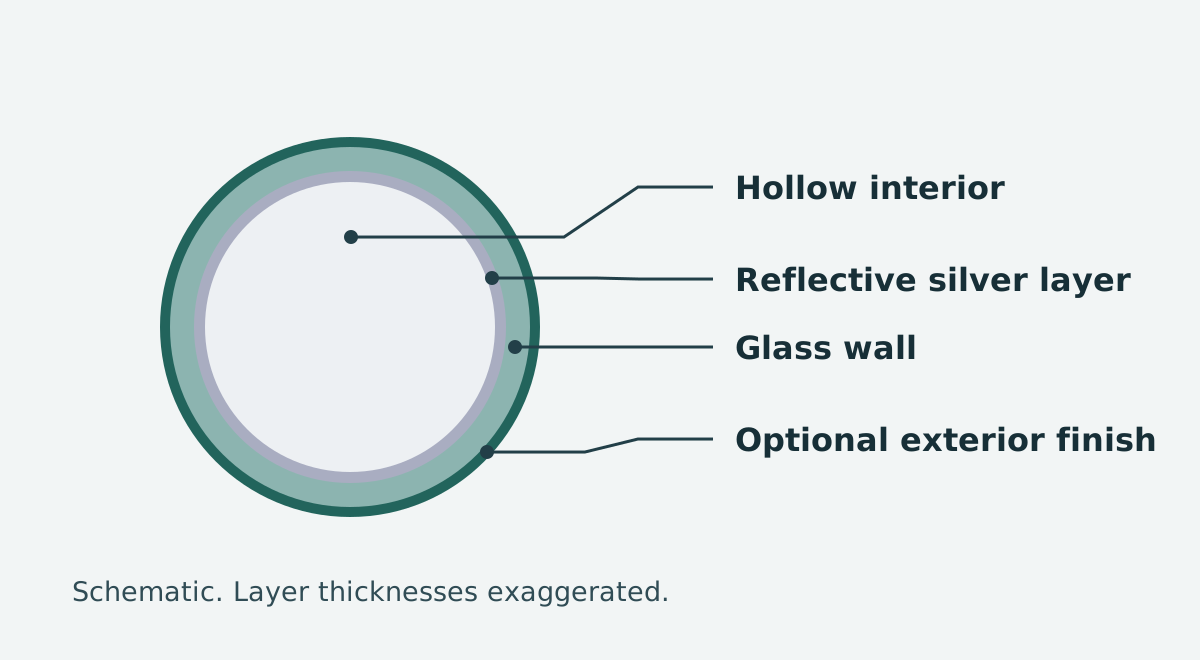
A hollow glass bauble can do that even when the color you see is on the outside. The German Commission for UNESCO describes a sequence still practiced in Lauscha: make the glass shape, silver it on the inside, then apply lacquer and painted decoration. In a silvered example, the glass makes the shape and the silver acts as a mirror. Look right through a clear or translucent area and you can see the light reflected by the layer behind it.
The ball in Berlin has a lead mirror
The German Historical Museum’s small blown-glass ball, AK 2013/1166, has a fused hook and an interior mirror. It dates the ornament to 1870–79 and identifies the mirror as lead, not silver. Its account says silver-nitrate mirroring increasingly displaced lead in the 1860s and 1870s. Here is an ornament from the time of that change which still used the older mirror. The dates tell us that the techniques overlapped, not that any one workshop switched in a specific year. See the museum’s lead-mirrored ball.
Lauscha’s Museum of Glass Art places simple glass balls in the 1830s and the expansion of the ornament trade in the 1870s. These are milestones in a local craft, not a single invention date. The Berlin record lists Germany for the object itself. It describes the region’s trade for context, but it doesn’t identify who made this particular ornament.
The one in Corning is silvered within
The Corning Museum of Glass catalogs a different bauble, 63.3.63-21, made about 1880–1910, probably in Germany. It has a yellow rib, pink and turquoise bands, and a metal cap with two wire loops. But the detail that explains its shine is one you could miss on a quick read of the record: the hollow glass is silvered on the inside. The cap hangs the ornament. It isn’t the source of the reflection, and the catalog does not call it silver. See the silvered ball at Corning.
This difference is useful when you take an old ornament out of its box. Keep the words “silver-colored” for appearance, “silvered glass” for a documented coating, and “sterling” for a documented alloy. A reflection alone can’t tell you which metal or finish made it. With vintage glass, photograph the finish and both sides of any box or label. Leave an old coating and a fragile cap in place rather than testing, scraping or polishing them.
Silvering also changed flat looking glasses and precision mirrors. Why telescope makers wanted their silver on the opposite side.
A lightbulb machine makes ornaments
At Corning, a set of eleven Shiny Brite ornaments takes the story across the Atlantic. The museum dates the set to about 1938–60 and describes the ornaments as machine-made, enameled and silvered. In the museum’s account, entrepreneur Max Eckardt’s earlier work in the glass-ornament trade near Lauscha connects that set to the German workshops. A Corning Glass Works machine built to produce lightbulbs formed the glass ornaments. They went on to New Jersey for decoration. See the Shiny Brite set and the story of the production line.
A silvered ornament and a sterling Christmas sixpence can both flash in the same room. The bauble’s mirror is a thin coating on glass. The modern sixpence is a silver alloy all the way through. Both are part of holiday traditions, but the material does a different job in each. Read the Christmas sixpence story or explore the wider Ornaments guide.
Lauscha’s 2026 ornament market
Lauscha’s city program lists the 2026 Kugelmarkt on November 28–29 and December 5–6, local time in Germany. Check the current program.