
Three lines on a ski pendant
A ski pendant bears three lines on its back: GUSTERMAN / GEORGETOWN / STERLING. One is a workshop name, another puts a place on the piece, and the third states the alloy. There is no year. For dating the pendant, that is a limit. For finding a story, the town is a good place to start.
The workshop name leads to Astrid and Stig Gusterman. The family’s account dates their move from Sweden to the United States to 1949 and records Stig’s personal mark as SGn. That is not the mark on the pendant. A workshop stamp does not say who did the bench work. It also does not prove where the piece was first sold. No record establishes that this pendant was sold at the Christmas market. The connection is the people who helped start it.
The silver town before the silversmiths
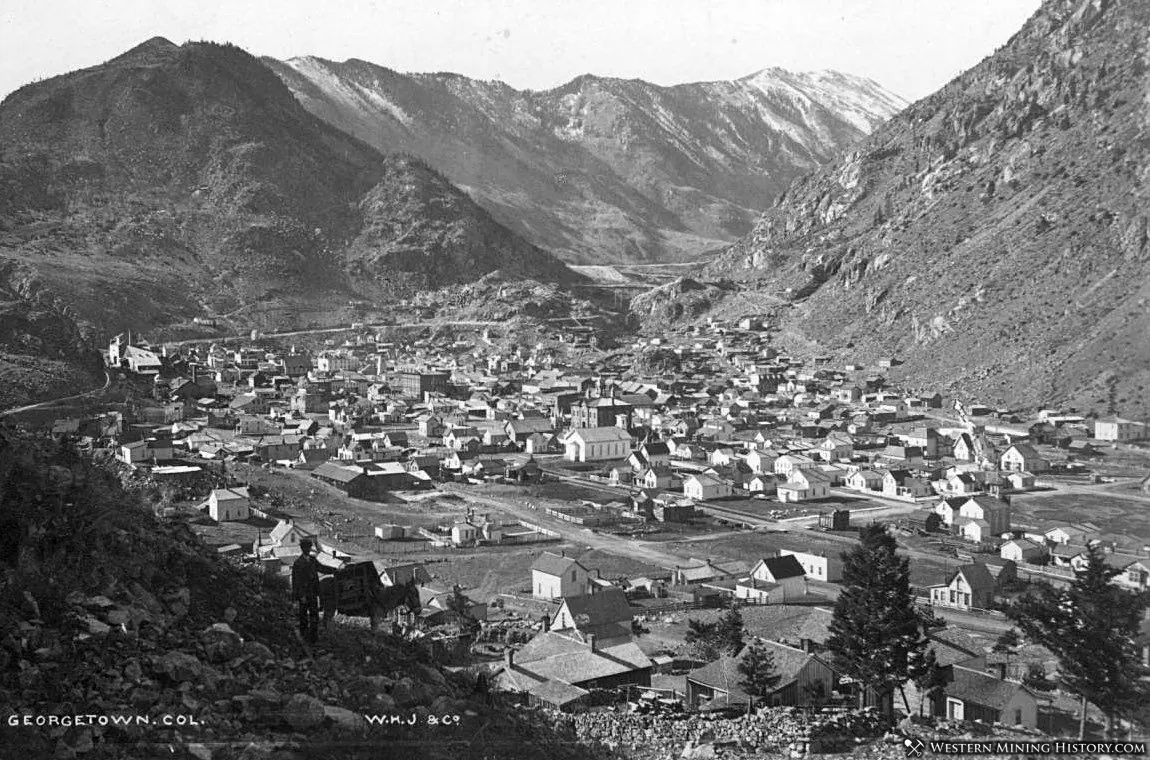
William Henry Jackson’s photograph shows Georgetown spread over the floor of a narrow valley. In federal Historic American Engineering Record documentation, the silver-mining town was known as the Silver Queen of the Rockies. Georgetown was already courting visitors by the time a mining slump hit in 1880. Long before the Christmas market, the town had reason to think about what would bring people up the valley besides ore.
Decades later the Gustermans worked silver on a different scale. The mining records tell us about the town; they do not tell us where the silver in a ski pendant came from. To see the earlier part of this story, start with the nearby Lebanon Silver Mine.
A Christmas market before the stalls
By 1960, drawing customers in winter was still a problem. In a 50th-anniversary account for Historic Georgetown, Cynthia Neely traces the market to the Gustermans’ memories of Christmas markets in Sweden and to the work they did with Odie Baehler and Annette Holmes. At first there were no vendor booths. There were roasted chestnuts, a Santa Lucia with a crown of lights, and a horse-drawn sleigh carrying carolers through town.
Neely describes children gathering pinecones for wreaths and rolling beeswax into candles in the early years. Much of what went on sale was made in town. A December 1969 newspaper account describes chestnuts and sleigh bells, and reports that Astrid was carrying on the silversmithing business she and Stig had started together. The paper records both kinds of work while the market was still young. It does not date the pendant.
A second generation, in two places
According to the family memorial for Britt Gusterman, the daughters opened a shop together in Santa Fe’s Sena Plaza in 1981. Britt made jewelry; Kerstin managed the business. Neely records another role for Kerstin: she helped plan the Georgetown market with Janice Moore and Patti Fraley. The craft traveled; the winter tradition stayed in the town where the family and their neighbors had made it their own.
The pendant’s stamp cannot tell us who held the tool or when the piece left the shop. It can still point to a workshop with a documented place in the life of a silver town. That is a better starting point than trying to read a date that is not there.
Keep reading: workshops and designers in silver jewelry · what a maker’s name actually tells you.
The procession in 2026
Historic Georgetown’s published 2026 schedule lists the market for December 5–6 and 12–13, with the Santa Lucia Children’s Procession at noon each day in the program at Rose and Sixth streets. That schedule is for 2026 only.
Sources and image rights
Read the records behind the story
- Gusterman family history: migration and Stig’s mark; not evidence of current ownership.
- Historic American Engineering Record, CO-103: Georgetown’s mining and tourism context.
- Cynthia Neely, The Silver Queen Preservation News, fall 2010, p. 3: Historic Georgetown’s market anniversary account, mirrored by Scribd.
- “Woman Grants Wish of Husband,” Kenora Daily Miner and News, December 18, 1969, PDF p. 10: contemporary coverage of the market and Astrid’s continuation of the silver business.
- Britt Gusterman’s family memorial, published in the Santa Fe New Mexican, September 2026: her work and the Sena Plaza opening.
- Historic Georgetown’s 2026 schedule: only this season’s dates.
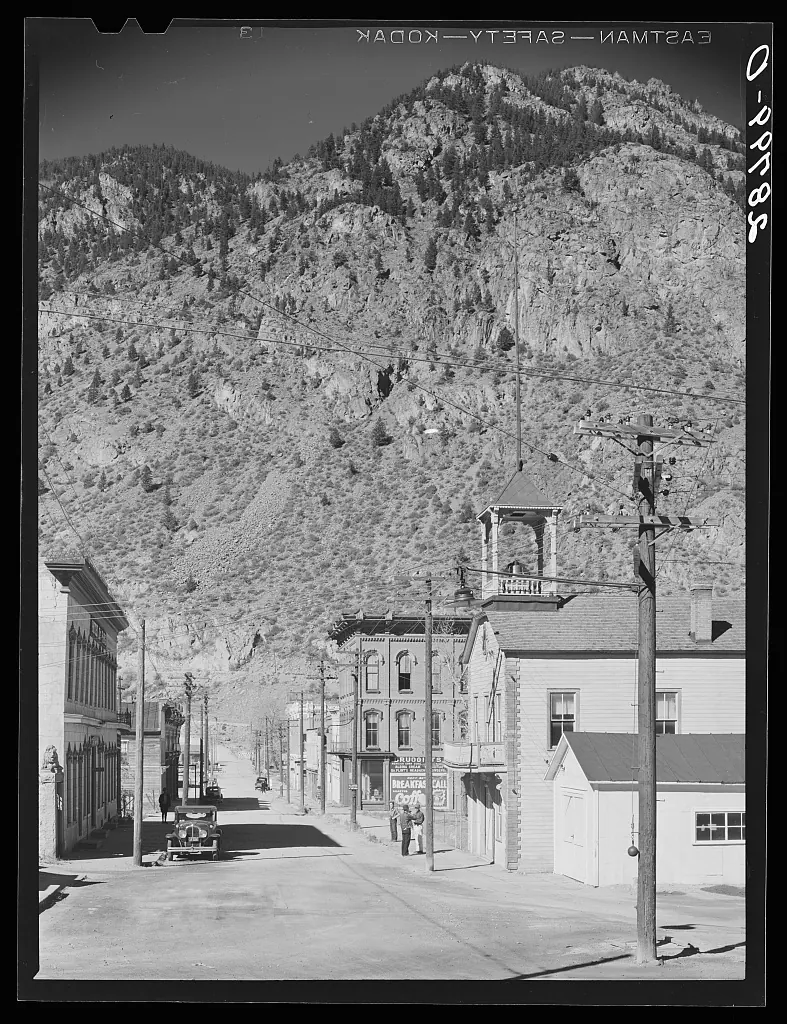
The two documentary photographs show Georgetown well before the inaugural market. Neither shows the pendant, the Gusterman storefront or the market itself.