
Why the Kennedy eagle sits low
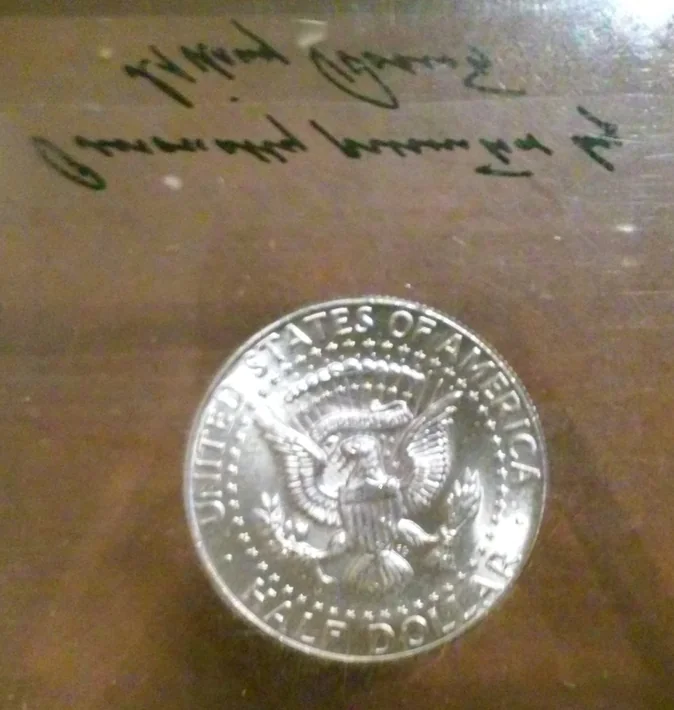
Turn over a 1964 Kennedy half dollar. Look at the eagle first, then back out to the ring of stars. The eagle is the center of the picture, but it doesn’t stand up above everything else. Frank Gasparro, who designed the back, said he set it low on purpose. He wanted the ring of fifty stars and the lettering around the edge to seem to radiate from it. He enlarged E PLURIBUS UNUM because the version on the presidential seal was too small to read easily on a coin.
There was a lot to fit. Gasparro counted thirteen arrows in one claw and thirteen leaves and olives on the branch in the other. He had already worked on the seal for the 1961 U.S. Mint presidential medal. For the half dollar, he had to lower the relief and reshape the field so the design would strike as a coin. In the engravers’ account preserved by the Mint, the back is Gasparro’s story. The front is Gilroy Roberts’s, right down to the part in Kennedy’s hair.
What an eagle carried to the Moon
The next time Gasparro put an eagle on a major new dollar, the bird wasn’t posed like a seal. Its wings flare, its feet are down, and the Earth is small enough to fit under the motto. Look close and you’ll see that the bird still has an olive branch. What’s missing is the bundle of arrows.
The source wasn’t a presidential medal. It was the Apollo 11 mission insignia. In the Mint’s original account of the Eisenhower dollar, Director Mary Brooks asked Gasparro for “a peaceful eagle.” The bird coming down to the lunar surface does most of the work. The branch makes the purpose of the gesture clearer, while the little Earth and the ground beneath its feet tell you where you are. The thirteen stars on this reverse refer to the original states, not the fifty-state ring on the Kennedy design.
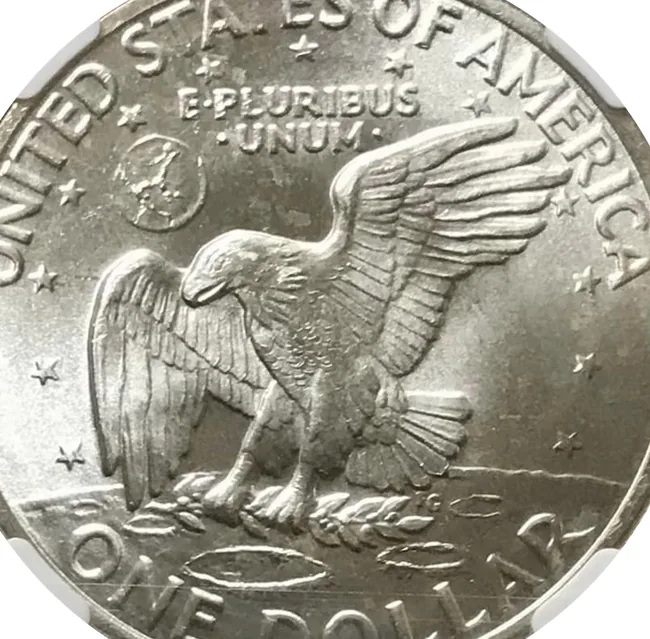
Try this with the coin in hand: Find Gasparro’s initials beneath the tail feathers on the Eisenhower reverse, then look up to the Earth. The eagle spans most of the space between. On a Kennedy half, let your eye follow the stars around the bird instead. The easiest difference to see isn’t the date or denomination. It’s the way each artist’s choice makes your eye move around the coin.
The eagle doesn’t tell you whether it’s silver
The original Apollo reverse appeared on both copper-nickel circulation strikes and 40% silver collector issues. The picture alone doesn’t identify the metal. The 1971 launch announcement priced the silver uncirculated issue at $3 and the silver proof at $10, while reserving the copper-nickel dollars for circulation. By 1973 the Mint was making a copper-nickel proof alongside the silver issues. Read the date and mintmark together, then check the specifications for that exact issue.
The Moon stayed after the eagle left
On the dual-dated 1776–1976 dollar, the Moon is still there. The eagle isn’t. Dennis R. Williams designed the Liberty Bell and Moon reverse for the Bicentennial competition. Gilroy Roberts, by then chief sculptor at the Franklin Mint, sat on the National Sculpture Society judges’ panel. Gasparro’s Eisenhower portrait stayed on the front. Three sculptors connect these designs, but they didn’t all do the same job.
Take the next coin in the sequence to our Bicentennial Eisenhower dollar guide. It shows how to tell the silver issue from the clad ones, even when the photo in a listing makes them look alike. For more of Gasparro’s work at the model stage, see the Smithsonian’s collection of his designs.
After you find Gasparro’s initials under the eagle, try a quarter. The three letters beneath Washington’s portrait took 90 years to get there.