
The hair part
On December 17, 1963, Jacqueline Kennedy examined a trial half dollar bearing her husband’s likeness. She liked the design on both sides. But she wanted the part in his hair less pronounced, with a few more accents. Gilroy Roberts went back to the model. It was about five inches across. The coin Americans would hold was barely a third that size.
We know this because Roberts put it in writing. His account preserved by the U.S. Mint tells us which model he worked on, when he revised it and how quickly the Mint had to move. It also shows how much more was at stake than getting Kennedy’s hair right. Roberts had to preserve a recognizable face while flattening a medal into something a coin press could reproduce by the millions.
A few years later he was working on a different kind of silver disc. It had no denomination and no president. On one Smithsonian example, there are two roadrunners and a cactus. On another, a single avocet stands while seven fly in the distance. The move from Kennedy to birds looks like a change of subject. It was also a change in who got to decide what a piece of struck silver was for.
Before the coin, the stamp
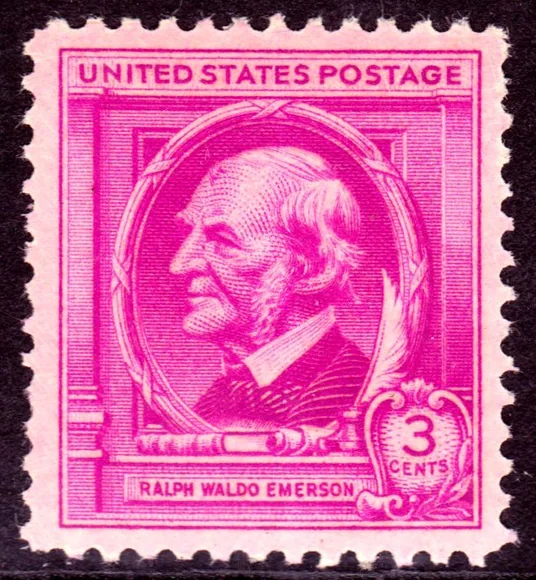
The three-cent Ralph Waldo Emerson stamp of 1940 is a useful place to begin. Under magnification, the dark areas of the portrait break into engraved marks. Printed close together, those marks suggest a shadow. With more paper showing between them, the same thin lines can suggest a cheek catching the light. Roberts was working at the Bureau of Engraving and Printing at the time; the American Philatelic Society credits him with engraving Emerson’s portrait. That’s a credit for the portrait, not the entire stamp.
A coin has to do a related job without ink. Move a lamp across Kennedy’s face and the shadows move with it. The line between brow and temple can appear or disappear depending on how you tilt the coin. Engraving a stamp and modeling a coin are different trades, but the stamp offers a way to see what Roberts was up against on both: he had only a small surface, and every mark competed for the eye.
Look closer: Compare the portrait in our Gilroy Roberts collector profile with the stamp on the same page. On the stamp, follow the drawn lines beneath Emerson’s cheek. On the coin, look for the change in surface around Kennedy’s cheek. One portrait is made with printed darkness; the other is made to catch whatever light is in the room.
What had to come off the Kennedy medal
Roberts wasn’t starting from scratch. He and Frank Gasparro already had models for a 1961 U.S. Mint presidential medal: Roberts’s portrait on the front and Gasparro’s version of the presidential seal on the back. That saved time, but it didn’t make the medal ready for the coin press. The two sculptors had to make separate decisions about what to keep, what to flatten and what to remove.
Roberts took out the coat and brought the head closer to center. He reshaped the background and lowered the relief on an intermediate model, then lowered it again for the trial dies. Gasparro had the reverse to solve. He had to make room for the coin’s lettering and make sure the seal’s tiny heraldic details were still legible. In his parallel account to the Mint, he describes sinking the eagle into the background and enlarging the motto. The two sides weren’t just shrunk to fit. They were redesigned to read clearly in a different metal object.
The Mint struck trials on December 13. After the December 17 review, Roberts softened the part in Kennedy’s hair. On December 27 he took new strikes to Treasury Secretary Douglas Dillon for review. Congress’s authorization was approved on December 30, and working proof dies arrived on January 2. Denver began regular production January 30, followed by Philadelphia. The coins reached the public in March. The deadline was not for a handsome model. It was for dies that could make coins.
Two medals, one source for the half dollar. The U.S. Mint’s presidential medal supplied the models. The Kennedy inaugural committee’s medal was a separate object by Paul Manship. If a listing calls something a “1961 Kennedy medal,” start with the design and artist, not the seller’s title.
See both faces of an actual 1964 Kennedy half dollar in the maker profile.
What a medal press could do differently
The private Medallic Art Company shows why the difference between a medal and a coin matters to the artist. Its workshop could strike a medal multiple times, softening the metal with heat between blows when necessary. The American Numismatic Society’s production history traces the work through clay models, plaster casts and the tools that transferred a large design into steel. Multiple strikes gave the metal more chances to fill the deepest parts of the die. That was a different set of choices from those facing Roberts and Gasparro on a coin intended for mass circulation.
“Designed by” and “struck by” aren’t the same thing. Roberts made designs that Medallic Art Company struck, but that doesn’t make him a Medallic Art Company employee or make those medals U.S. Mint products. The same distinction carries into his later career: the Smithsonian can record Roberts as the designer and the Franklin Mint as both maker and issuer. On the Smithsonian American Art Museum’s silver Nixon–Agnew inaugural medal, the museum specifically credits Roberts with the obverse and Franklin Mint with fabrication.
A bird medal someone could order by mail
By 1970 Roberts was chairman of the Franklin Mint’s board. The company’s annual report describes Roberts Birds as introducing a larger, two-inch art medal for the company and says it offered five new birds quarterly. One early issue survives at the Smithsonian: the Ringnecked Pheasants medal, with three birds in flight and No. 3 and 1970 on the back. A May 1971 advertisement puts the business in human terms. It invited readers to buy one medal for $20 or five for $90. It advertised the offered medals as proof-quality solid sterling, each in its own clear case; the walnut display for five was an optional extra. The offer had a mail deadline. These are the company’s claims for that offer, not an assay of every medal collectors now find.
Those cases mattered. A half dollar was meant to be handled, spent and passed around. The birds were meant to be seen as a collection. In the Smithsonian’s descriptions, the Blue Jays perch together; the Quail are already in flight. The Roadrunner shares its shallow field with a cactus, while the Avocets use a lone foreground bird and a distant group. Notice how much the artist could express simply by choosing where one shape sat in relation to another. No bird has to project far out of the medal for it to seem near or far.
Collector’s tip: No. 24 doesn’t mean one of 24. The Smithsonian records the reverse of its Quail as naming the bird, giving its number in the series and dating it 1971. That number isn’t the specimen’s serial number or the mintage. The museum lists its material as silver. If the fineness matters to a purchase, look for a clear edge or hallmark photograph and accompanying documentation. The seller calling it sterling isn’t the same evidence as you seeing the mark. Our Franklin Mint collector guide is a good next stop if you’re comparing listings.
Back where Roberts made the coin
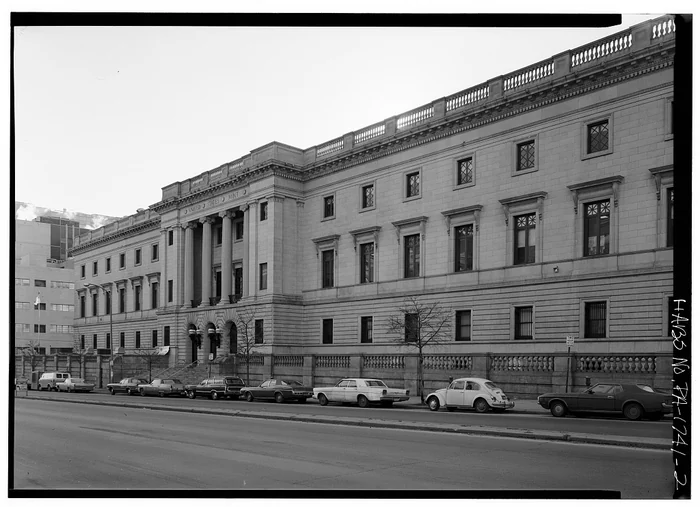
The old Philadelphia Mint at Spring Garden Street is now part of Community College of Philadelphia. Inside, the Gilroy Roberts Gallery brings the workshop back into the story: a recreation of his home studio, the tools he worked with, the molds he made, and examples of the objects those molds produced. The college rotates works from the collection, so look at the exhibit as a way into the process rather than a promise that any one medal will be out when you visit.
The next time a Kennedy half dollar lands in front of you, tilt it instead of just turning it over. See how little raised metal it takes to keep that face recognizable. Then think about the seven distant avocets. Roberts spent his career finding out how little depth a convincing image actually needs.
Read Frank Gasparro’s two-eagle story to see how the Kennedy reverse and the Apollo 11 dollar use the same bird differently.