
Start at the little bowl
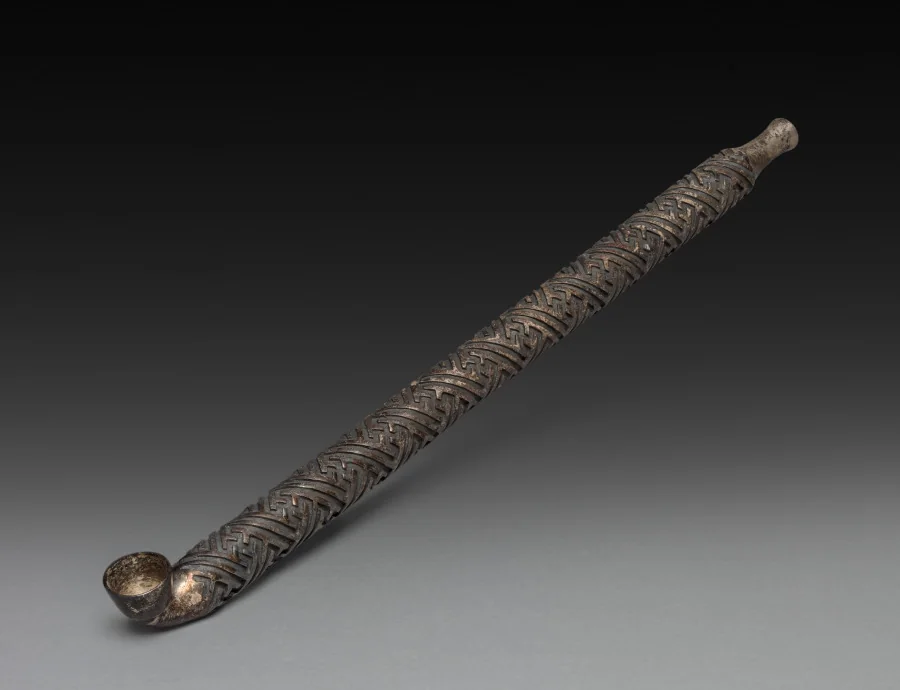
The bowl at the end of this silver pipe is an unexpectedly small detail. Most of the object is a long stem with a diagonal lattice worked into its surface. Cleveland dates the pipe to the 1700s through the mid-1800s and gives its length as 26.8 centimeters, a little over ten and a half inches. The mouthpiece narrows at one end. At the other, the neck curves up into a bowl hardly wider than the stem appears in the photograph. The Metropolitan Museum of Art explains the scale: a Japanese tobacco pipe, or kiseru, held a small serving of finely cut tobacco. It did not need a deep bowl to do the job for which it was made.
Cleveland catalogues this object simply as silver. That's enough to recognize what makes the pipe relevant here, but not enough to put a percentage on the alloy, say how the lattice was made, or identify the owner. The photo shows a dark surface broken by lighter areas near the bowl. It cannot tell us how much of that color belongs to the original finish and how much appeared later. Leave the dark surface in the story rather than treating it as a flaw to polish away.
The rest of the arrangement
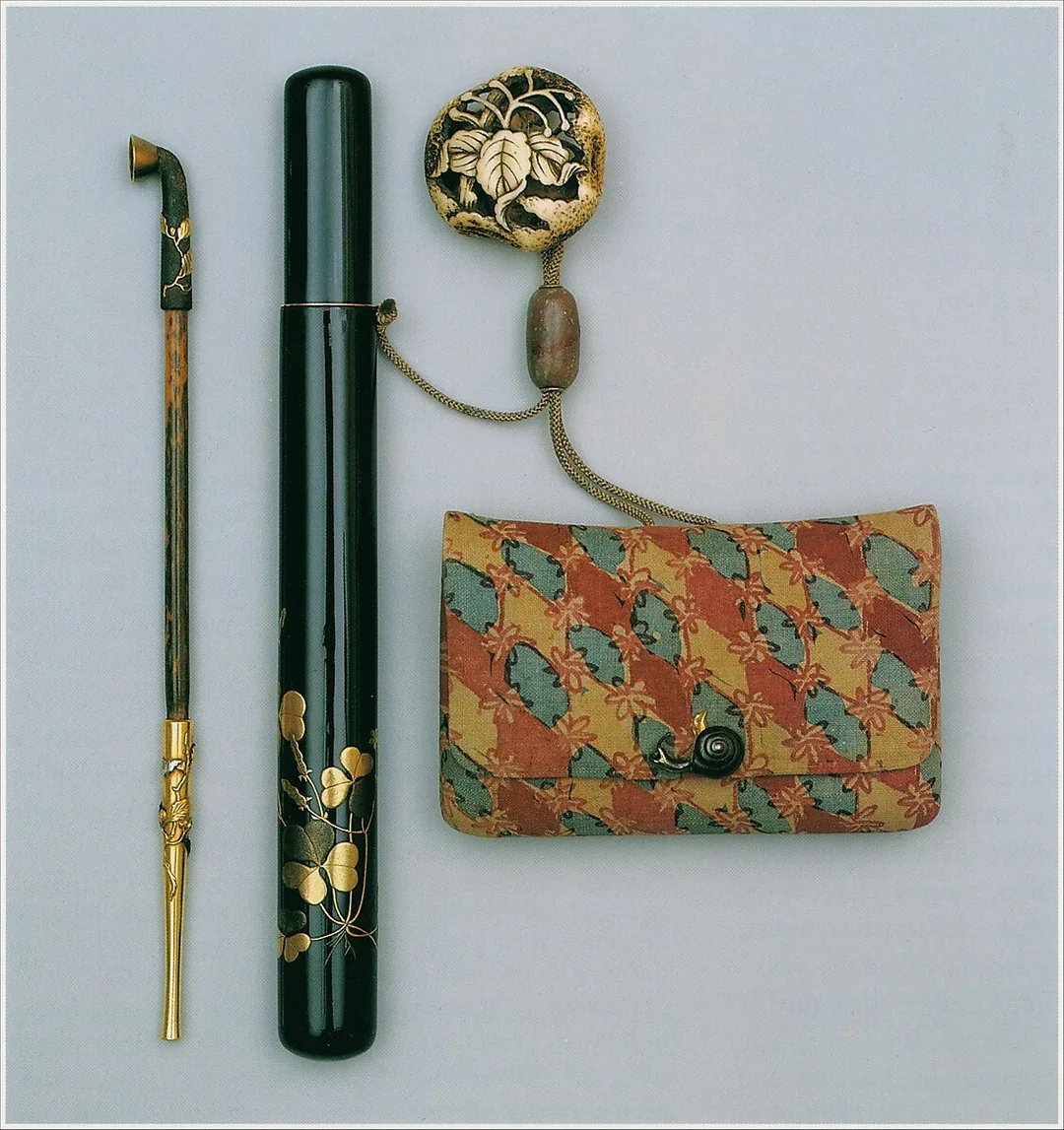
A pipe in a display case can look like a complete thing. Shibata Zeshin's early nineteenth-century ensemble shows what an isolated pipe leaves out. Beside the long, slender pipe is a black lacquer case. Look up and across the photograph: a cord leads toward a round toggle with a flower-like design, and the patterned pouch sits off to the side. What looks like a still life is a kit for carrying several objects in a specific relationship to each other.
The long case is a kiseruzutsu; the pouch is a tabako-ire. The small toggle is a netsuke. The Met says this case once hung from its owner's obi, or sash, held in place by that netsuke. The toggle isn't merely a pendant dangling below the pouch. It catches at the sash so the rest of the arrangement can hang between waist and hip. One of the easiest ways to understand the kit is to trace what holds what: sash to toggle, toggle to cord, cord to the pieces that contain the things being carried.
Display was part of the arrangement, too. The museum notes that a fashionable man could carry a coordinated pipe, case and pouch and that they became conversation pieces. We can read that purpose in Zeshin's wood-sorrel design without giving this particular owner an occupation or imagining an occasion we cannot document.
Find the silver again
Set Zeshin's ensemble beside Cleveland's pipe. Cleveland's one-word medium, silver, describes the pipe. The Met needs multiple lines to describe the ensemble. It identifies the pipe as iron, gold and silver on wood; its black lacquer case has decoration in gold and silver hiramaki-e, a flat form of sprinkled-metal lacquer decoration. The pouch is dyed cotton with a metal fitting; the netsuke is carved staghorn. There is no basis for calling every reflected highlight silver, or for treating the entire ensemble as a quantity of precious metal.
That component-by-component reading is useful beyond pipes. An iron incense box on our Japanese decorative arts guide carries gold and silver in a flowering-vine design. The gleam matters to the work without telling us what the whole piece is made from. It is worth recording both what carries the silver and what the silver contributes: a structural part, a line of inlay, or a decoration across a lacquer surface.
A print gives the pouch a speaking part
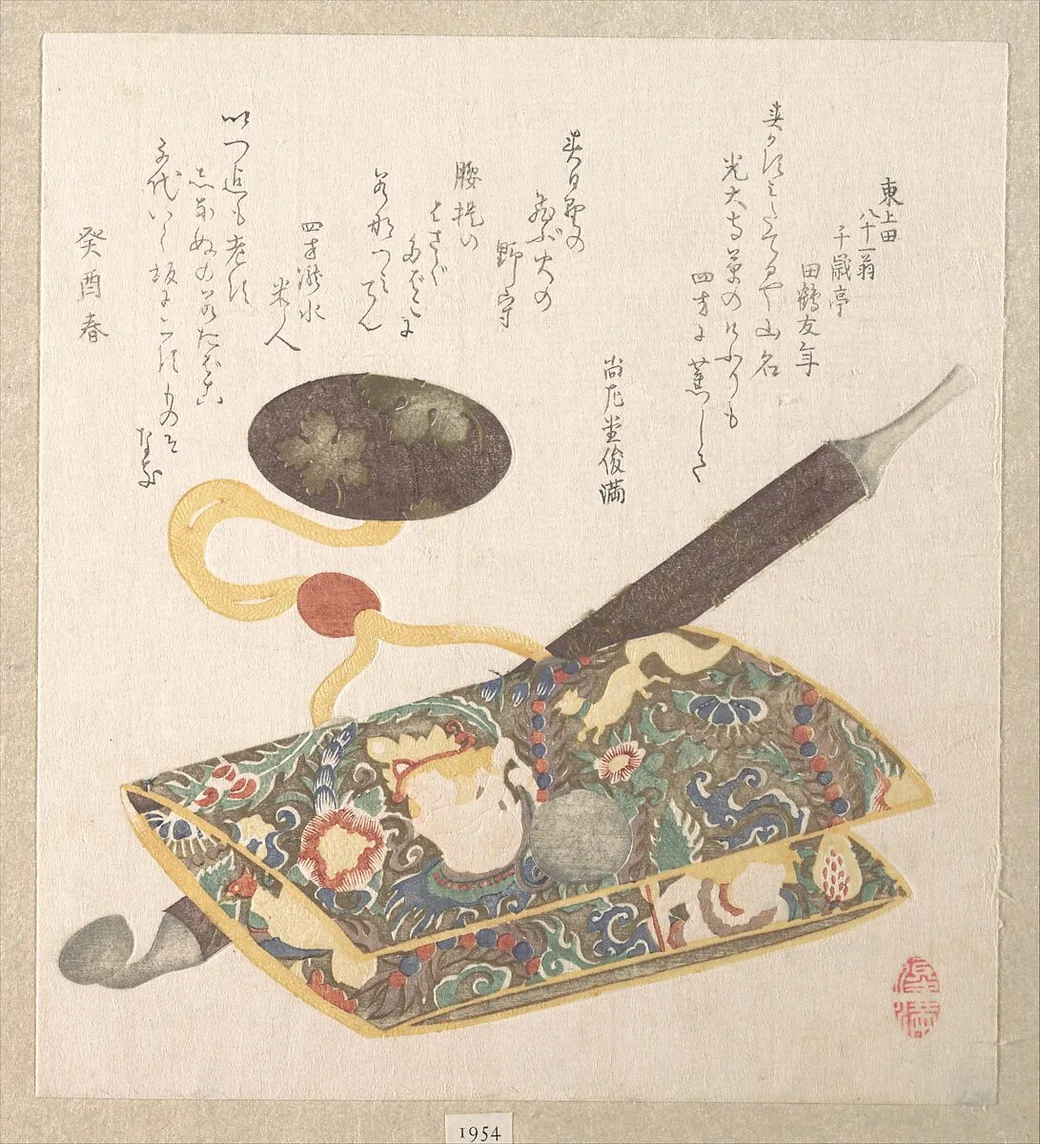
In 1813 the artist Kubo Shunman put a pipe and a richly patterned pouch into a small commemorative woodblock print. The pipe slopes across a corner of the composition. A cord, a bead and a dark oval toggle let the eye piece together the same sort of arrangement seen in the surviving case set, although this is not a portrait of Zeshin's example. The toggle's material and the pipe alloy cannot be identified from this picture alone.
Verses fill the space above the objects. The Met's reading connects the fires at Kasuga Temple in Nara with the smoke of a guard's pipe. What might look to a modern reader like a picture of accessories was also a prompt for poetry. The print doesn't show somebody wearing the ensemble. It does give us something the silver pipe by itself cannot: evidence that the things carried as part of this habit could be recognized and enjoyed as a subject in their own right.
The pocket isn't the whole story
It's tempting to explain all sash-hung objects with a single line about the absence of pockets. The fastening evidence gets us farther. In Zeshin's kit, the case protects a slender object, the pouch holds a different material, and the toggle supports them where they can be carried. The textile pattern and lacquer also make the kit worth looking at. This isn't the same object, or an interchangeable name, as a European chatelaine. Read the structures side by side and a sharper question emerges: what did a wearer choose to carry visibly, and what on the surviving piece lets us see how they carried it?
When recording a set, photograph each piece, both ends of the pipe, and the view that makes the connections clear without pulling them tight or taking them apart. Note the different materials and record missing components as missing, not as proof that the object never had them. A pipe can make sense on its own as metalwork. The case, cord and toggle make sense of the way someone once carried it.
Sources
Museum records and image credits
- The Cleveland Museum of Art, Tobacco Pipe, 1939.323. Exact hero, silver, dimensions, range and open-access record. API rights.
- The Metropolitan Museum of Art, Shibata Zeshin, Pipe and Pipe Case with Tobacco Pouch, 2015.500.2.43a,b. Exact object, component material descriptions and sash-use interpretation.
- The Metropolitan Museum of Art, Kubo Shunman, Tobacco Pouch and Pipe, JP1954. Exact 1813 print and interpretation of its inscribed poems.
- Terry Satsuki Milhaupt, Netsuke: From Fashion Fobs to Coveted Collectibles, Metropolitan Museum of Art, 2009. Fastening and broader dress context. Do not ascribe generic inrō threading or use to every tobacco kit.
- The Metropolitan Museum of Art, Tobacco Pipe, 91.1.1087, a second silver pipe, 29.2 cm, nineteenth century, Edo or Meiji; useful for an optional source comparison, not necessary to image.