
An iron made of silver
Cornelia De Groot remembered that her mother got her first ear-iron at twelve. It was silver. Four years later her parents bought her a gold one, and at sixty-eight she was still wearing it. That sounds like a jeweler’s upgrade until De Groot describes the thing itself: a helmet-like piece worn between layers of cap, with ornaments fastened near the ears. Her mother wore it to visit, to go to church, or to go to town. While working in the morning, she made do with a simple crocheted cap.
The Dutch word oorijzer translates literally as “ear-iron.” It names a piece of headwear, not the alloy, and it isn’t an earring. On the table, the Rijksmuseum’s seventeenth-century example looks more like a broken pair of spectacles than a piece of ceremonial dress. But nothing is obviously missing from this plain band: the silver curves around and finishes in two shaped knobs. The catalogue gives its weight as just 30 grams. Compare that with De Groot’s description of her mother’s gold piece, which she sometimes removed because it gave her a headache. The same word can cover quite different things to wear on your head.
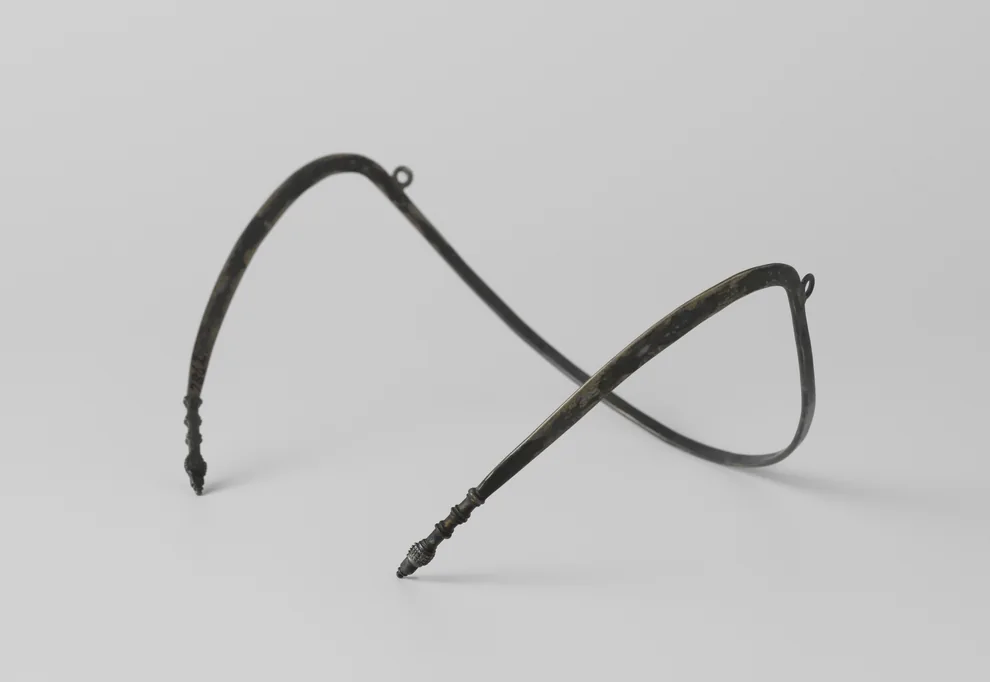
Where the pins went
To understand the silver band, set it next to a similar piece that isn’t silver at all. A gilt brass ear-iron found below Amsterdam’s Waterlooplein probably dates to 1575–1600. One of the little attachment eyes is missing. Both ends are decorated, though, and the Netherlands Open Air Museum explains why: those were the parts meant to show beneath the cap. Pins attached the cap to the metal, leaving the decorated ends out of the fastening.
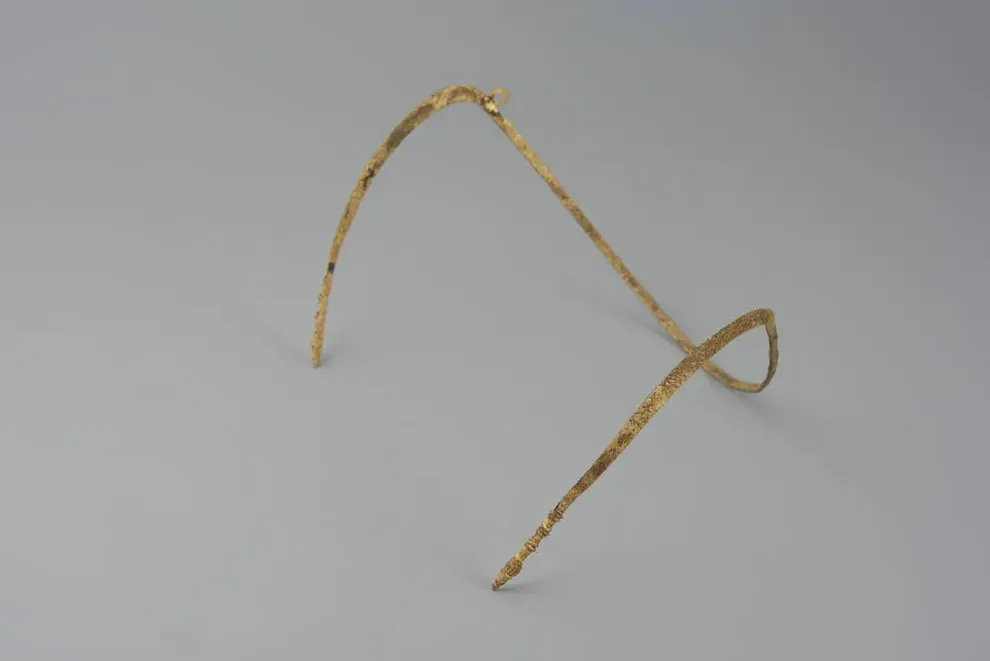
Look first at the curve, then at the tips. The curve gives the cap a frame to fasten to; the tips turn that hidden frame into something other people could see. A museum photograph on a plain backdrop gives both parts the same importance. On the head, they did different jobs. There’s no need to make the Amsterdam example the ancestor of the silver one to see what each makes easier to notice. The strongest comparison is about construction, not a family tree of designs.
How the long cap went on
In 1942, Thijs Mol photographed a woman demonstrating the long cap of Zandvoort. The museum’s account gives a dressing order you can follow. First came the undercap. The ear-iron went on over it, with square ends called boeken. Bells hooked into those ends, and a pair of side pins went in behind them. The long cap went over the frame. A separate pair of cap pins fastened the fabric to the ear-iron.
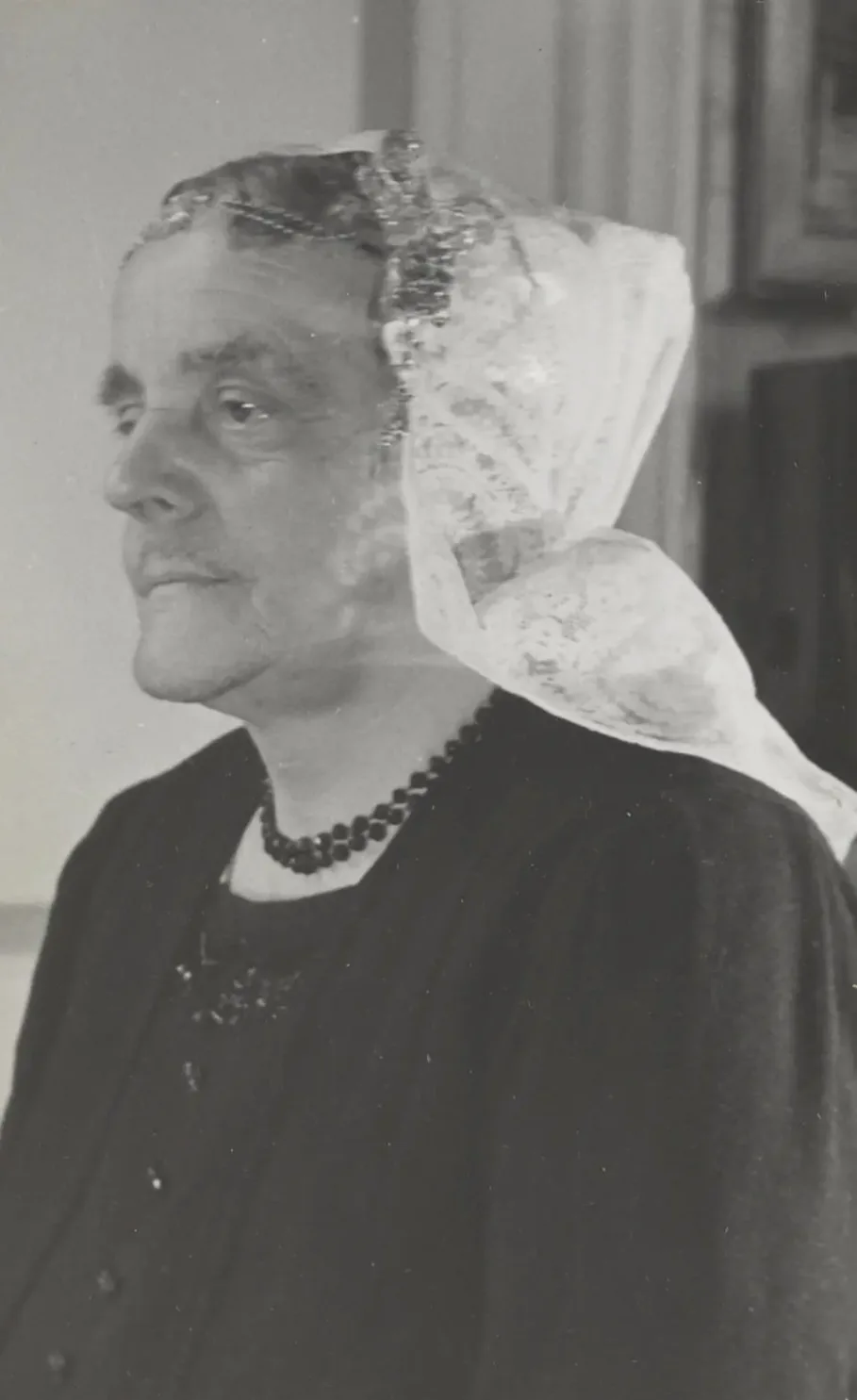
The portrait shows the result in profile: the edge of the cap near her face and the fabric hanging behind. You don’t see every fastening. That’s precisely what makes the museum’s account useful. The bells and side pins belonged to the visible dress, but the cap pins did a quieter job. They joined the cloth to something underneath it. This is a record of one place’s practice in 1942, not a photograph of someone wearing the Rijksmuseum’s silver band. The record does not specify the metal of the frame shown here.
What silver looked like when worn
For a photograph of a woman wearing an ear-iron specifically catalogued as silver, look to Staphorst, not Zandvoort. The museum dates this portrait to about 1900–1910. Its description works through the layers: an undercap, a silver ear-iron with spiralling ends, and a band around the ear-iron. Those spirals are a different answer from Zandvoort’s square ornaments. The catalogue also identifies silver buckles on her shoes. In this one picture, the metal appears at two places where the dress was held together.
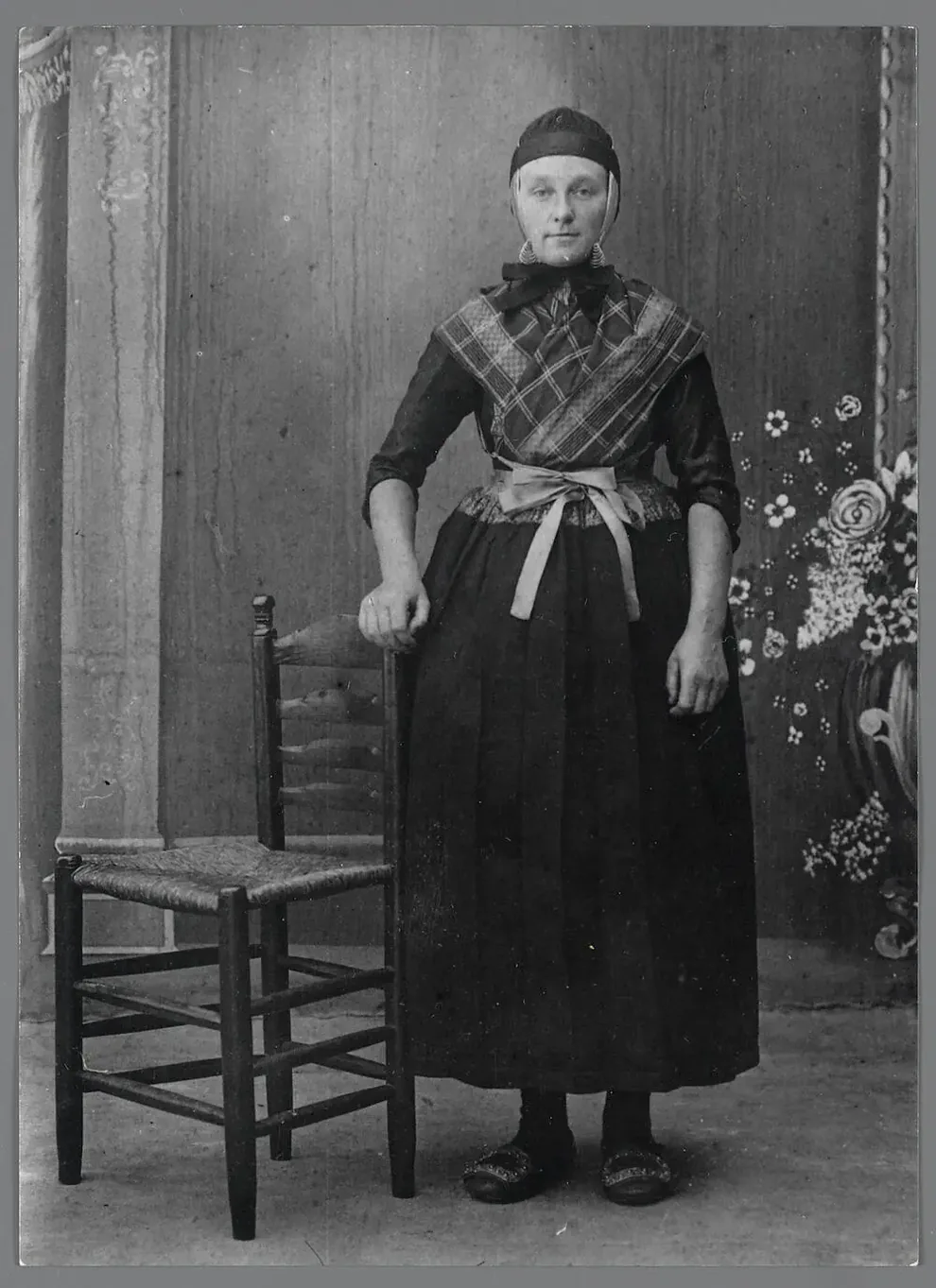
De Groot recalled distinctions in the materials people wore in her Frisian community, but she also remembered her mother changing headwear as the day changed. In one life a plain cap, a silver ear-iron, and an elaborate gold headpiece all had a place. The photograph from Staphorst records another place and another outfit. Neither gives us a universal code for telling a wearer’s income, marital status, or identity from one ornament. Even the silver in the Staphorst portrait is something we know from the catalogue, not something a black-and-white photograph can prove.
Start with the fit, not the shine
If you see a loose band and suspect it belonged to a cap, photograph the entire curve from several angles. Include both terminals, any little loops or holes, and any fabric, pins, or other attachments that came with it. The Amsterdam find is a reminder that the two sides may not match if a fitting has been lost. Don’t assume the band should be straightened, or that dull silver and worn gilding need to be polished to answer the first question. If it has a family history, write down where it came from before the pieces and their story become separated.
Then look for a comparison tied to the same place and kind of dress. A portrait is good at showing what the wearer wanted visible. A surviving band is better at showing what the maker put underneath. The most revealing evidence can come from one alongside the other. You can make the same comparison with these silver forehead spectacles: a photograph or portrait can supply something the objects alone can’t tell us about how a support fit the wearer. The personal dress silver guide has more examples of metalwork that fastened clothes as well as ornamenting them.
Sources and photographs
- Rijksmuseum, silver ear-iron BK-NM-7862: dimensions, material and description. CC0 object photograph.
- Netherlands Open Air Museum, gilt brass ear-iron N.3702: findspot, attachment eyes and visible terminals. CC0.
- Netherlands Open Air Museum, Thijs Mol’s Zandvoort photograph AA 17066: cap layers and attachment sequence. Public domain.
- Netherlands Open Air Museum, woman in Staphorst dress: silver spiral ends and silver shoe buckles. Public domain.
- Cornelia De Groot, When I Was a Girl in Holland (1917), pp. 38–44: firsthand family account in the chapter “How We Dressed.”