
The fork with a mule at one end
The mule is easy to miss. At one end of a slim silver handle, two points curve out just far enough to catch a bite or hold a piece steady. At the other end are two more points: the ears of a little mule. Cleveland’s fork, made in Roman Italy around 375–425 CE, is about eight inches long. Set it beside a modern dinner fork and the resemblance makes it tempting to imagine a Roman diner doing exactly what we do. The metal has survived. The gesture hasn’t.
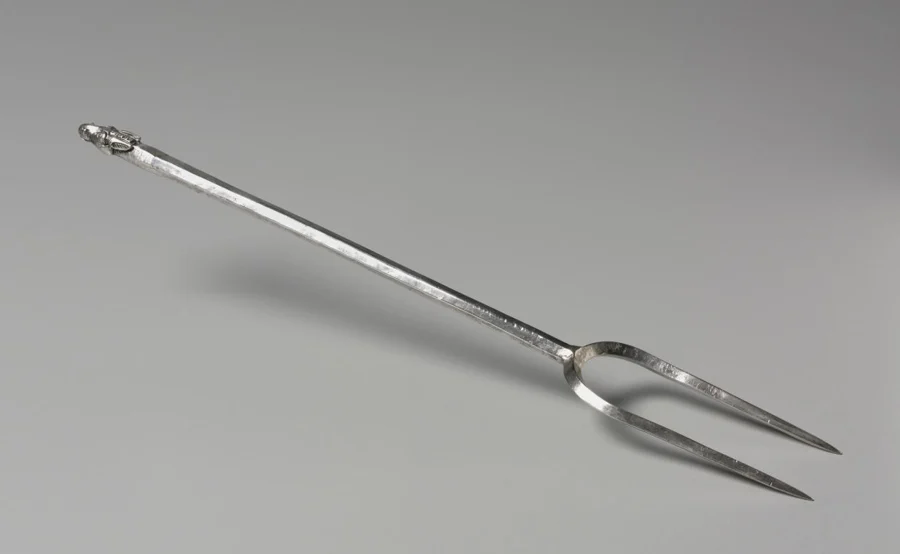
Did a cook use those points to steady meat? Did someone lift a morsel out of a serving dish? Did the food go straight to a diner’s mouth? The museum leaves all three possibilities open. Even the mule head, which the museum suggests might hint at a connection to meat, can’t tell us who held the fork or when it came out. Cleveland also notes that surviving forks from the premodern Mediterranean are rare, with many of the known examples made of bronze. A silver fork tells us someone made and valued this implement. It cannot tell us how many households used one.
The panther between a spoon and a fork
There is a second animal to look for on a third-century Roman object at The Met. A spotted panther occupies the handle of a silver utensil with a spoon bowl at one end and a fork at the other. The museum reads the fork end as more likely to have picked up food from a shared dish than from the user’s own plate. It’s a small distinction, but it changes the scene: a fork can be used during a meal without doing the job of a modern dinner fork.
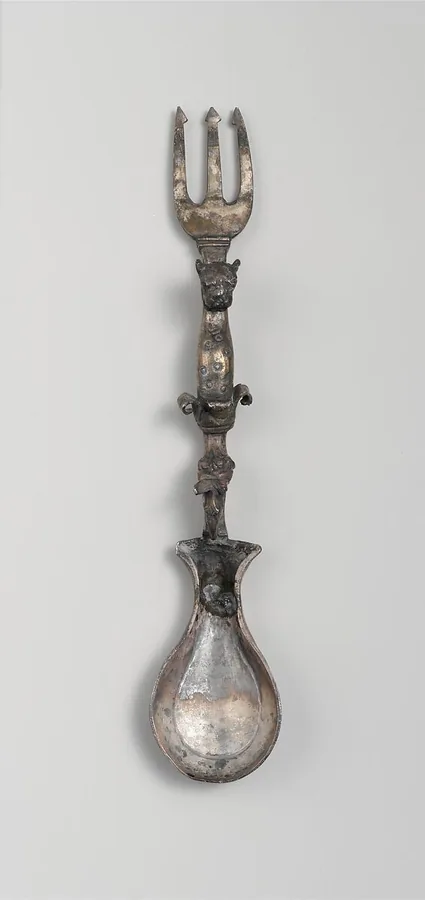
Turn the object around in your mind. A bowl scoops and can carry liquid; points catch something a bowl might push away. A double-ended piece puts these two jobs within one hand’s reach. We can observe that the maker gave it two working ends and note the museum’s interpretation of one of them. We can’t reconstruct the meal, assign it to an individual diner, or assume that the fork end was always used in one way.
What a cloven hoof can tell you
Another Cleveland fork from the 300s has two tines, too. This one is less than six inches long and finishes in a cloven hoof. The museum catalogues it as Byzantine and puts a question mark after Syria. Both the change in scale and that small punctuation mark matter. Where the larger Roman piece is from Italy and carries a whole animal head, this one has a much shorter shaft and a different ornament. A family resemblance is not evidence of a common workshop, a shared owner, a single place of manufacture, or even the same task.
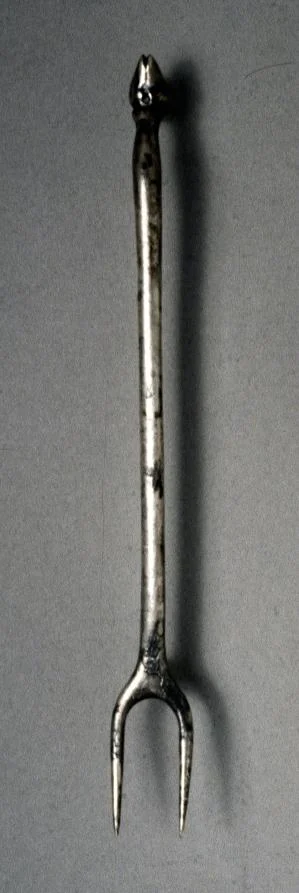
That is the useful side of finials, the ornaments at the tips of handles. They invite comparison without requiring us to turn the comparison into a conclusion. Our flatware identification guide puts these two animal details alongside later patterned silver. If you’re tracing a piece of your own, photograph the terminal from the front and the side, then record the length and the shape of the working end before you try to name it.
What changes when you find its partner
On a seventeenth-century Paris fork, the telling detail isn’t an animal. It’s a second object. The gilded silver fork and matching spoon by Louis Nicolle, both dated 1683–84, survive at The Met. It calls the matched fork and spoon a couvert, an arrangement that emerged in France in the second half of that century. The two pieces belong together, and there is a documented dining practice to explain what that pairing meant. The knife became part of the arrangement later in the century; it would be a mistake to call Nicolle’s pair an incomplete three-piece set on the strength of modern expectations alone.
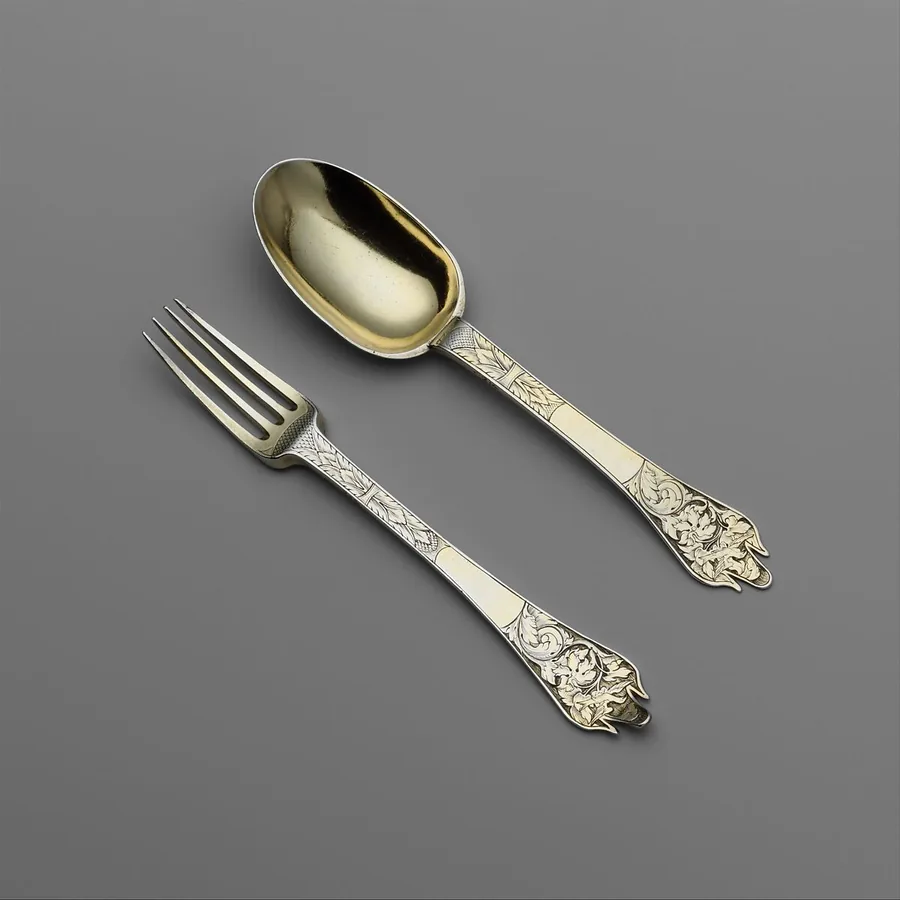
Even the survival of that pair takes some explaining. The Met notes that royal edicts beginning in 1689 sent silver into the French mint to pay for Louis XIV’s wars, and changing fashions sent other pieces back to the melting pot. Silver gives us objects we can hold and examine centuries later, but it also gives someone a reason to destroy the form and keep the metal. What survives is especially valuable evidence for examining a practice, not a reliable count of how often it occurred.
How to read a fork without guessing
Start with what it can do. Look at the length, stiffness, spacing and curve of the points, and whether there is a rest or any other moving part. The Gorham carving fork with a folding rest is a useful comparison in how much a physical feature can tell you: the rest changes what happens when the utensil is put down. It is a better clue to a specialized job than the mere fact that it has two prongs.
Don’t date it by counting the points. Colonial Williamsburg’s catalogue of a later English silver fork notes that English trefid forms with two, three and four tines all appeared during Charles II’s reign. That one documented overlap is enough to break the neat rule that two must be older than three and three older than four. Use the pattern and maker guide to compare the handle, marks and documented examples together; don’t use the tine count on its own.
Ask what the evidence can actually show. A manuscript can show a fork in use: in its record for a later Italian fork, The Met points to an eleventh-century manuscript at Montecassino that depicts two diners using two-pronged forks. A museum can identify a match, as it does for Nicolle’s spoon and fork. An isolated object without context is a different case. The best answer for Cleveland’s mule-head fork is not that it never went to someone’s mouth, or that it always did. It’s that we can’t tell which side of the serving dish it usually worked on.
Object records and further reading
- Cleveland Museum of Art, Fork with Mule-Head Finial (1987.210): date, measurements, material and possible functions.
- The Met, Roman Silver Spoon and Fork (2006.514.3): both ends, panther and the curators’ reading of the fork end.
- Cleveland Museum of Art, Fork with Animal Hoof Finial (1952.7): form, scale and tentative place attribution.
- The Met, Louis Nicolle’s Fork (48.187.214) and matching spoon (48.187.215): the early French couvert and the loss of period silver.
- The Met, fifteenth-century Italian fork (2010.180.1): mixed materials and the reference to the Montecassino manuscript.
- Colonial Williamsburg, John Brooke’s fork (1971-239): English tine forms and documented overlap.