
A flying backpack
In the Bell rocket belt, fine silver screens helped turn hydrogen peroxide into gases that pushed a person into the air. Despite its name, the “belt” was a pack held by a harness. A surviving example belongs to the Smithsonian’s National Air and Space Museum.
The device could lift off, hover and turn. Silver’s contribution happened inside the propulsion system, where it helped a chemical reaction happen quickly.
Silver’s part in the chemistry
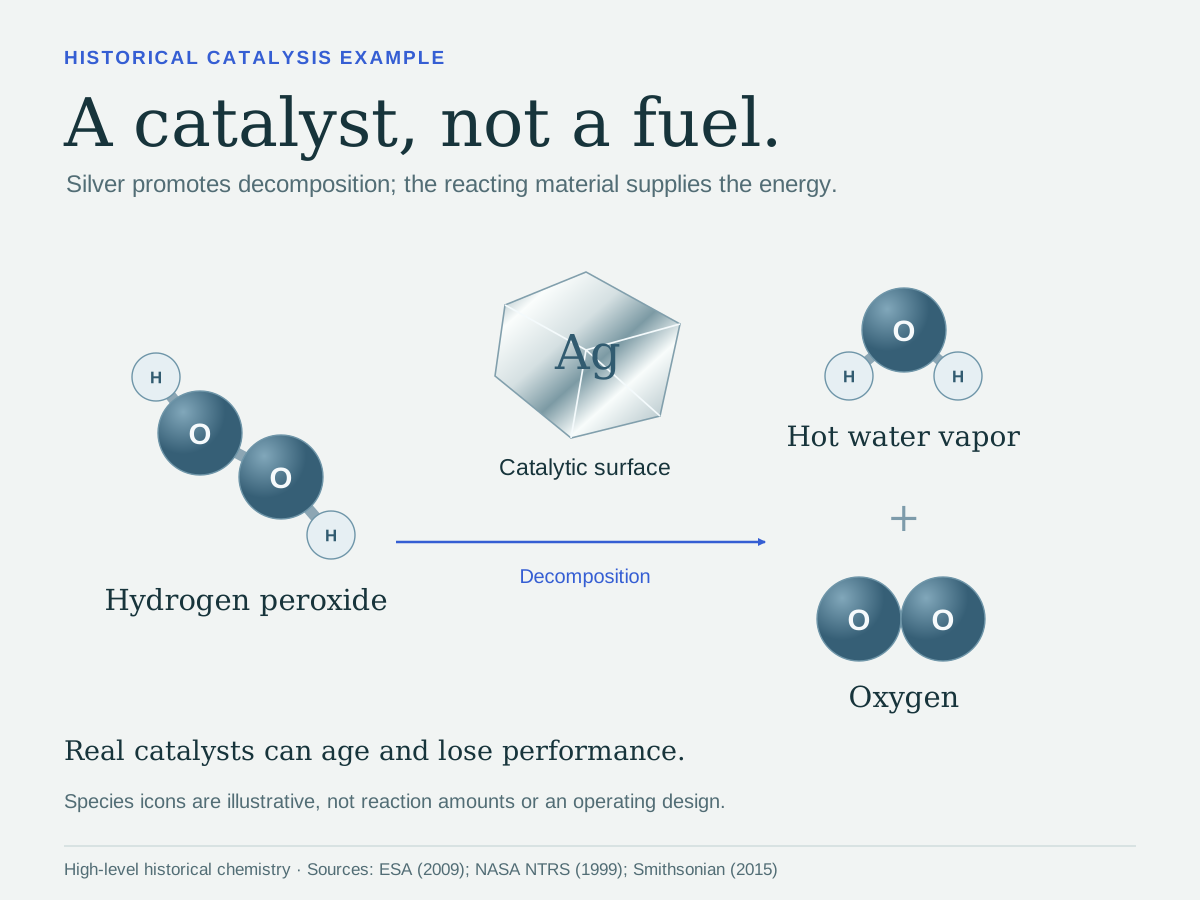
Silver served as a catalyst: a material that speeds up a chemical reaction. Hydrogen peroxide broke down into hot water vapor and oxygen. The expanding gases produced thrust, the pushing force that lifted the wearer.
The propellant was the reacting material that supplied the chemical energy. Silver supplied a surface that promoted the reaction. It was not being burned as a metal fuel. ESA describes this type of hydrogen-peroxide propulsion as a monopropellant system, meaning it uses a single propellant.
A spectacular flight with practical limits
The Smithsonian’s account puts the Bell device’s flights at roughly 20 seconds. Carrying enough propellant for a much longer trip added too much weight, one reason it never became everyday transport.
Silver catalysts also have limits. A 1999 propulsion study archived by NASA found declining performance during tests of aging silver and silver-plated screens. The historical achievement is real, but it is not a simple or safe home experiment.
About this edition
Original source and editorial notes
Adapted from original material by Rich Silver. Original source card: Silver fact: supplied original card (publication date not established).
Reviewed 2026-11-05. This edition explains silver’s catalytic role through historical sources. It separates the catalyst from the reacting material and acknowledges catalyst aging, without practical operating instructions. Reader-first revision opens with the museum’s Bell rocket belt, defines catalyst, thrust and monopropellant, and retains catalyst aging and the distinction between propellant and catalyst. No operating instructions, concentrations, preparation or apparatus details are added. Existing section-2 and section-1 anchors follow the device and chemistry after reordering.