
The metal itself had been money
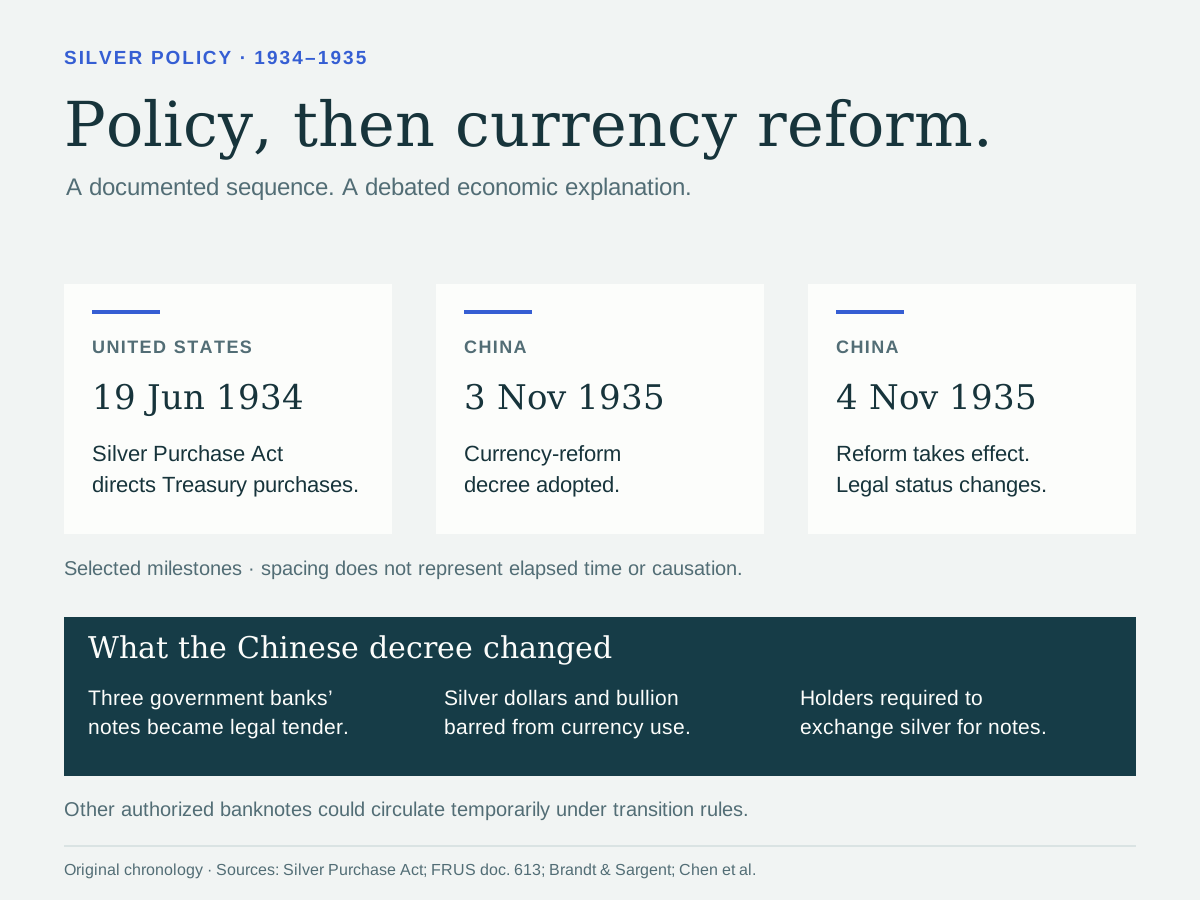
Silver was part of China’s money system, not just a material for valuable objects. That changed under a government decree adopted on November 3, 1935 and effective the following day: silver dollars and bullion could no longer be used as currency.
Bullion means metal held for its precious-metal content. The decree required holders to hand over their silver coins and bullion in exchange for paper notes. Notes from three government banks became full legal tender, meaning legally recognized money for paying debts and taxes.
Paper money was not new
China already used banknotes. The reform changed their legal standing and the system behind them, establishing the managed paper currency known as fabi. Other previously authorized banknotes could remain in circulation temporarily, with limits and a plan to replace them.
For a person holding silver money, this was a change in what could legally settle a debt. For the government, it changed how the country’s currency and silver reserves were controlled.
Why an American law enters the story
In June 1934, the United States had passed the Silver Purchase Act, directing Treasury purchases to increase silver’s share of the value of U.S. gold-and-silver monetary stocks. Chinese officials protested rising silver prices and reported large outflows of the metal. With Chinese money tied to silver, changes in the metal’s value had consequences far beyond the mining trade.
How much those American purchases drove China’s difficulties is disputed. Researchers have examined bank-issued money, domestic policy and other pressures, and challenged the simple claim that silver leaving China automatically caused its money supply to collapse. The legal change is documented; a single-cause explanation is not.
About this edition
Original source and editorial notes
Adapted from original material by Rich Silver. Original source card: Silver fact: supplied original card (publication date not established).
Reviewed 2026-11-05. This edition distinguishes a documented chronology from debated economic explanations. China’s decree was adopted November 3 and took effect November 4, 1935; the reform is not attributed to one foreign cause. Reader-first revision starts with silver’s monetary role and the November 1935 decree, defines bullion and legal tender, and explains that banknotes were not new. Retains transition rules, the adoption/effective-date distinction, and disagreement over the economic effects of U.S. silver purchases. Reordered original anchors follow their matching legal/policy explanations; section-2 aliases the combined policy-and-causation section.
Sources & further reading
- Silver Purchase Act of 1934, 48 Stat. 1178 ↗
- Austin Dean, The United States, China, and the Money Question (2016) ↗
- Memorandum by Chinese Minister of Finance Kung, January 30, 1935 ↗
- The British Embassy to the Department of State, February 25, 1935 ↗
- Loren Brandt and Thomas J. Sargent, Interpreting New Evidence about China and U.S. Silver Purchases (1989) ↗
- Bo Chen, Dan Li and Yiqing Xie, Silver, fiduciary money, and the Chinese economy, 1890–1935 ↗
- Cunningham to the Secretary of State, November 4, 1935: official summary of the Chinese currency decree ↗