
Why put silver on the outside?
Some connectors that carry radio-frequency signals use a thin silver coating on their electrical contacts. RF stands for radio frequency, a range used for radio communication and related technologies. The current carrying these signals changes direction very rapidly. Silver conducts electricity well, and at these frequencies the surface of a conductor has an especially important job.
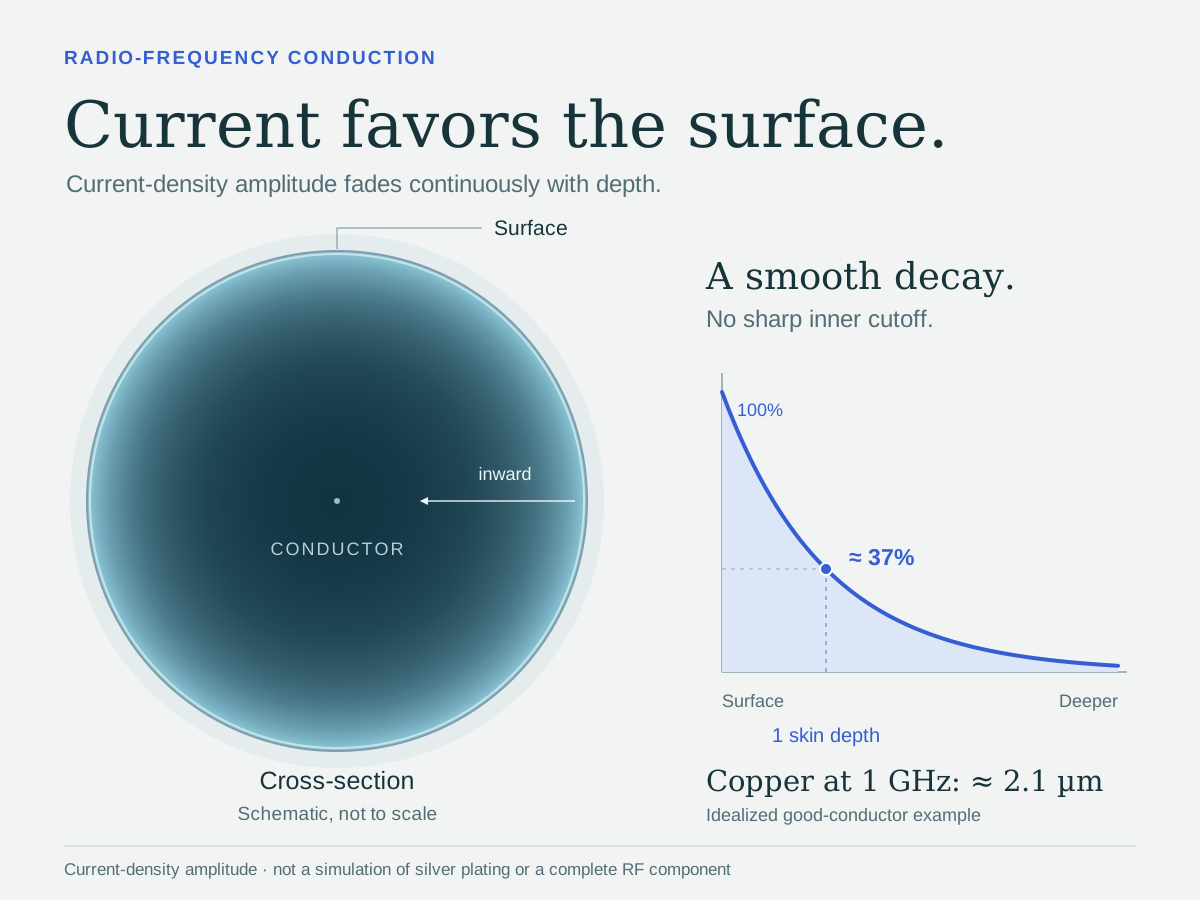
Instead of being distributed evenly through the metal, alternating current becomes concentrated near the surface. This is called the skin effect. The current fades gradually with depth; it does not stop at the edge of a hard outer shell.
A small coating becomes part of the design
A silver layer can provide a highly conducting surface without making the whole component from silver. Amphenol RF lists silver-plated contacts in connectors designed for low signal loss and precise measurements.
The result depends on more than the choice of metal. The coating, underlying layers, surface condition and shape of the component all matter. Silver can also tarnish. A silver-colored finish alone is not a performance specification.
How thin is the “skin”?
Engineers use skin depth to describe how quickly current decreases inside a conductor. In the standard model, the strength of the alternating current per unit area has fallen to about 37% of its surface value at that depth.
The accompanying diagram uses copper, not silver, for a worked example: at one billion cycles per second, its skin depth is about 2.1 micrometres. A micrometre is one thousandth of a millimetre. The example shows why tiny surface details can matter; it is not a prediction for a particular silver-plated connector.
About this edition
Original source and editorial notes
Adapted from original material by Rich Silver. Original source card: Silver fact: supplied original card (publication date not established).
Reviewed 2026-11-05. This edition explains skin effect as a gradual change with depth, not a sharp boundary. Its copper example is an idealized comparison, not a prediction for a plated commercial component. Reader-first revision: Leads with the silver-plated component and defines RF, skin effect and micrometre. Retains the copper worked example because the existing educational schematic displays it; explicitly distinguishes that illustration from silver-plating performance. Existing lead-image identity, caption and source IDs retained.