
The short answer
Some photochromic glass lenses use silver-halide crystals for reversible light-induced darkening. Modern plastic photochromic lenses can use organic molecules instead.
Silver inside glass
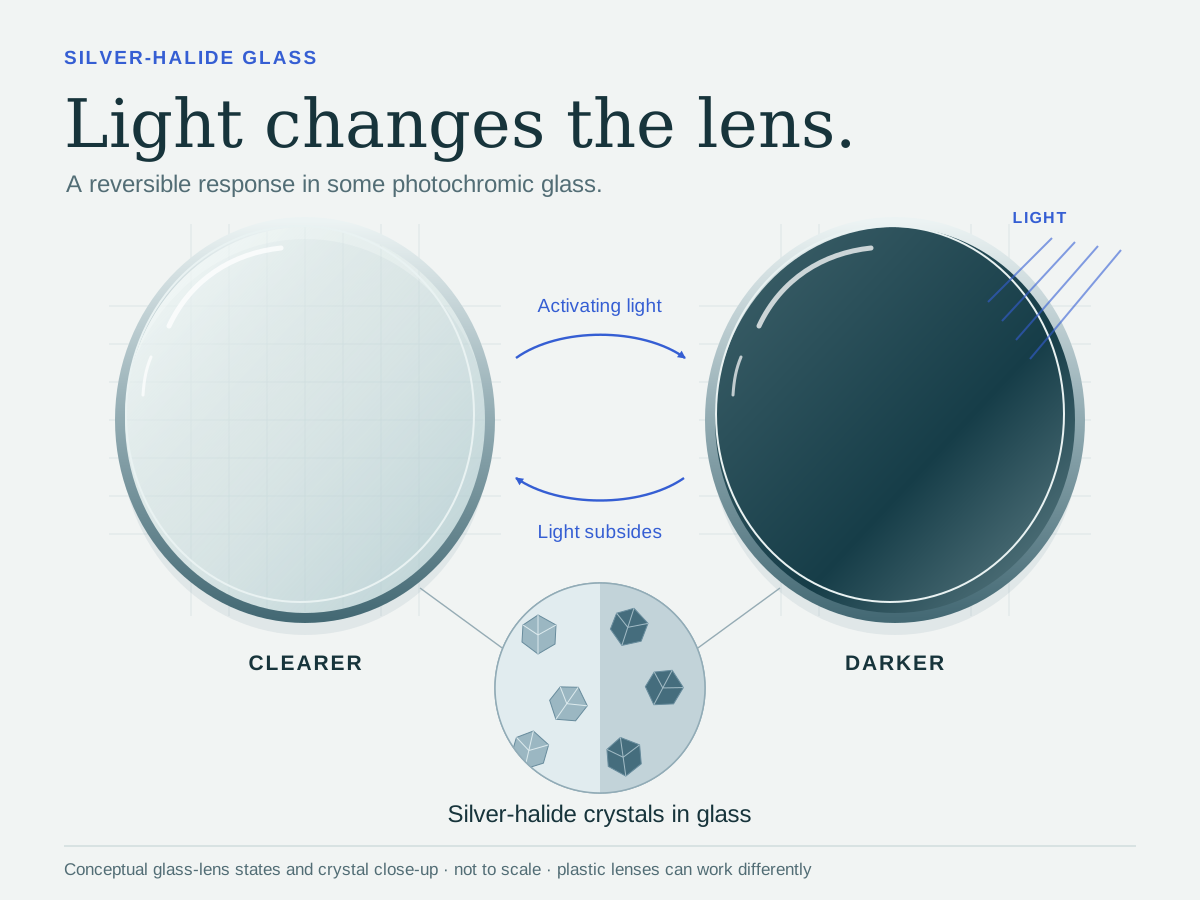
Some light-adaptive glass lenses darken because they contain silver. Tiny silver-halide crystals, including silver chloride and silver bromide, are formed within the glass during manufacture. Corning’s work on this technology dates to the early 1960s, with an Armistead–Stookey patent filed in 1962 and a scientific paper published in 1964.
A reversible change
When activating light reaches the crystals, some silver ions are reduced to metallic silver, increasing the lens’s absorption of visible light. When that illumination subsides, the chemistry reverses and the lens lightens again. The glass holds the reactive material in place, allowing repeated darkening and clearing. This shares silver-halide light sensitivity with traditional photography, but photochromic glass is designed for reversible use rather than a lasting developed image.
Not every lens uses silver
The important distinction is the lens material. Silver-halide photochromic glass is not the explanation for every pair of light-adaptive glasses. Modern plastic products can instead use organic molecules that change structure in light. Silver’s role belongs to a specific, long-established branch of photochromic lens technology.
About this edition
Original source and editorial notes
Adapted from original material by Rich Silver. Original source card: Silver fact: supplied original card (publication date not established).
Reviewed 2026-11-05. This edition focuses on photochromic mineral glass. It distinguishes glass chemistry from plastic-lens systems and avoids universal claims about response time.