
A wire with two different jobs
Silver helps engineers build wire around a surprising ingredient: a brittle ceramic. The ceramic, called Bi-2212, can become a superconductor, carrying electrical current without resistance under suitable conditions. But a brittle material is not easily turned into an ordinary length of wire.
One approach starts with ceramic powder enclosed in silver. The material is worked into a composite wire, meaning a wire made from materials with different roles. It can contain many thin ceramic strands, or filaments, surrounded by a silver matrix: the metal that holds them together.
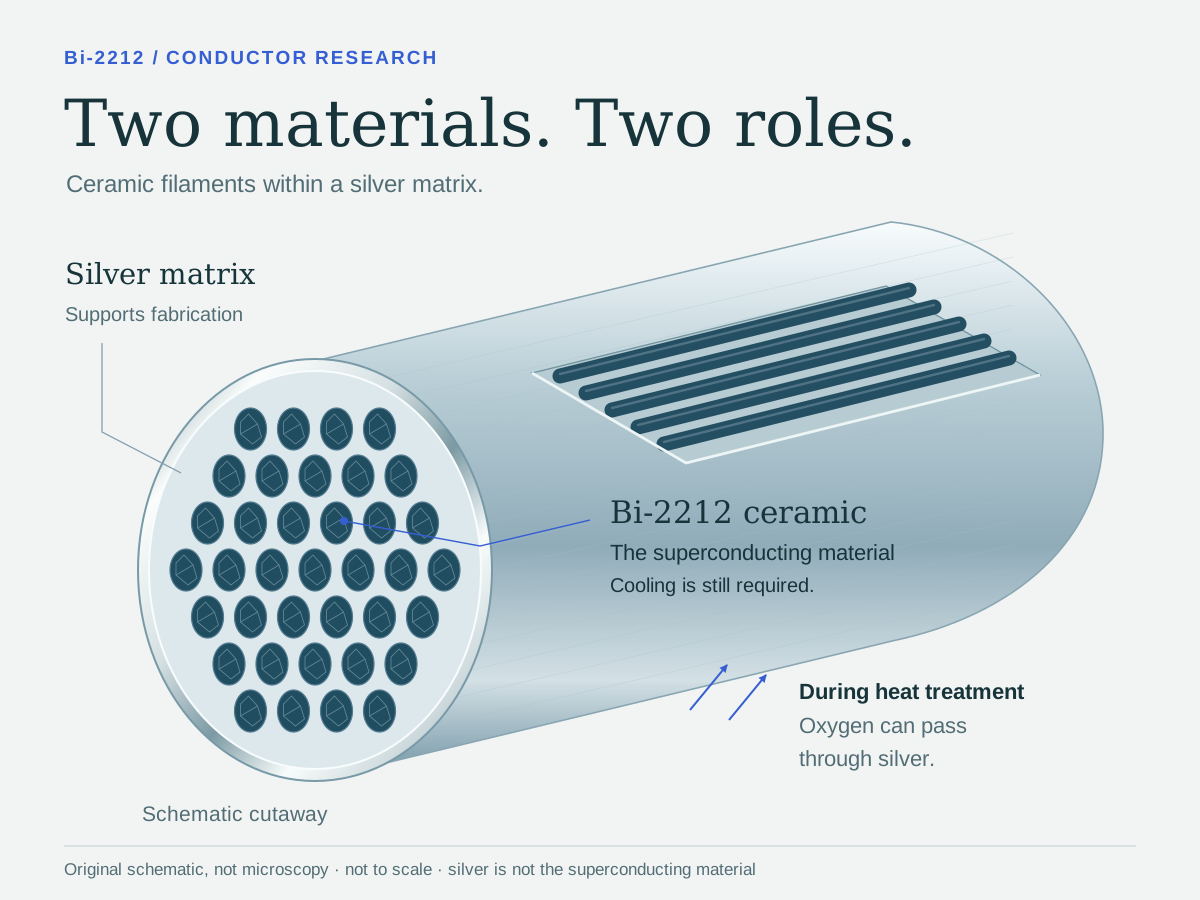
Silver lets oxygen through
The wire still needs carefully controlled heat treatment. During that processing, the ceramic’s particles join into the structure needed for current to pass through them. Oxygen is part of the process, and it can move through the surrounding silver.
That gives silver two useful roles: helping form the wire and allowing oxygen to reach the ceramic during manufacture. Berkeley Lab describes this approach in its research on conductors for powerful accelerator magnets.
“High temperature” can still mean very cold
Bi-2212 belongs to a family called high-temperature superconductors, but the term is relative. It still needs cooling to work as a superconductor, and demanding magnet applications may use very low temperatures.
The ceramic supplies the superconducting path; silver helps make the composite conductor possible. Other superconducting materials and magnet designs use different arrangements, so this is a particular engineering solution rather than the construction of every superconducting wire.
About this edition
Original source and editorial notes
Adapted from original material by Rich Silver. Original source card: Silver fact: supplied original card (publication date not established).
Reviewed 2026-11-05. This edition focuses on Bi-2212 composite conductors. It distinguishes the ceramic superconducting path from the silver matrix and accelerator research from universal commercial adoption. Reader-first revision: Explains brittle ceramic, superconductor, composite, filament and matrix in ordinary language before the oxygen-processing detail. Existing schematic and its limits retained unchanged. No processing recipe, room-temperature superconductivity or universal magnet-adoption claim added.