
A tiny starting point for ice
Silver can help start a snowflake, even though it is not the shiny metal itself doing the job. Some cloud-seeding operations use silver iodide, a compound of silver and iodine, to encourage ice to form inside cold clouds.
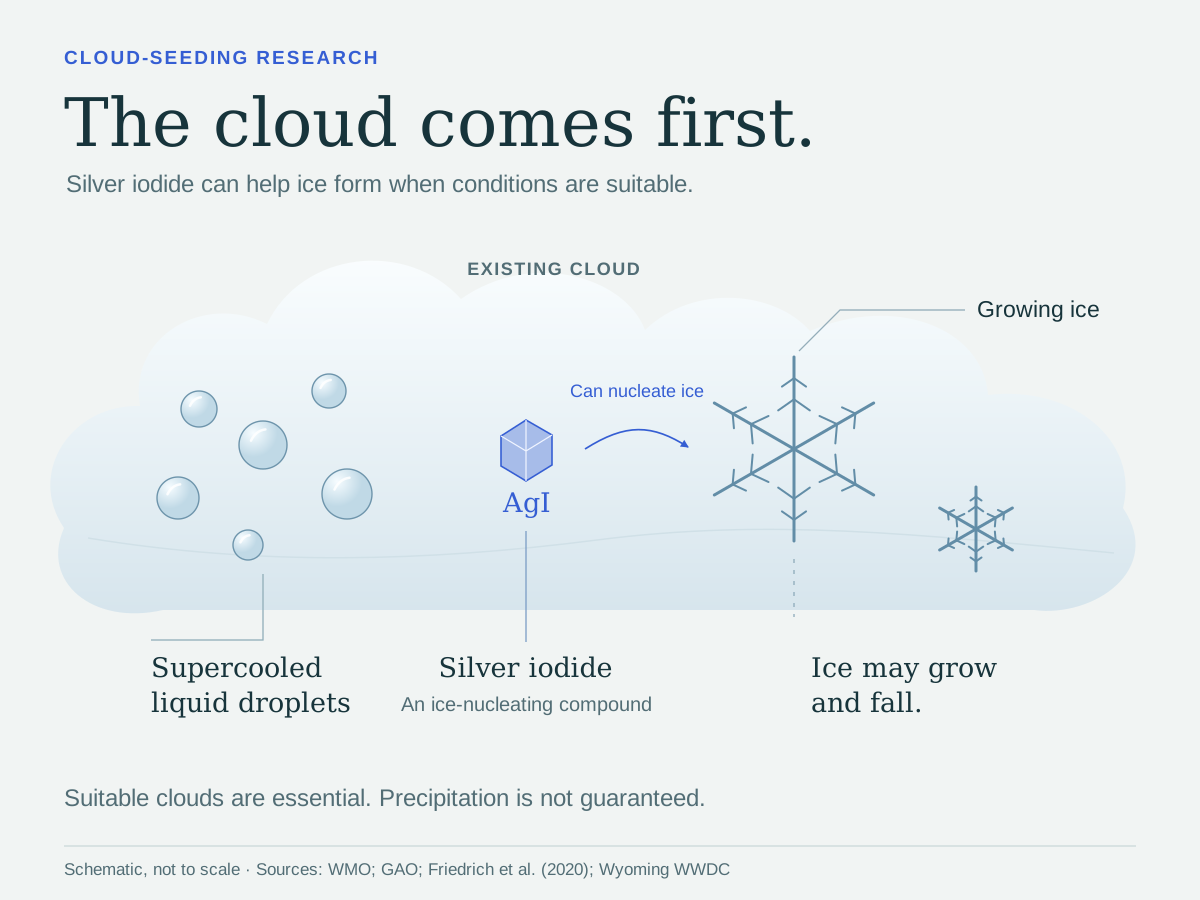
Those clouds can contain supercooled water: droplets that remain liquid below freezing. Tiny silver iodide particles provide surfaces on which ice can begin forming. The ice crystals can then grow by gathering water vapor and, if conditions allow, become large enough to fall as snow.
Watching the snow arrive
During the SNOWIE experiment in Idaho’s mountains, researchers followed clouds seeded with silver iodide on three days in January 2017. Radar tracked the developing snowfall, and instruments on the ground measured snow as it arrived. Their 2020 study connected the seeding process with measurable snowfall in those particular winter clouds.
That is what makes the silver connection interesting: a specialized silver compound can help initiate a change in water already present in the atmosphere.
The cloud still supplies the water
Cloud seeding cannot make a rain system out of a clear sky. It needs suitable clouds, and natural weather makes the added precipitation difficult to measure. A successful observation in Idaho is not a promise of the same result elsewhere.
Environmental effects also need careful study. Limited research at existing levels of use does not establish that releasing more silver iodide, or using it in different settings, would be harmless.
About this edition
Original source and editorial notes
Adapted from original material by Rich Silver. Original source card: Silver fact: supplied original card (publication date not established); Silver fact: supplied revised card (publication date not established).
Reviewed 2026-11-05. This edition distinguishes silver iodide from metallic silver and explains why suitable clouds are required. Observed effects under particular conditions do not establish guaranteed rainfall or zero environmental risk. Reader-first revision: moves the silver discovery and necessary definitions into the opening, retains substantive limits in visible prose, and avoids a duplicated short-answer block. Source identity, original URLs and existing artwork are retained.