
The short answer
Silver-containing experimental memory cells can switch resistance by forming and disrupting metallic filaments. The wider CBRAM family also uses other metals, and reliable retention requires engineering.
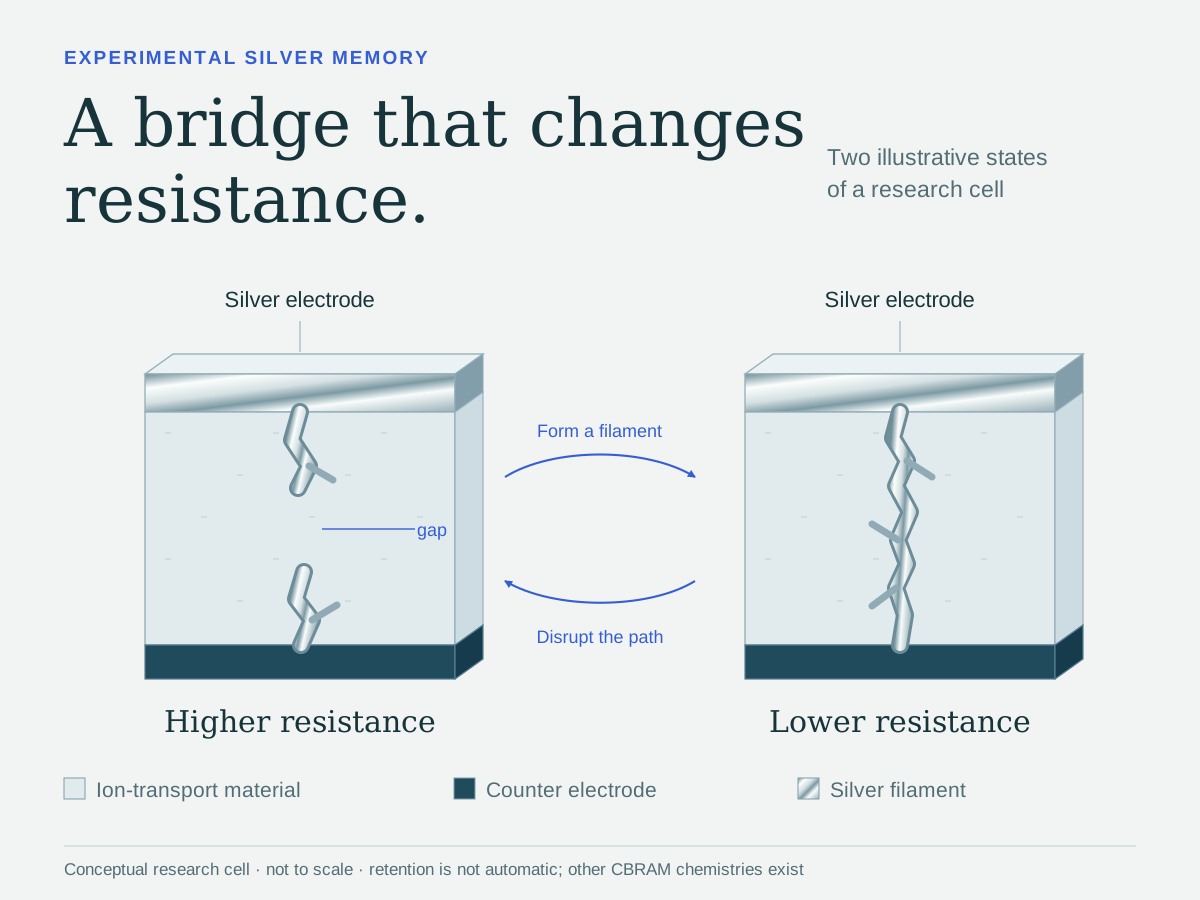
A bridge changes resistance
Some memory research uses silver as more than an electrical contact. In a silver-based programmable metallization cell, electrical stimulation moves metal ions through a thin material and helps form a conducting filament. A connected path lowers resistance; disrupting it raises resistance. The two states can encode information. A 2005 study reported reversible switching in fabricated silver-containing cells.
A filament must last
The idea is part of the broader conductive-bridge memory family, which can use silver or copper. Keeping a written state is an engineering challenge. A 2019 study examined how tiny metallic filaments can break after formation, distinguishing devices designed for lasting memory from volatile switches whose states disappear. Forming a filament alone does not guarantee nonvolatile storage.
Research and products are different evidence
The technology family has also been commercialized: GlobalFoundries announced its acquisition of CBRAM technology from Renesas in February 2023. That transaction does not establish that every product uses silver. The reliable silver-specific fact is the demonstrated mechanism: moving a small amount of metal can change a device’s resistance and create a controllable information state.
About this edition
Original source and editorial notes
Adapted from original material by Rich Silver. Original source card: Silver fact: supplied original card (publication date not established).
Reviewed 2026-11-05. This edition separates silver-containing memory experiments from the wider commercial CBRAM family, which can use other metals. Reliable retention is an engineering requirement, not an automatic result of filament formation.
Sources & further reading
- Kozicki, Park and Mitkova, Nanoscale memory elements based on solid-state electrolytes (2005) ↗
- Wang et al., Surface diffusion-limited lifetime of silver and copper nanofilaments in resistive switching devices (2019) ↗
- GlobalFoundries acquires Renesas non-volatile resistive RAM technology (February 9, 2023) ↗
- Menzel et al., Switching kinetics of electrochemical metallization memory cells (2013) ↗