
A current with a silver reference
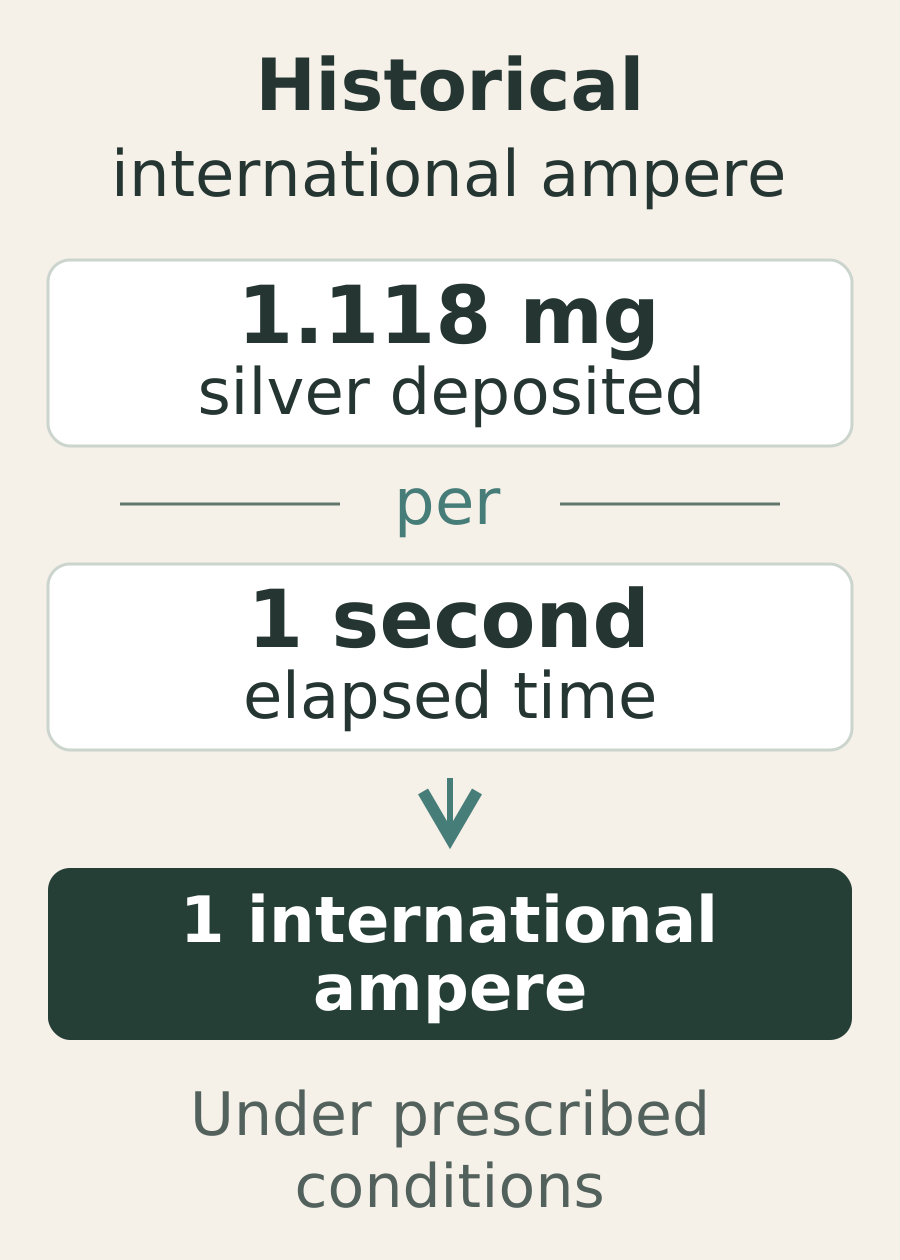
An electrical current once had a surprisingly tangible yardstick: a small deposit of silver. The historical international ampere was defined as a steady current that deposited 0.00111800 grams of silver per second from silver-nitrate solution under prescribed conditions. That is 1.118 milligrams each second.
The striking connection is between things a laboratory could measure: a deposit on an electrode, a change in mass and an interval of time. Silver helped give an invisible flow of electric charge a physical reference.
Weigh the deposit and watch the clock
The device was a silver voltameter. Despite the similar name, it was not a voltmeter, the familiar instrument used to measure voltage. Current passing through its solution caused silver to collect on the cathode, the negative electrode.
Researchers compared the cathode’s mass before and after the measurement. Under ideal conditions, that added mass was proportional to the electric charge that had passed. Current is charge per unit time, so a clock was essential too. The 1916 Bureau of Standards circular explicitly included the chronometer in the standard.
Getting laboratories to agree
The International Electrical Congress introduced international units for current and resistance at Chicago in 1893. A conference in London confirmed their definitions in 1908. The aim was agreement between laboratories, so that an electrical measurement in one country meant the same thing in another.
Writing down a definition was only the beginning. Laboratories also needed a dependable way to reproduce it, and the silver voltameter made that challenge very tangible.
Small impurities, real differences
The 1916 circular describes how purity and preparation could affect the mass collected. It even identifies impurities introduced by filter paper as a source of disagreement. A carefully specified number did not make every experimental result exact.
The circular also records that final international agreement on the voltameter’s specifications had still not been reached. Silver gave the standard a concrete form, but turning that form into consistent measurements took painstaking work.
The ampere moved on
A replacement based on the force between parallel current-carrying wires took effect on January 1, 1948, following a 1946 decision. Silver’s role in defining the international ampere belonged to the earlier system.
Since May 20, 2019, the SI ampere has instead been defined by fixing the elementary charge at exactly 1.602176634 × 10⁻¹⁹ coulombs. Today’s ampere is therefore not defined by a silver deposit. The old method remains a memorable chapter in measurement history: a little metal on an electrode helped laboratories agree about electricity.
Sources & further reading
Sources reviewed .
- NIST: Ampere: History, the silver voltameter and international ampere
- Bureau of Standards: Electric Units and Standards, Circular No. 60 (1916), printed pages 34–36 and 43
- BIPM: Historical perspective on the ampere, 1893 to the revised SI
- BIPM: Resolution 1 of the 26th CGPM (2018), effective May 20, 2019
- BIPM: SI base unit ampere, the present elementary-charge definition