
Catching particles that keep a reaction going
Silver has a surprising job inside some nuclear reactors: helping capture neutrons. These uncharged particles can sustain the chain reaction that releases energy from nuclear fuel. A material that absorbs them reduces the number available to keep that reaction going.
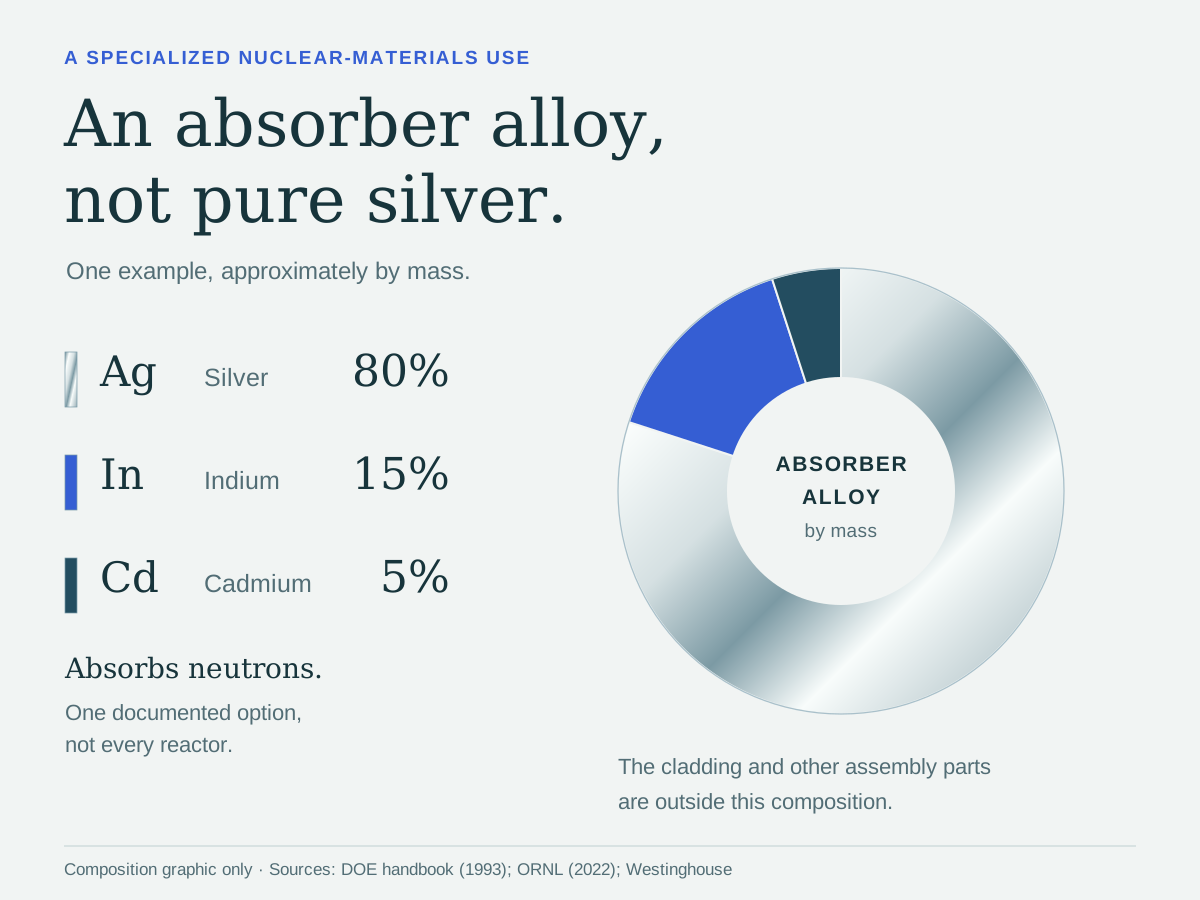
Some control rods use silver combined with two other metals, indium and cadmium. This mixture is an alloy. The Department of Energy describes a common composition of about 80% silver, 15% indium and 5% cadmium by mass. Together, the metals provide an effective neutron-absorbing material.
This is a different use of silver from a contact in an electrical switch. The alloy is chosen for its interaction with neutrons, rather than for the familiar ability of silver to conduct current.
The silver-rich material is inside a larger component
The absorber is only part of the finished control rod. Westinghouse’s documentation for one family of control assemblies describes the silver-indium-cadmium alloy inside stainless-steel cladding, the outer covering around the material.
The covering and the absorber perform different jobs. The DOE handbook describes the steel tube as protection against corrosion from hot reactor water. Calling the entire assembly “80% silver” would therefore confuse the contents with the container and other parts.
Other reactor designs use other absorber materials, including hafnium and boron-containing materials. Silver’s role is a specific engineering choice, not a universal feature of nuclear power. The striking connection is that a metal familiar from coins can also be part of a material designed to capture subatomic particles.
About this edition
Original source and editorial notes
Adapted from original material by Rich Silver. Original source card: Silver fact: supplied original card (publication date not established); Silver fact: supplied revised card (publication date not established).
Reviewed 2026-11-05. This edition distinguishes the absorber alloy from the cladding and complete control-rod assembly. The approximate mass composition describes one documented material, not all reactors or annual silver demand. Reader-first revision: Explains neutron capture, control-rod purpose, alloy and cladding in plain language. Retains approximate absorber-only composition and some-reactor scope. Existing composition graphic unchanged. No reactor operations, fabrication procedure, component geometry, quantities per reactor or market-demand inference added.