
The surprise is inside the glass
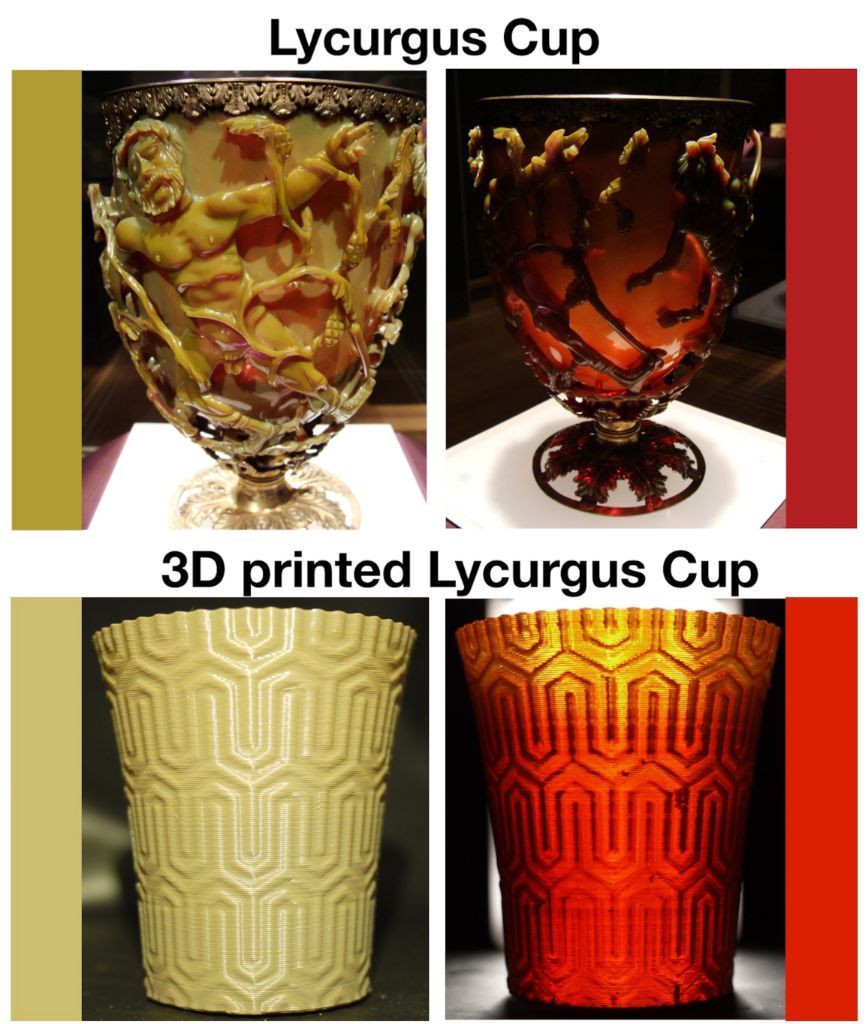
Silver and gold help create a remarkable trick of light in the Lycurgus Cup, a Roman glass vessel now in the British Museum. Look at light reflected from the cup and it appears green. Shine light through it and the glass glows red.
The name for this effect is dichroic: two different colors seen under different lighting arrangements. Changing the lighting is enough to reveal the difference.
Precious metal too small to see
Scientists examining samples of the glass found tiny metal particles made from a silver-gold alloy with a little copper. They sit within the glass rather than forming a shiny coating on its surface.
Observed particles were roughly 50–100 nanometres across. A nanometre is one billionth of a metre, so these are far too small to distinguish with the naked eye. Their interaction with light helps explain the cup’s unusual appearance.
The glass dates to the fourth century CE. Its particles are an ancient example of material working at the nanoscale, but they do not show that Roman craftspeople understood modern nanoscience. How the coloring process was first discovered remains uncertain.
The carving is another marvel
The cup’s figures stand out from the vessel, connected by small bridges of glass. Craftspeople cut and ground a thick glass blank to leave this intricate decoration. It shows the mythological King Lycurgus trapped in a vine.
The metal rim and foot are later additions, and the cup’s early history and findspot remain unknown. The Roman glass itself holds the lasting surprise: tiny amounts of precious metal can change what an entire object looks like.
About this edition
Original source and editorial notes
Adapted from original material by Rich Silver. Original source card: Silver fact — supplied original card (publication date not established).
Reviewed 2026-11-05. Expanded the original card using British Museum interpretation and published analytical research. Replaced the playful “mood cup” description with the actual reflected/transmitted-light distinction. Retained approximately 50–100 nanometres as an observed particle-size range, not a universal size for every particle. Added the small copper component and distinguished nanoscale material from evidence of deliberate modern nanotechnology. Used fourth-century dating rather than a rolling age. No museum image or illustration is reproduced or licensed by this entry. The original card has no verified publication date or public URL; neither has been inferred from file metadata. Reader-first revision: Names silver and the two lighting arrangements immediately; defines dichroic and nanometre inline. Retains observed-particle scope, small copper component, unknown manufacture/history and later mounts. Removes generic collecting advice and method-heavy research chronology. No new image rights, exact origin or Roman scientific knowledge asserted.
Sources & further reading
- British Museum: The Lycurgus Cup, museum-authored interpretation on Google Arts & Culture ↗
- British Museum: Room 2a Waddesdon Bequest large-print guide, Lycurgus Cup entry ↗
- D. J. Barber and I. C. Freestone: An investigation of the origin of the colour of the Lycurgus Cup by analytical TEM (1990), author-uploaded full text ↗
- I. Freestone, N. Meeks, M. Sax and C. Higgitt: The Lycurgus Cup — A Roman Nanotechnology (2007) ↗