
A long journey hidden in a bracelet
Silver bracelets from the tomb of Egypt’s Queen Hetepheres I point toward a surprisingly distant source for their metal: the Greek islands. Hetepheres was the mother of Khufu, the king associated with the Great Pyramid at Giza. The bracelets date to around 2600 BC.
In 2023, a team led by Macquarie University reported tests of bracelet samples held by the Museum of Fine Arts, Boston. Alongside the silver were tiny traces of other elements, including lead. Those traces helped the researchers investigate where the metal came from.
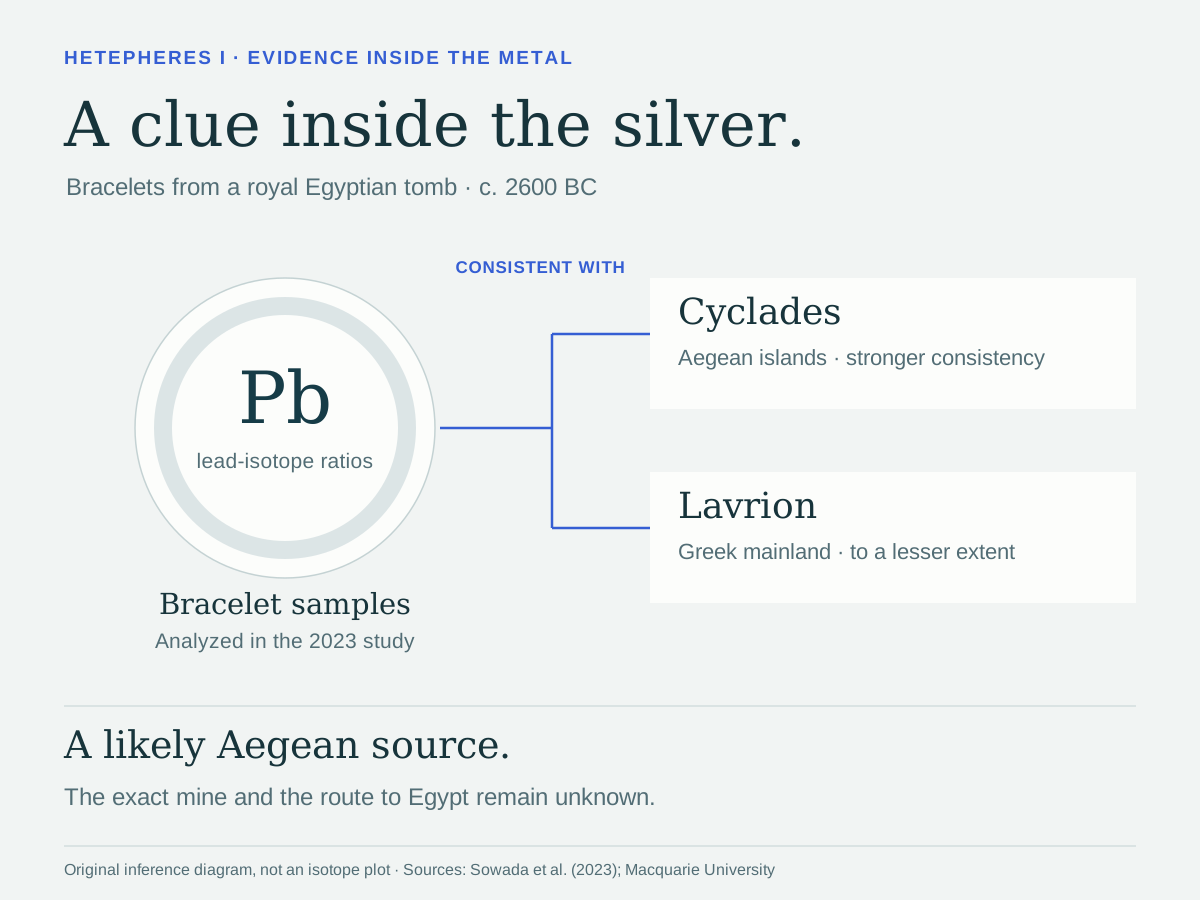
Lead occurs in different atomic forms called isotopes. Comparing the proportions of those forms in an object with the proportions in known ores can help narrow down possible sources. The bracelets’ lead-isotope ratios were consistent with those in ores from the Cyclades, a group of Greek islands in the Aegean Sea, and to a lesser extent with those from Lavrion on the Greek mainland.
A trade clue, with part of the journey still missing
The result supports a likely Aegean origin for the silver, rather than identifying one mine beyond doubt. It is evidence that metal for Egyptian royal jewelry was moving across the eastern Mediterranean more than four millennia ago.
The researchers suggest it may have reached Egypt through Byblos, a port on the coast of present-day Lebanon. That route remains a hypothesis, not a documented itinerary.
The bracelets tell us more than how an ancient queen’s jewelry looked. Their chemistry preserves a clue to the wider world that supplied it, even though the exact journey is still unknown.
About this edition
Original source and editorial notes
Adapted from original material by Rich Silver. Original source card: Silver fact: supplied original card (publication date not established).
Reviewed 2026-11-05. This edition describes lead-isotope evidence for a likely Aegean source while preserving uncertainty about the exact mine and route. The visual is an evidence diagram, not an archaeological reconstruction. Reader-first revision names silver and the Greek-island connection in the title, explains lead isotopes as a source-comparison tool, and locates the Cyclades and Byblos for a novice reader. Preserves likely origin, weaker Lavrion match and unknown exact mine/route. Does not restore unsupported “buried wearing” or a precise journey distance from the original card.